Author Archives: Admin

29 September – Go, make disciples, baptize them

View or print as a PDF

Pentecost 19
29/9/2024

Romans 6:3-14
Psalm 122
Mark 16:14-20

Sermon preached by Rev. Em. Prof. Robert Gribben


Over the years I have noticed that certain important topics, which ought to be preached about in a regular congregation are not, or hardly ever.  It’s rarely a practical thing to preach a solid sermon at a baptism – though if we baptized more adults, it would simply be necessary, and they would not disrupt as infants sometimes do.

In this, we at Mark the Evangelist have been privileged, since we have had a succession of ministers who have been thoughtful theologians as well as pastors.  But the matter or baptism has been occupying my mind lately, chiefly because it is the sacrament which joins people to Christ and the Church, and we are not alone in rarely celebrating it. Is this one of those signs of the times we had better take notice of? Is it not also a prophecy?

I fear that that the Uniting Church has generally failed to grasp the call to reform which church union opened to us.  Some have noticed that in the UCA we do things differently from our previous denominations; very few will have noticed that UiW-2 moved forward from its predecessor.

The Basis of Union says (#7) that “The Uniting Church acknowledges that Christ incorporates people into his body by Baptism. In this way Christ enables them to participate in his own baptism, which was accomplished once on behalf of all in his death and resurrection and which was made available to all when, risen and ascended, he poured out the Holy Spirit at Pentecost.”  That is a rich statement of the very Gospel itself, and baptism proclaims it, in a sacred action, a “visible Word”.

The baptism of a child cannot convey all the Basis holds out because it is built on their parents living the baptized life. It may preach the inclusion of children into Christ’s kingdom, but the mothers of Salem knew that. The accounts in the New Testament of children being baptized only occur at the baptism of their parents (and their slaves) which is what “household” implies in the text. That communal understanding of family carried the logic that all who live depending on each other should also share in the blessings of the God who is our Father and our Mother. But the fact is, theologically and historically, that baptism is for adults. (Yes, after all those years, the Baptists were right – at that point!)  It is a response to the Gospel by adults. It is for mature-enough human beings working out their faith in fear and trembling.

Both Uniting in Worship books set new standards in word and action, in 1988, to take the step from our three traditions into the new union; in 2000, to learn from the ecumenical renewal. They both offered baptism by immersion as the first option. Of “the mode of pouring”, the rubric (the little directions in red) reads “the minister pours the water visibly and generously on the candidate’s head three times, once at each name of the Trinity.”  The mode of sprinkling officially disappeared from the UCA in 1988.

Of course, there is a danger in rubrics: in the Nonconformist tribal memory is a deep-seated fear of anything imposed and I share it – except for when the Gospel demands it. Yes, rubrics diminish the ability of ministers to “do it their way”. They may reopen old arguments, but there may be fresh freedoms in our time.  It may be that we just don’t like change, so we blame the Anglicans or the Baptists because it was one of their peculiar ways.  They, by the way, have similar fears of us.  The Gospel itself demands a new way of life – and expects we will live it in the way of Jesus, and we accept that obligation as part of our faith.

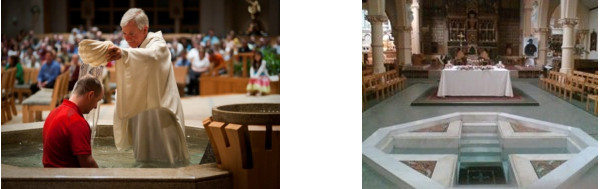
Image of Baptism and Font Oxford St LondonOther churches are also making changes to reclaim a believable baptismal practice. On the front cover is one way of doing a normal Catholic baptism; on the back cover are two serious modern fonts, one in a Catholic Church just off Oxford Street in London, which regularly baptizes adults as well as children; the other is in the beautiful cathedral at Salisbury, UK, designed by William Pye in 2008 and he has now supplied a new moveable nave altar in the same style.  It can also accommodate a child or an adult.
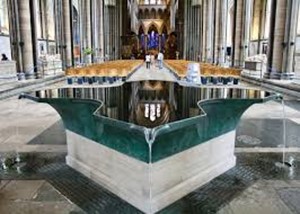
Inside its rim are the words of Isaiah 43: 1-2,

Font - Salisbury Cathedral‘Do not fear for I have redeemed you.

I have called you by name, you are mine.

When you pass through the waters, I will be with you.

And through the rivers,

they shall not overwhelm you.’

This font preaches. Every presbytery should have one!

Our inherited suspicions of “show”, both religious and Australian – have reduced what was simple and beautiful even under the Puritans to a harsh minimalism.  When I visited Methodist Churches in England, I used to play the game “Find the font”. In my native Cornish chapel, it was in the vestry and contained a pencil and a ping-pong ball. But without display, colour and beauty can find its right place in a Uniting Church. If they draw attention, let it be to central things and let their symbolic language be clear. Let what we do also critique the gaudiness and commercialism of our current culture. But there are further issues.

Some now object to baptism in the name(s) of the Trinity, because of our new and proper sensitivity to destructive relationships based on masculine predominance, and it is right that we have sought fresh expressions. But that trinitarian formula has been a test of Christian authenticity from at least the Council of Nicaea (325 AD), and if we want baptisms in the Uniting Church to continue to be accepted as true baptism in other churches – which has been one of the great ecumenical and pastoral victories of our time – then we will need to find ways both to keep it and express it acceptably.

Of course, the Nicene Fathers knew well they were trying to define a Mystery and were concerned to maintain both the unity of God and the distinctiveness of the ways God has revealed Godself.  I am not saying the questions need not be pursued: the Mystery was set for us by God, by the very nature of God, and the Spirit opens our minds to the truth. But tread gently, in next year’s seven-century celebration of the Nicene Creed, lest we lose everything.

The UCA is not face this alone – and the post-Vatican II Roman Catholic Church has shown what can be done. The great Pope John XXIII called for aggiorniamento, a wonderful Italian word meaning “up to today-ness”.  The Vatican Council startled us all by its thoroughness, holding together its high view of doctrine, church, liturgy – and evangelization. Then, it made a priority of educating the clergy and the laity in the implications of the reform.  (We have never done that thoroughly. After my Guide (1990), we had to wait for Pilgrim’s Anglican professor of liturgy to produce a most commendatory book on Uniting in Worship[2012] !)[1]  In the process, the Vatican Council challenged all the other churches to reopen old debates and re-examine old prejudices, and to “up-to-today” it all, led by Uniting in Worship.  UiW-2 was published in the year 2000, a quarter of a century ago.  We no longer seek a UiW-3, but nor is there the slightest sign that we are providing material to inspire worship for the middle of this century, of a church which declares itself to be ecclesia reformanda, reformed and always being reformed.[2]

This great work will fall to hands other than ours.  Our congregation, by its weekly eucharist, with its worthy preaching, and in its courageous outlook, is in the vanguard. We should continue to make sure that everything we do is the very best we can offer.

God will honour our sacrifice.  Christ will call disciples. The Spirit will be our

[1] Stephen Burns, Pilgrim People, An Invitation to Worship in the Uniting Church, 2012.

[2] At the very least, we should have material prepared to put into the hands of enquiring adults. The Catholic catechumenate has been adapted by Anglicans, Lutherans and Baptists.

helper.

25 August – Principalities and powers

View or print as a PDF

Pentecost 14
25/8/2024

Ephesians 6:10-20
Psalm 34
John 6:56-69


“…for our struggle is not against blood and flesh but against the rulers,
against the authorities, against the cosmic powers of this present darkness,
against the spiritual forces of evil in the heavenly places”
(Ephesians 6.10)

Paul’s talk of spiritual principalities and the powers strikes most today as quite alien. Even for many believers, it is embarrassing language, the residue of an earlier time we are keen to leave behind.

Yet, any embarrassment we might feel here about Paul’s language is in strange tension with what doesn’t embarrass faith – the very belief in God. There is a tension here because, recalling what we said last week about the God of Israel and Jesus Christ as one God among many, this God is a kind of principality or power. We find ourselves, then, in the strange situation that we can believe in God as a “spiritual” goodie, but not in Paul’s spiritual baddies – the principalities and powers. The spiritual realities Paul refers to in the first couple of verses of today’s reading are not something we now consider to be “real”, but God as spirit is.

And yet we know that there is real evil – at least in the “historical” world, if not in any sensible way in the “spiritual” world. This suggests that in much common religious belief, Good is fundamentally a “spiritual” thing insofar as it springs from God, but Evil is a secular or historical thing – something which springs from human activity and not from outside. Paul’s distinction between good and evil – between God and the “principalities and powers” – becomes for us a distinction between spirit and world.

This is much of the malaise of Christian faith today, for what has the spirit to do with the world? To throw away the principalities and powers as “spiritual” realities is to throw away any connection between God and the world, if God is “just” spirit.

Now, the point here is not that faith in God as spirit requires that we believe in evil spirits, as Paul seems to believe in them. Rather, the point is that our belief in God floats off and away from the world if what we will or won’t believe leaves us with an idea that the things of God are “spiritual” and so outside the world, and that whatever evil is it is something which resides in the world as only a historical, secular or human reality. If we really can’t believe in evil spirits – and I doubt that many of us actually can – then we must also dispense with the idea that God is a “spiritual” reality if the idea of “spirit” separates God from the world. We need to think the tangible world as the realm of spirit, or spirit as the worldly realm.

It’s not overstating the issue to say that the future of the church hangs on an understanding of what this means – not only the future of our congregation but of Christian faith itself.

The critical point has been that God deals with us as we are, here and now – not with a view to changing us into some perfect ideal of a human being, but to bring life to the kinds of people our particular history has made us. It is as we are – formed by our particular culture and history – that God addresses us. It is through the ideas and expectations of our particular world that we are called to faithfulness and trust.

This means that if, as is largely the case in our society today, there is really no other intangible “heavenly” world where powers for good and evil reside, then it’s in this very tangible and real world that we will meet God, in and through what we touch and do.

If God has no other heaven than the world in which we now live and move and have our being, then that world becomes the means of God’s work with us. If, as our modern society has come to understand, evil can only be believed to exist in the ins and outs of the historical world – and not in some spiritual realm floating above us – then this is also the place where God is found. God is found nowhere else but in the wo rld we can touch and see, because there is nowhere “else” for God to be. The battlefields of heaven and hell are the battlefields of our lives here and now. It is in the very midst of our lives that Paul’s “spiritual” battles take place. Or, to put it more clearly, our struggles in the world are precisely spiritual struggles.

In view of the struggle of faith Paul describes, he calls us to  “tool up” – to be equipped with the armour and the weapons which God provides for the purpose of standing firm in the promise of the full humanity of Jesus Christ becoming ours: the belt of truth, the breastplate of righteousness, as shoes whatever will make you ready to proclaim the gospel of peace, the shield of faith, the helmet of salvation, and the sword of the Spirit, which is the word of God.

But just as the forces for good and the forces for evil are not wafty spiritual entities doing their thing in some invisible space, so also the belt of truth and the breastplate of righteousness and the shield faith and so on are not just nice Christian ideas to nod our heads at. They are not “spiritual” things in heads and hearts. These are disciplines – practices – which will necessarily mark every believer who is seriously engaged in the struggle for an authentic human and Christian existence.  If God’s place is in the world, so also are God’s ways with us “worldly”. We find a firm footing in life by attention to God’s calling, through practice and discipline, through study and prayer and fellowship and lives lived in accordance with God’s patterns for how we ought to relate to each other. As we can learn and be influenced and trained by negative influences, so also we must continually be learning and training ourselves in faith.

Paul’s claim is that it is hard work being a Christian because, the forces arrayed against human freedom are they are powerful in a very worldly sense. There is much to hold us back, much to limit us, much to tempt us into less than the fullness of life for which we were created.

We are called, then, to stand firm in all that God has given as resources for growing in faith and understanding, for defending what God has already made of us, and for working with God in making further inroads into the realms of darkness and captivity, that the world might take hope in the promise of light and freedom.

Paul ends his letter to the Ephesians with a call to them, and to us: Stand firm. Grow. Do not look back. Look only forward to the life to which we are all called, secured by what God has given us for the purpose.

This doesn’t happen as if by magic. One Christian commentator has remarked that one of the reasons our Christian faith often doesn’t make sense to us is that we lack practices which reflect it and make it real. If God is only a matter of head and heart – and in this sense only “spiritual” – then the things of God will make little sense in a world less about spirit than it is about what we actually do, touch and manipulate. Christian faith rests on habits and patterns which will strengthen us in lives of love and righteousness.

God is faithful.

If God will meet us with grace when we fail in our discipleship, how much more will God meet and strengthen us if we seek earnestly to be shaped by growing in knowledge and understanding, in the practice of prayer, in love and service, and in active commitment to peace in the world which God is healing.

Stand firm, Paul says to us. Continue not only to “believe” but to look like people who believe – people whose faith is not realised elsewhere but in the shape of the lives they live.

It is by God’s own grace that we might do this; let us, then, claim that grace, and give it form in lives which claim this world as God’s own.

11 August – Between heaven and earth

View or print as a PDF

Pentecost 12
11/8/2024

2 Samuel 18:5-15
Psalm 34
John 6:35, 41-51


Most of you here this morning probably have in your pocket or bag a device which is capable of recording and storing thousands of photographs and tens of thousands of books.

These days, information is cheap – recording the details of our lives is cheap, and easy. We can click a picture of every meal we eat and upload it to share for others (for reasons not entirely clear), or write posts on all sorts of platforms, sharing instantly and perhaps forever what thought has just arced from one place to another in our minds.

We know that it wasn’t like this in the “olden days”, of course. But what is less obvious is what this meant for recording information back then. In the times that the Scriptures were written, materials were expensive, and the labour required to transmit a written story was enormous.

One effect of this was that you would keep the details down to just what needed to be said. While we – at a whim – can afford to store high resolution images and detailed texts we might never look at or read – the writers of what are now our Scriptures had to be sure that what was recorded actually mattered.

This being the case, what do we make of all the detail we have about the life of David in the scriptural narrative – for the detail abounds?

Today’s reading from 2 Samuel skips over a lot of the Absalom affair, precisely to be brief. But, to fill in some of that detail: Absalom’s sister Tamar was raped by their half-brother Amnon. Knowing this, David nevertheless refused to act against Amnon. Eventually, Absalom kills Amnon and flees into exile, later to be reconciled to David. Absalom, however, has high political ambitions, and campaigns to replace David as king, forcing David to flee Jerusalem. Absalom pursues David but, despite David’s insistence that he not be hurt, the young man is killed, as we heard in today’s reading. In the midst of all this, there are defections and spies, passion and suicide – all the makings of a great TV series.

Whatever judgement we might make about all that, we might wonder, Why even tell the story? Why do we need to know the “days of our lives” of these 10th Century (BC) Israelites? Of course, we can moralise happily about this or that event in the story. But if that was the intention of the writers themselves, then perhaps they might have given us a bit more of their own moralising because there isn’t very much of that in the text. Mostly, we hear what happened but not what it means or what judgement we should make of it.

Why, when it was so difficult to record and reproduce this information, risk leaving it to readers to work out the moral of the story for themselves?

The reason for the detail has to do with the very humanity of the story. We might imagine those early editors looking at all the material they have in front of them, ranging from the innocence of David as a young shepherd and his courage in fronting up to Goliath, to his abuse of Bathsheba and murder of Uriah and his loss of strength and sense in the face of Absalom – looking at all this and simply wondering how it could all be so.  How could God’s favourite be all this?

And so they write it all down, or enough of it to make the point. Here is the breadth and length, the height and depth, of the life of any one of us. Even though the story has comparatively little detail compared to what we might tell about ourselves today, in a context where recording and storing information was so expensive the story displays an extraordinary interest in the details of human relationships and the impact of those details upon those people themselves. That David is the king makes the story all the more compelling because, as we have noted before, David serves here not simply as one person among the many billions of us who have lived before and since but as a representative figure.

When we come then to speak of God’s dealings with us, we must remember that it is with this kind of humanity that God engages. We are brave and beautiful, we kill and steal, we plant and build, we are neglected and raped. We are no mere “stars” which descend from heaven for a time before returning, as is sometimes sentimentally said, as if our core reality were the simplicity of a single light. We are – each of us – whole galaxies of hopes, experiences, achievements and failures.

Yet, for the most part, we prefer either to oversimplify the complexity of the good and the bad which we are. Such oversimplification is akin to the sentimentality we considered last week. It speaks a partial truth: “stop the boats”, “a woman’s right to choose”, “from the river to the sea”, “God gave us this land”, “but Absalom is my son” are partial truths, wishful oversimplifications of deep and complex human realities. Sentimentality omits inconvenient details about what we are.

But even if oversimplification serves us nicely in distracting us from unpleasant details of our reality, this doesn’t work for God. God will consider us without reduction, without covering over. There are no fig leaves adequate for shielding us from the God who already knows what we look like uncovered.

This is not necessarily good news. We oversimplify and distract ourselves and others from the details of our personal and collective humanity for good reason: we would rather others did not know, often enough even that we ourselves did not know. We don’t what this, not here, not now. The complex mess which we are – now right, now wrong, now strong, now weak, now sure, now unsure – makes the world more than we can bear. We simplify to survive.

But we are not in this way brought to heaven. And the result is that we cease to be either properly of the world or of heaven. Rather, like the unfortunate Absalom hanging in the fork of a tree, we are strangely suspended: hanging between heaven and earth. This is where we live most of our lives.

And so anything worth hearing of God and gospel must acknowledge this. The Old Testament narratives don’t just tell us “what happened”. They show David – and everyone else – now ascending a little, now descending a little, neither properly divine nor properly human. For whatever other reasons we might value the Old Testament, we have to love its realism.

And it’s because of this that the place Jesus himself occupies is our actual place: hanging on the cross, suspended between heaven and earth, seeming to be neither human nor divine. God know us here, as we are.

To say with John that the Word became flesh is to say God becomes our flesh in all its messy, suspended detail. And now the detail which matters most about us is that we are known better than we know ourselves. The detail which matters most is God’s very knowledge of us, and its purpose: that we be loved as we are, caught between what we wish we were and what we see ourselves to be.

The details of the stories – David’s and ours – matter first because they are what make us us. This is us. But the details also matter because they are known by a God who – sometimes in spite of the details, sometimes because of them – loves us and cherishes us: for better, for worse, for richer, for poorer, in sickness and in health.

This is not a simple God for a simple people. God is complex and variable because we are. And God is this, in order that we might simply be his. The scriptural writers invest so much in the detail of David’s life because it is the life of one of us, as we are; and it is a remarkable thing that such a one as he does not simply fall within God’s capacity to love, but is in fact the focus of that love.

And so also for us. This is a love which shines in our darkness and yet is not overcome by it.

For such an all-searching, all-comprehending and all-embracing love, all thanks be to God.

And let our thanksgiving take the form of turning to the messy, suspended world, and loving it as God does.

« Older Entries Recent Entries »