View or print as a PDF
Pentecost 19
29/9/2024
Romans 6:3-14
Psalm 122
Mark 16:14-20
Sermon preached by Rev. Em. Prof. Robert Gribben
Over the years I have noticed that certain important topics, which ought to be preached about in a regular congregation are not, or hardly ever. It’s rarely a practical thing to preach a solid sermon at a baptism – though if we baptized more adults, it would simply be necessary, and they would not disrupt as infants sometimes do.
In this, we at Mark the Evangelist have been privileged, since we have had a succession of ministers who have been thoughtful theologians as well as pastors. But the matter or baptism has been occupying my mind lately, chiefly because it is the sacrament which joins people to Christ and the Church, and we are not alone in rarely celebrating it. Is this one of those signs of the times we had better take notice of? Is it not also a prophecy?
I fear that that the Uniting Church has generally failed to grasp the call to reform which church union opened to us. Some have noticed that in the UCA we do things differently from our previous denominations; very few will have noticed that UiW-2 moved forward from its predecessor.
The Basis of Union says (#7) that “The Uniting Church acknowledges that Christ incorporates people into his body by Baptism. In this way Christ enables them to participate in his own baptism, which was accomplished once on behalf of all in his death and resurrection and which was made available to all when, risen and ascended, he poured out the Holy Spirit at Pentecost.” That is a rich statement of the very Gospel itself, and baptism proclaims it, in a sacred action, a “visible Word”.
The baptism of a child cannot convey all the Basis holds out because it is built on their parents living the baptized life. It may preach the inclusion of children into Christ’s kingdom, but the mothers of Salem knew that. The accounts in the New Testament of children being baptized only occur at the baptism of their parents (and their slaves) which is what “household” implies in the text. That communal understanding of family carried the logic that all who live depending on each other should also share in the blessings of the God who is our Father and our Mother. But the fact is, theologically and historically, that baptism is for adults. (Yes, after all those years, the Baptists were right – at that point!) It is a response to the Gospel by adults. It is for mature-enough human beings working out their faith in fear and trembling.
Both Uniting in Worship books set new standards in word and action, in 1988, to take the step from our three traditions into the new union; in 2000, to learn from the ecumenical renewal. They both offered baptism by immersion as the first option. Of “the mode of pouring”, the rubric (the little directions in red) reads “the minister pours the water visibly and generously on the candidate’s head three times, once at each name of the Trinity.” The mode of sprinkling officially disappeared from the UCA in 1988.
Of course, there is a danger in rubrics: in the Nonconformist tribal memory is a deep-seated fear of anything imposed and I share it – except for when the Gospel demands it. Yes, rubrics diminish the ability of ministers to “do it their way”. They may reopen old arguments, but there may be fresh freedoms in our time. It may be that we just don’t like change, so we blame the Anglicans or the Baptists because it was one of their peculiar ways. They, by the way, have similar fears of us. The Gospel itself demands a new way of life – and expects we will live it in the way of Jesus, and we accept that obligation as part of our faith.
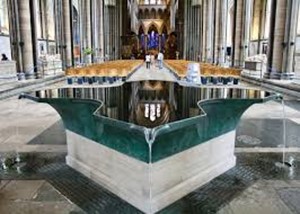
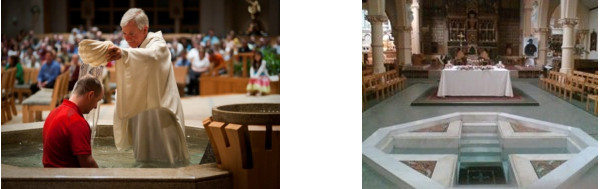 Other churches are also making changes to reclaim a believable baptismal practice. On the front cover is one way of doing a normal Catholic baptism; on the back cover are two serious modern fonts, one in a Catholic Church just off Oxford Street in London, which regularly baptizes adults as well as children; the other is in the beautiful cathedral at Salisbury, UK, designed by William Pye in 2008 and he has now supplied a new moveable nave altar in the same style. It can also accommodate a child or an adult.
Inside its rim are the words of Isaiah 43: 1-2,
 ‘Do not fear for I have redeemed you.
I have called you by name, you are mine.
When you pass through the waters, I will be with you.
And through the rivers,
they shall not overwhelm you.’
This font preaches. Every presbytery should have one!
Our inherited suspicions of “show”, both religious and Australian – have reduced what was simple and beautiful even under the Puritans to a harsh minimalism. When I visited Methodist Churches in England, I used to play the game “Find the font”. In my native Cornish chapel, it was in the vestry and contained a pencil and a ping-pong ball. But without display, colour and beauty can find its right place in a Uniting Church. If they draw attention, let it be to central things and let their symbolic language be clear. Let what we do also critique the gaudiness and commercialism of our current culture. But there are further issues.
Some now object to baptism in the name(s) of the Trinity, because of our new and proper sensitivity to destructive relationships based on masculine predominance, and it is right that we have sought fresh expressions. But that trinitarian formula has been a test of Christian authenticity from at least the Council of Nicaea (325 AD), and if we want baptisms in the Uniting Church to continue to be accepted as true baptism in other churches – which has been one of the great ecumenical and pastoral victories of our time – then we will need to find ways both to keep it and express it acceptably.
Of course, the Nicene Fathers knew well they were trying to define a Mystery and were concerned to maintain both the unity of God and the distinctiveness of the ways God has revealed Godself. I am not saying the questions need not be pursued: the Mystery was set for us by God, by the very nature of God, and the Spirit opens our minds to the truth. But tread gently, in next year’s seven-century celebration of the Nicene Creed, lest we lose everything.
The UCA is not face this alone – and the post-Vatican II Roman Catholic Church has shown what can be done. The great Pope John XXIII called for aggiorniamento, a wonderful Italian word meaning “up to today-ness”. The Vatican Council startled us all by its thoroughness, holding together its high view of doctrine, church, liturgy – and evangelization. Then, it made a priority of educating the clergy and the laity in the implications of the reform. (We have never done that thoroughly. After my Guide (1990), we had to wait for Pilgrim’s Anglican professor of liturgy to produce a most commendatory book on Uniting in Worship[2012] !)[1] In the process, the Vatican Council challenged all the other churches to reopen old debates and re-examine old prejudices, and to “up-to-today” it all, led by Uniting in Worship. UiW-2 was published in the year 2000, a quarter of a century ago. We no longer seek a UiW-3, but nor is there the slightest sign that we are providing material to inspire worship for the middle of this century, of a church which declares itself to be ecclesia reformanda, reformed and always being reformed.[2]
This great work will fall to hands other than ours. Our congregation, by its weekly eucharist, with its worthy preaching, and in its courageous outlook, is in the vanguard. We should continue to make sure that everything we do is the very best we can offer.
God will honour our sacrifice. Christ will call disciples. The Spirit will be our
[1] Stephen Burns, Pilgrim People, An Invitation to Worship in the Uniting Church, 2012.
[2] At the very least, we should have material prepared to put into the hands of enquiring adults. The Catholic catechumenate has been adapted by Anglicans, Lutherans and Baptists.
helper.

