Author Archives: Admin

13 March – Where prophets dare to tread

View or print as a PDF

Lent 2
13/3/2022

Philippians 3:14-4:1
Psalm 27
Luke 13:31-35

Sermon preached by Rev. Dr Peter Blackwood


The gospel lessons through Lent traditionally and understandably relate to Jesus’ travelling towards Jerusalem. That is where the crucial drama will happen. But on the way there is plenty going on. On his way to Jerusalem Luke’s Jesus has been saying some interesting and provocative things.

Do you think that I have come to bring peace to the earth? No, I tell you, but rather division! (Luke 12:51) 

 A gardener is told, ‘If it bears fruit next year, well and good; but if not, you can cut it down.’ (Luke 13:9)

To some Pharisees he said, ‘You hypocrites! Does not each of you on the sabbath untie his ox or his donkey from the manger, and lead it away to give it water?’ (Luke 13:15)

‘Strive to enter through the narrow door; for many, I tell you, will try to enter and will not be able.’ (Luke 13:24)

Then you will begin to say, ‘We ate and drank with you, and you taught in our streets.’  27 But he will say, ‘I do not know where you come from; go away from me, all you evildoers!’  28 There will be weeping and gnashing of teeth… (Luke 13:26-28)

If Jesus had been running for an elected position he was certainly getting right up the nose of his opposition. Even some who were not on his side were warning that going to Jerusalem was not a good political decision.

At that very hour some Pharisees came and said to him, “Get away from here, for Herod wants to kill you.” (Luke 13:31)

Did Jesus take their advice? Hardly. ‘Go and tell that fox… (Luke 13:32) he replied – I am casting out demons and performing cures today and tomorrow, and on the third day I finish my work.’ Then follows the deep sigh. ‘Jerusalem, Jerusalem, the city that kills the prophets and stones those who are sent to it! How often have I desired to gather your children together as a hen gathers her brood under her wings, and you were not willing!’ (Luke 13:34)

It looks like there are to be consequences for not being willing to be gathered by Jesus. The reader may well ask whether they are included among the unwilling, among the not gathered. Surely not. Me, the reader couldn’t be a part of Jesus’ deep sigh. Anyway, I am not from Jerusalem. I am Australian, and if you want to push my ancestry, I am Celtic – a long way from Jerusalem. I visited there once but surely that doesn’t count. My belonging and heritage don’t number with the prophet killers. My lot didn’t lob stones at the ones sent by God – did they?

You can see what I am doing here. I am looking to point the finger onto someone else, at least anxious to point away from me. It might have been easier to do this if I hadn’t read all the other bits of Luke to discover that no one seems to escape Jesus’ deep sigh. The religious leaders are hypocrites, Judas betrays him, Peter denies him, the other disciples run away. The occupying Romans get a red card – Pilate washes his hands of him and the rest of them didn’t know what they were doing so he forgave them. In Luke’s world all humanity seems to fit into the company of the unwilling.

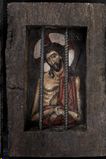
What about our world? The image on the front of our order of service this morning was painted by an artist in St Petersburg. The artist posted the image on social media two weeks ago. Above it he wrote: ‘My country invaded Ukraine. I am really sorry. I wish it never happened. Please, forgive me if there was something I could have done and didn’t do.’ Philip had been praying for peace for weeks. He and his wife have been on the streets protesting. They have signed petitions denouncing the war. Their son is of inscription age. Her mother lives with them and agrees with every decision the President makes. Luke’s Jesus said there would be families divided. Philip has played no part in the violence against Ukraine, but he wears the shame of what is happening as if he did. As willing as he is to be a follower of Jesus, to defend the prophets, he knows himself to be part of the community of the unwilling, the ones who refuse to be gathered.

I was talking of these things with Kateryna, a Ukrainian friend, another icon painter. She told me that the stories she is hearing of the attacks and resulting privation remind her of the stories her parents told her of the time they had to leave Kiev in the Second World War.

Then she said something that came like a slap in the face. She said, ‘I wonder if these stories remind our indigenous people of the times their land has been attacked and stolen by us.’ Pointing the finger at what is happening half a world away was a whole not more comfortable than remembering Australian history of the past 200 years.

Jesus’ deep sigh over Jerusalem applied to all its inhabitants, all its visitors, all who looked to Mt Zion for strength and inspiration and faith. Jesus’ deep sigh over Jerusalem envelopes that city and all cities that have ever looked to Jerusalem as a focus of the saving actions of God – all the cities with links to the Abrahamic faiths. The sigh ‘Jerusalem, Jerusalem, the city that kills … and stones…’ can always be applied to cities everywhere. Moscow, Moscow, the city that… Canberra, Canberra, the city that… then fill in memories of first peoples’ dispossession and refugee incarceration. ‘How often have I desired to gather your children together as a hen gathers her brood under her wings, and you were not willing!’

The good news is that Jesus’ desire to gather the children of the cities of the world never fades. St Anthony of Egypt said, ‘To say that God turns away from the sinful is like saying that the sun hides from the blind.’ Jesus’ invitation to be gathered continued as he made his way into Jerusalem, as he confronted hypocritical displays of virtue, as he was tried and executed, as he rose to new life, as he ascended to reign at the right hand of the Father.

6 March – The freedom of the children of God

View or print as a PDF

Lent 1
6/3/2022

Psalm 91
Luke 4:1-13


In a sentence:
All temptation questions our relationship to God; all resistance to temptation claims that we are God’s children

In our gospel reading today, we see playing out something of what has just been put to us by Stanley Hauerwas in his reflections on the mission of the church. Jesus, that is, engages “wittily” with the Devil.

The wit is ironic – the assertion below the surface of Jesus’ responses that there is more going on than first meets the eye. The joke Jesus hears in these temptations is the suggestion that he look for something which has not been lost – his identity. “If you are the Son of God…”, then do this. That is, prove – or test – that you are who you say by making bread from stone or being miraculously caught in free-fall from the pinnacle of the Temple.

For Jesus to have his “wits” about him here is simply for him to know who he is. In his exchange with the Tempter, he is forced to express his identity negatively by saying No to the Tempter’s proposals, but the No is not the point. The point is the “Yes” Jesus implies. For he is confident that he does not, to draw again from Hauerwas, have to prove himself to himself, to others or to God; Jesus doesn’t have to “make the world work”.

If the testing of Jesus here is the same as the testing – the temptations – we experience, then our temptations are about the same thing as his, and about one thing: who do you think you are?

We might do many right things at any moment of decision, but there is only one properly wrong thing. It looks like there are many wrong things as well, but only one of them will present itself as the thing that “tempts” us, or “tests” us, and so which we work hard to justify. We could be irresponsible with our money in a hundred ways, but it is only the one way we choose that we argue most strongly for, for it is the point at which we have to prove we are acting like the children of God. We could tell lies about a hundred different things, but only the one lie we want to tell matters. We could choose from a dozen future options for the congregation, but only one of them is really going to tempt us, is really going to require the necessary rationalisation which will prove to everyone that it is where we are most faithful. At this point – as with our money, or our flexibility with the truth, or our infidelities, or our forward mission planning – we will be “making the world work”, particularly for ourselves, and making God work for us too. We will, in this, be proving ourselves to ourselves, to others and to God.

But to know ourself as a son or daughter of God – this is not to make anything “work”, not to prove anything. If we are a child of God, the work has already been done. We need then only be as children are at their best: without guile. We are only ever tempted at one point: does this which I want to have or to do or to say express that I am a child of God, here and now? A “Yes” to this question cannot be argued, cannot be proof-texted. Children just are and do; there is no “if”.

Our childness, of course, is often compromised. Parents muck it up. Siblings drive us crazy. We are ourselves simply rebellious. In all of this, the “if” is making itself felt. We wonder, am I the child? This is the source of anxiety, fear and self-justification.

To learn to live by our wits as Jesus does – and it is a thing learned – is to learn to see when our being in God is challenged, and to laugh it off.

For we have nothing to prove. In Jesus is proof enough that nothing can separate us from the love of God. All that we do should be proof that we believe this.

2 March – On “giving up” for Lent

View or print as a PDF

Ash Wednesday
2/3/2022

2 Corinthians 5:20b-6:10
Matthew 6:1-6, 16-20


In a sentence:
Lent is a time to give up anything which reduces us or others

Where your treasure is, there will your heart be also.

We hear this every Ash Wednesday and, with the text ringing in our ears, we have learned that Lent is a time of “giving up”. We “give up” wine, or meat or coffee or chocolate or some other thing which might count as a “treasure”. This is, in part, an act of sacrifice which honours Jesus’ own “giving up” of his life in faithfulness to his calling.

Of course, the implication o “giving up” for a season is that we will then, with a sigh of relief, “take up” whatever we have sacrificed once Easter arrives. There is nothing particularly wrong with this, especially if the disciple of such time-limited sacrifice causes us to think about the ministry of Jesus and the meaning of the cross.

But let’s consider that not all treasures are alike. In particular, not all treasures glitter but they still seem important to us. At least, we invest a lot of time and energy in them.

So, for example, what would it mean to give up gossip for Lent? Or slander? Or snobbishness? What we treasure in these things is judgement. Let us give up being judgemental for the 40 days of Lent; there’s plenty of time to judge others over the rest of the year.

Of course, the real sting in judgement is that, if we are really good at it, we will also judge ourselves, for better or for worse. The “worse” is the more interesting here. What if we gave up our shame? Or our guilt? Or our fear? Again, the venerated tradition of giving things up for Lent means that we can start feeling ashamed and guilty and afraid again once Easter comes. Lent is only 40 days, and surely we can cope with not judging ourselves for that long.

Where your treasure is, there is your heart. Where your heart is, there is your treasure. This tells us what we value, but not what is valuable in itself. What is valuable, Jesus says, is what cannot rust or be snatched away. Whatever good Lenten disciplines might indeed do for us, penitence is not a season because forgiveness is not a season. Forgiveness doesn’t corrode and can’t be stolen away because it is a re-valuing of all value – God’s own re-valuing

To judge another is to place a value on her, and so we feel justified in denying her our treasures. To judge ourselves is to have treasured the wrong thing. We reduce ourselves to our knowledge of who we are rather than God’s knowledge of us.

Lenten disciplines are targeted at those things which make us less than free and loving human beings. We give up only what does not accord with that, and we do not take those things up again. This might or might not include wine or chocolate; it almost certainly includes slander and guilt.

Let us then, at least for the season of Lent, stop being sad and fearful at our own expense, greedy and safe at the expense of others.

And let us see what God will do with that.

27 February – On not knowing what we say

View or print as a PDF

Transfiguration
27/2/2022

2 Corinthians 3:12-4:2
Psalm 91
Luke 9:28-36


In a sentence:
We don’t know what we see in Jesus, but we know that it is good

Many approaches have been taken to the story of the Transfiguration. Some imagine that we have here a dream sequence or a vision – something which only happens inside the disciples’ heads and but not “really” occurring in time and space. The story is so rich in symbolism that the symbols themselves cry out for recognition, to the extent that questions of “what really happened” become quite secondary. Others have thought that this is a resurrection narrative that has been dislodged – deliberately or accidentally – from the end of the gospels to become something of a hinge point in the middle of the narrative. Others, of course, have taken it to be a reliable account of a historically “objective” event.

Our approach today won’t be to untangle these tightly knotted and confused approaches but simply to take the story at face value, and dive in at one particular point. In response to the strange change in Jesus, Peter apparently gathers his senses and speaks on behalf of the disciples: “Master, it is good for us to be here; let us make three dwellings, one for you, one for Moses, and one for Elijah”. Our focus text today will be the remark which follows: Peter has spoken, “not knowing what he said”.

We’ve long heard that this comment characterises Peter’s state of mind at this point. Like the callow teenager who has long loved from a distance a pretty girl in his class, only to respond with something utterly stupid when one day she speaks to him, so Peter is generally cast as blurting out the first thing which comes into his head, “not knowing what he said”. On this reading, he might as well have said, “…the slithy toves / Did gyre and gimble in the wabe”.

But biblical texts are economical. We already know that Peter and co. are out of their minds with fear. His building proposition, and naming this as incoherent, scarcely seems necessary.

We might, then, come at this another way. The Greek word behind “dwelling” is translated in other places as “tabernacle”. The Tabernacle was a tent-like structure in which God dwelt before the construction of the Temple. This is, then, a heavily loaded word – not merely a “place to stay” but having connotations of a holy presence. In the prologue to his Gospel, the evangelist John writes, “…The Word became flesh and made his dwelling among us” (John 1.14). John uses the same word here: the Word “tabernacled” among us.

In this light, Peter’s proposal of tabernacles becomes less silly than naïve. That is, tabernacles might be entirely appropriate but does Peter understand what that would mean? Has he grasped what it means that Jesus is in the same room as Moses and Elijah?

The Transfiguration story follows an episode in which Jesus puts a question to his disciples, Who do you say I am? To this, Peter responds, You are the Christ. Jesus then goes on to explain what will happen to him. In Mark and Matthew’s version of the story, this greatly offends Peter, who demands that such things must not be allowed to happen. Jesus then hammers Peter in return, naming him “Satan” and announcing that Peter, in effect, has not understood what he himself has said – what “Christ” means.

Luke doesn’t have that part of the story. Still, perhaps Peter’s announcement about the tabernacles is the same: “not knowing what he said” is about saying the right thing while not understanding what it means, or saying the wrong thing but, at a deeper ironical level we don’t yet recognise, being precisely right.

This naïve irony is not an unusual experience – certainly not merely a “religious” experience:

“Will you take this man, to have and to hold in the covenant of marriage, loving, comforting, protecting and faithful

as long as you both shall live?” “I will”, she said, not knowing what she was saying.

“Let’s start a family,” he said, not knowing what he was saying.

“We would like to offer you the job”, they said, not knowing what they were saying.

“You are the Christ”, Peter confessed, not knowing what he was saying.

“Let us build a tabernacle”, Peter said, not knowing what he was saying…

Or consider our own current deliberations:

“Let’s amalgamate with another congregation”, said the one, not knowing what he was saying.

“Let’s find another place to call our own”, said another, not knowing what she was saying.

As a community, we have before us a range of options, about which it can be easy to speak and yet not know what we are saying. If we are ignorant of the facts or simply ignoring them, we have a responsibility to expose those deficiencies. This will be part of the work of the Church Council towards a final tabernacling proposal.

But there is another “not knowing what we say” which has to do with the very nature of the church as the people of this mysterious transfiguring God.

We have spoken about the fact that change is inevitable. When things are more or less comfortable, more or less easy, change becomes something we endure rather than embrace. To endure what happens next is to doubt that God could look anything different from what God appears to be here and now. To embrace what happens next is to expect God to be transfigured for us but still be the same God. This transfiguration won’t be a mystical mountaintop vision but perhaps a re-discovering of God in a house of sticks or straw after having we have known him in a house of bricks. To embrace what happens next is not to know that it is right, but to commit to it being right and then discovering how – in God – it can be. And if it is truly a choice for this God, what we have chosen will be both wrong and right: we didn’t expect that, but we needed it.

In a couple of month’s time we will hear a proposal from the Church Council which will be put for all sorts of good reasons, and in Peter’s sense we won’t know what we are saying, or choosing. If we are to continue to represent what we think MtE has stood for up to this point, what is required from every one of us is the expectation that God will meet us in some unexpected transfiguration, whether our next thing is a house of bricks or that we become members of someone else’s household.

The deep ironic truth in Peter’s “let’s build a tabernacle” is that a tabernacle is built for Jesus in the gospel. It is just that his tabernacle is made of only two pieces of wood joined in the shape of a cross. And, to recast his call to discipleship, this Jesus says to us: whoever would be my disciple must take up his tabernacle and follow me. This is not a call to mere self-sacrifice on a cross. It is a call to believe in the God who raises the dead.

This we say, not really knowing what it means, but that it matters. For we do know that tabernacling God, the giving of flesh to our faith, becoming the Body of Christ: this is the end of all things, the goal towards which all creation is oriented, and what God most earnestly seeks. To hope that we will faithfully be the church in all that we choose is to hope…we’re not quite sure what, but we know that it matters.

To say it again, what is required of us now is the expectation that, whether it is on a mountaintop or in the last place we might have imagined MtE to end up, Jesus will meet us there and, in his own strange way, will remake us and renew us.

The dwelling we seek to build is not about mere space. It is about place: life in all its fullness. The tabernacle of Jesus doesn’t finally house him but us; he is a place for us in God, wherever we find ourselves in the world. And we will discover ourselves – not knowing how – finally at home.


20 February – Love your unfriends

View or print as a PDF

Epiphany 7
20/2/2022

Psalm 37
Luke 6:27-38


In a sentence:
The command to love knows no bounds, and is to be part of everything that we do

Take a few moments to reflect upon who your enemies are.

Perhaps this is a confronting task. We are strongly conditioned today towards keeping the peace through broad tolerance. Having enemies is perceived to be wrong – so wrong, perhaps, that we are inclined towards thinking we don’t have enemies, only people we can learn to tolerate under certain circumstances.

Yet let us consider: are there places you cannot go because of who is there, or who might be? Perhaps a part of town, or a country, where we would expect to be unwelcome, or perhaps certain streets after dark, or the gatherings you can scarcely abide but must attend and yet cannot speak your mind.

“Enemy” might seem too strong a word for characterising at least some of those we might encounter in those spaces. But it’s worth keeping in mind the etymology – the word sources – behind our word “enemy”. The English word is comprised of two constituent Latin words. The second is the most interesting: the ‘-emy’ at the end of the word comes from “amicus” – friend (amicable, amiable, amigo, French “ami” – friend/ly, etc.). The first part of our English word – the “en-“  – is just a negation. An enemy is, literally, an “unfriend” (the Greek word in our gospel reading today – echthros – similarly goes back to meanings of “stranger” and externality). This broadens greatly our sense of what “enemy” might mean: not merely those who passionately oppose us but those we don’t want much to do with.

It is not such a long bow to draw, when we equate enemies and unfriends. The social media platform Facebook calls adding people to your network an adding of “friends”; to remove someone from your network is to “unfriend” them. This is very often taken with great offence by the one excluded in this way. To unfriend can often be to make an enemy.

But the presence of enemies in our world is reflected more deeply than in word origins and social media spats. Our perception of the omnipresence of enemies is reflected in our story-telling, something very close to the heart of our being as social creatures. The stories we tell are almost universally structured by “agonism” – by conflict. The protagonist – typically the hero or heroine – is opposed by the antagonist: Churchill vs. Hitler; Dr Who vs. the Daleks; Harry vs. Voldemort; Little Red Riding Hood vs. the Wolf; Jesus vs. – well, how we complete this last one would reveal a lot about where we think enmity finally resides in the world – for another time, perhaps!

Some have wondered whether this experience of the world and our telling stories to inform that experience needs to be changed. This is because the fact of unfriends easily morphs into the need for unfriends. We can begin to define ourselves over against our unfriends. And our world shrinks a bit with every unfriend. With each unfriend we identify there is another place we cannot safely go, another thing we cannot learn, more love we cannot receive. However, the losses we incur in “enem‑ising” others often seem to be offset by gains. Enemies can be convenient. We can cast enemies as the source of all that is wrong in our experience. In this, we can transfer what might be wrong in us to another. It is easier that she might be “a piece of work” than that I might be.

This is all very general, of course, and in any particular instance there might be at play things over which we have little control. But recognising the general dynamics of life with unfriends might help us a little towards acting on the confronting imperative of Jesus: love your enemies, do good to those, who hate you, bless those who curse you, pray for those who abuse you.

Let’s see whether we can bring this closer to home by considering what it might mean for our life together as a congregation and the decisions we have to make about our future. Most of us met last week to look at some basic scenarios for that future, including obtaining a new place of our own (even if only on long-term lease), co-habiting with someone else and amalgamating. Very roughly, only a few of those 25 or so people present preferred amalgamation over the two remain-as-MtE options, and only about a third could “live with” amalgamation as a prospect. The two stay-as-MtE options each gathered about half the group as a first-preference and about 80 per cent of us as a “could live with” continuing as MtE in our own or a shared space.

At first blush, I took from this that our thinking prioritised retaining our identity as a congregation. It looks like an affirmation of what MtE is and stands for in itself. By extension, however, amalgamation looks like the loss of what is signified and made possible by a continuing of MtE.

There are various reasons why we might say not to amalgamation – some better than others – but let us consider some which have been articulated.

We wonder whether the congregations we might join value what we value. Will we still be able to have a weekly Eucharist? A liturgy like the one we still have? Where there are differences, we wonder whether other congregations can become more like us so that we need not become too much like them.

Implicitly, perhaps, we take the answer to these questions to be, No. We have not yet tested this, of course. But as the Church Council considers what it has heard from everyone, and the resources we have, and our freedoms and responsibilities, it must also consider the motivations behind our expressed preferences. In this case, is amalgamation per se the problem, or who we might amalgamate with? We need to be sure we know why not if we choose not to go this way.

In making these observations I’m not proposing that amalgamation is our best option. It’s just that, while we did a good job last week of hearing Where people are “at”, we didn’t do so well at testing and teasing-out and understanding more deeply the Why. In this case, why do so few of us find amalgamation unattractive, given the many clear benefits it could have? Regarding the perceived differences between ourselves and others we might say – humbly – that we are too difficult for others to get along with, so it’s not going to be worth trying. Less humbly, we might mean that, given they are impervious to the truth, we don’t want to have to give up what matters to find a way to get along with them.

Or is it that amalgamating would be admission of defeat? Or do the anticipated conversations seem too difficult? Do we fear getting lost in such a change? Of course, more positively, we might think that there really needs to be a Uniting Church in North Melbourne(-ish). But we haven’t quite said that.

Again, I’m not proposing (yet!) that we amalgamate. I am simply wondering what the relationship is between our future as a congregation and Jesus’ commandment to love our enemies. We might not consider other congregations enemies, but perhaps they are not quite friends either and, in some sense, are unfriends. When Jesus says love your enemies, it’s almost easy to agree with him that it is a good idea – easy because our enemies are often a long way away. Or, to take him literally, no one really hates us, curses or abuses us. But “love your unfriends” – this is hard, because unfriends are everywhere, even very close, and are not quite nasty enough that Jesus might have meant that we should love them.

What then, shall we do? There is no final answer yet, but we might still need to put some questions to the answers – the assumptions – we think we already have.

In view of what Jesus says today and our place in the Uniting Church, we might at the very least say that the imperative to love our enemies ought to part of the rationale for all that we do, not least what we plan to become as a congregation.

“Love your enemies”, Jesus says, “do good to those who hate you, bless those who curse you, pray for those who abuse you…Be merciful, just as your Father is merciful…Do not judge, and you will not be judged; do not condemn, and you will not be condemned. Forgive, and you will be forgiven…give, and it will be given to you. A good measure, pressed down, shaken together, running over, will be put into your lap; for the measure you give will be the measure you get back.”

« Older Entries Recent Entries »