Category Archives: LitBits

April 18 – Kentigern

These weekly “People to Commemorate” posts are a kind of calendar for the commemoration of the saints, reproduced here from a Uniting Church Assembly document which can be found in full here. They are intended for copying and pasting into congregational pew sheets on the Sunday closest to the nominated date.

Images (where provided) are of icons by Peter Blackwood; click on the image to download a high resolution copy of the image.


Kentigern, Christian pioneer

St. Kentigern was born about 518 in Culross, Fife, Scotland, to Thenaw, the daughter of a British prince, Lothus.  Kentigern, (the name means “head chief”) was popularly known as St. Mungo, meaning “dear one”.   He is believed to have been brought up by St. Servanus at a monastery in Fife. His father’s name is unknown.

At the age of 25, Kentigern began his missionary labours at Cathures, on the Clyde, the site of modern Glasgow.  He was welcomed there by Roderick Hael, the Christian King, and laboured in the district for some thirteen years.  He lived an austere life in a small cell where the Clyde and Molendinar rivers met.  By his teaching and example many people converted to the Christian faith. The large community that grew up around him became known as clasgu, meaning “dear family”.   The town and city ultimately grew to be known as modern Glasgow.

About 553 a strong anti-Christian movement in Strathclyde compelled Kentigern to leave the district.  He retired to Wales, and stayed with St. David at Menevia, later founding a large monastery in Llanelwy and serving as its first abbot.   In 573, accompanied by many of his Welsh disciples, he returned to Scotland at the request of the king, after a battle secured the Christian cause. For eight years he continued his evangelical outreach to the districts of Galloway and Cumberland.

Finally, in 581 Kentigern returned to Glasgow, where he remained until his death in 603, continuing his work amongst the people.

Several miracles were attributed to him including restoring life to a bird that had been inadvertently killed, the discovery inside a fish he caught of the missing ring of the Queen of Cadzow, and the rekindling of a fire that he had been tending, but which had gone out.  These events are commemorated in the Coat of Arms of the City of Glasgow.   The fourth symbol is a bell, believed to have been given to Kentigern by the Pope, Gregory I.

St. Kentigern is buried in Glasgow on the spot where a beautiful cathedral dedicated to his honour now stands.   He is remembered on 13 January each year, the anniversary of his death.  His humble life, lived in the service of God, affected the lives of many people, particularly in Wales, Galloway and Cumberland in Scotland, in parts of the northwest of England, and, of course, in Glasgow.  St. Kentigern is still remembered as a model of how we can make a difference in the lives of others.

Contributed by Sandra Batey

April 4 – Martin Luther King, jnr

These weekly “People to Commemorate” posts are a kind of calendar for the commemoration of the saints, reproduced here from a Uniting Church Assembly document which can be found in full here. They are intended for copying and pasting into congregational pew sheets on the Sunday closest to the nominated date.

Images (where provided) are of icons by Peter Blackwood; click on the image to download a high resolution copy of the image.


Martin Luther King Jnr, martyr & social activist

Martin Luther King, Jr. was a product of southern black Baptist Protestantism in the United States. The son, grandson, and great-grandson of Baptist preachers, he was born in Atlanta, Georgia.  Driven by an “inner urge to serve God and humanity,” he accepted the call to ministry and was ordained at age nineteen. From that point, King committed himself to an active and well-rounded ministry, a ministry that was spiritually satisfying, intellectually sound, and socially relevant.

King’s exposure to a social gospel began at Atlanta’s Ebenezer Baptist Church, a congregation pastored by both his maternal grandfather, Adam D. Williams, and his father, Martin Luther King, Sr. While at Ebenezer, and later at Atlanta’s Morehouse College, King studied the gospels and the entire biblical revelation, and concluded that biblically and theologically inspired Christians had a responsibility to pursue freedom, peace, and justice in the social, political, and economic realms of society.

The lessons King learned at Ebenezer and Morehouse were reinforced and provided more of an intellectual structure during his years at Crozer Theological Seminary and Boston University, where he immersed himself in the writings of the Social Gospel theologian Walter Rauschenbusch.  Rauschenbusch advocated redeeming individual and corporate life by applying the biblical principles of love and justice to the church, the family, the state, and other institutions, and King found here “a theological basis” for the social concern he had already embraced during his upbringing at Ebenezer Baptist Church and studies at Morehouse College.

King’s application of Social Gospel principles began with the Montgomery bus boycott in Alabama in 1955-56, his very first attempt at organized social protest.  In Montgomery, King combined the teachings of Jesus’s Sermon on the Mount with the nonviolent methods of Mohandas K. Gandhi, thus forging both a personal ethic and a social ethic that would guide him throughout the thirteen years of his leadership in the struggle for civil and human rights.

After the successful outcome of the Montgomery bus protest, King led civil rights demonstrations throughout the American South, achieving varying degrees of success. His efforts led to the elimination of structures and patterns of racial segregation, and also the achievement of basic civil and/or constitutional rights for black people.

From 1965 to 1968, the last three years of his life, King consciously shifted his focus beyond basic civil and/or constitutional rights for blacks to issues of economic justice and international peace. He called for a radical redistribution of economic resources for the benefit of the poor in America and abroad, and for a world without war and the stockpiling of weapons of mass destruction.  At that point, King’s call for “a new South” and the fulfillment of “the American dream” had become thoroughly intertwined with his vision of “the great world house,” in which humans must learn to live together in peace and harmony despite differences in race, nationality, religion, and culture.

King was assassinated in Memphis, Tennessee on April 4, 1968, while involved in a strike with sanitation workers.

Lewis V. Baldwin

March 31 – Maria Skobtsova

These weekly “People to Commemorate” posts are a kind of calendar for the commemoration of the saints, reproduced here from a Uniting Church Assembly document which can be found in full here. They are intended for copying and pasting into congregational pew sheets on the Sunday closest to the nominated date.

Images (where provided) are of icons by Peter Blackwood; click on the image to download a high resolution copy of the image.


Maria Skobtsova, martyr

Maria Skobtsova was an Orthodox Christian nun in Paris in the early twentieth century. She encouraged hospitality and love of one’s neighbour, often in the most uncompromising of terms. She considered this to be the foundation of the Christian gospel, and she embodied it in her life. She is often compared to Dorothy Day, an American Roman Catholic who founded the Catholic Worker movement. Maria Skobtova died in Ravensbrück prison. She was glorified as a saint by the Orthodox Church on January 16, 2004, along with her companions, the Orthodox Priest Dmitri Klepinin, her son George (Yuri) Skobtsov, and Elie Fondaminsky. They are commemorated on July 20 in the Orthodox Church.

Born to a well to do, upper-class family in 1891 in Latvia, she was given the name Elizaveta Pilenko. Her father died when she was a teenager, and she embraced atheism. In 1906 her mother took the family to St Petersburg, where she became involved in radical intellectual circles. In 1910 she married a Bolshevik by the name of Dimitri Kuzmin-Karaviev. During this period of her life she was actively involved in literary circles and wrote much poetry. Her first book, Scythian Shards, was a collection of poetry from this period. By 1913 her marriage to Dimitri had ended.

Through a look at the humanity of Jesus, “He also died. He sweated blood. They struck his face,” she began to be drawn back into Christianity. She moved, now with her daughter, Gaiana, to the south of Russia where her religious devotion increased.

In 1918, after the Bolshevik Revolution, she was elected deputy mayor of the town of Anapa in Southern Russia. When the White Army took control of Anapa, the mayor fled and she became mayor of the town. The White Army put her on trial for being a Bolshevik. However, the judge was a former teacher of hers, Daniel Skobtsov, and she was acquitted. Soon the two fell in love and were married.

Soon, the political tide was turning again. In order to avoid danger, Elizaveta, Daniel, Gaiana, and Elizaveta’s mother Sophia fled the country. Elizaveta was pregnant with her second child. They travelled first to Georgia (where her son Yuri was born) and then to Yugoslavia (where her daughter Anastasia was born). Finally they arrived in Paris in 1923. Soon Elizaveta was dedicating herself to theological studies and social work.

In 1926, Anastasia died of influenza, a heartbreaking event for the family. Gaiana was sent away to Belgium to boarding school. Soon, Daniel and Elizaveta’s marriage was falling apart. Yuri ended up living with Daniel, and Elizaveta moved into central Paris to work more directly with those who were most in need.

Her bishop encouraged her to take vows as a nun, something she did only with the assurance that she would not have to live in a monastery, secluded from the world. In 1932, with Daniel Skobtov’s permission, an ecclesiastical divorce was granted and she took monastic vows. In monasticism she took the name Maria. Later, Fr Dmitri Klepinin would be sent to be the chaplain of the house.

Mother Maria made a rented house in Paris her “convent.” It was a place with an open door for refugees, the needy and the lonely. It also soon became a centre for intellectual and theological discussion. In Mother Maria these two elements, service to the poor and theology, went hand-in-hand.

When the Nazis took Paris in World War II, Jews soon approached the house asking for baptismal certificates, which Father Dimitri would provide them. Many Jews came to stay with them. They provided shelter and helped many escape. Eventually the house was closed down. Mother Maria, Fr Dimitri, Yuri, and Sophia were all taken by the Gestapo. Fr Dimitri and Yuri both died at the prison camp in Dora.

Mother Maria was sent to the camp in Ravensbrück, Germany. On Holy Saturday, the day before Easter in 1945, Mother Maria was taken to the gas chamber and entered eternal life. It is suggested that she took the place of another who had been selected for that death.

By Father Kyril

LitBit Commentary – William Cavanaugh on Christian Community

LitBits Logo - 2

LitBit: … gathering in solidarity and love was not a Christian innovation. Members of Roman collegia addressed each other as brethren and often held goods in common. What distinguished the Christian Eucharistic community was the way that it transcended natural and social divisions. In Christ there is no Jew or Greek, slave or free, male or female (Galatians 3.28).

William Cavanaugh, Theopolitical Imagination, p.115f


How to use LitBit Features and Commentaries.

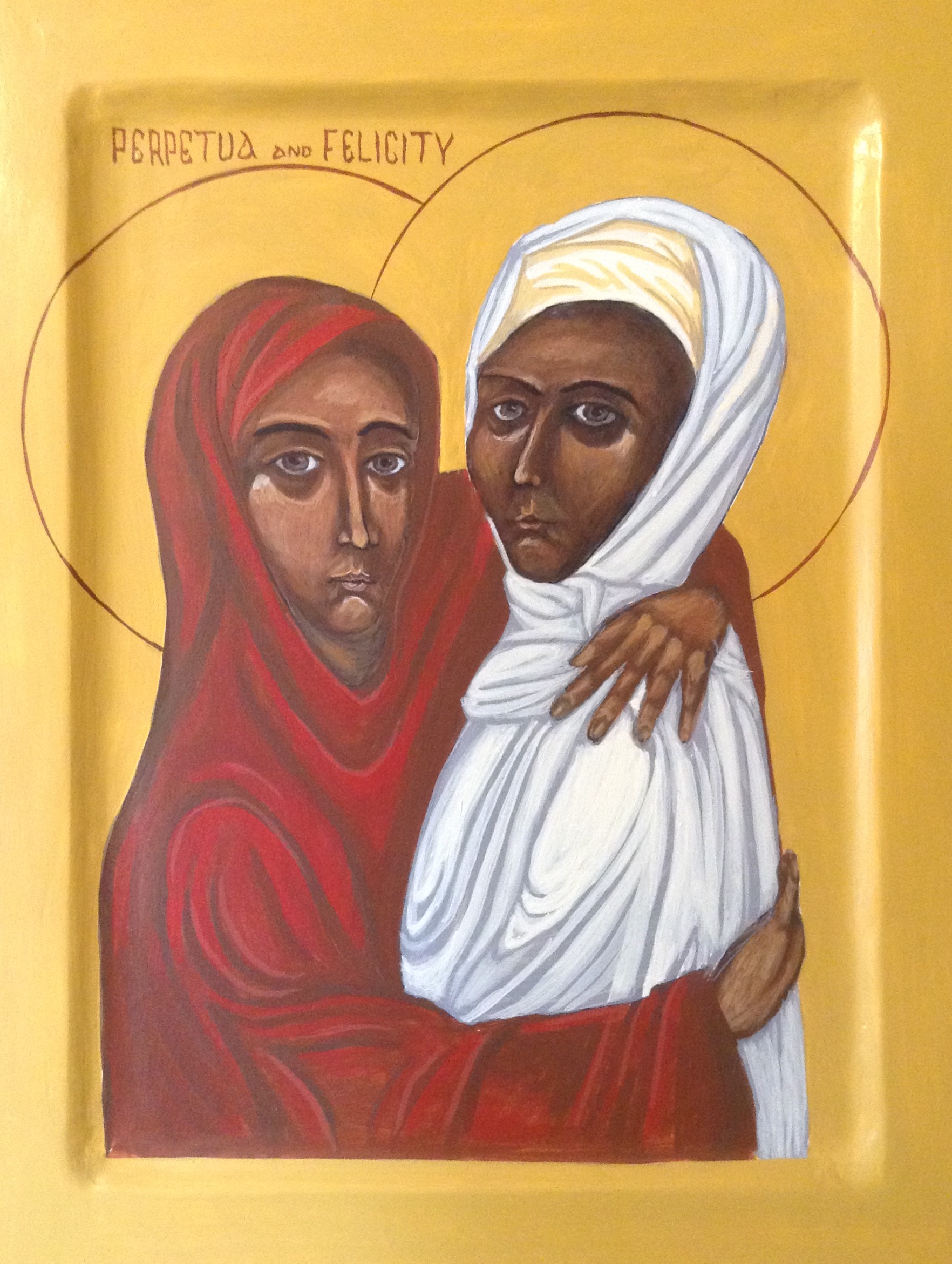
March 7 – Perpetua & Felicitas

These weekly “People to Commemorate” posts are a kind of calendar for the commemoration of the saints, reproduced here from a Uniting Church Assembly document which can be found in full here. They are intended for copying and pasting into congregational pew sheets on the Sunday closest to the nominated date.

Images (where provided) are of icons by Peter Blackwood; click on the image to download a high resolution copy of the image.

Perpetua & Felicitas, martyrs

Perpetua and Felicitas

Few women have shaped the Christian spiritual tradition like the young North African martyr and visionary, Vibia Perpetua. She has inspired people of different centuries, countries, and cultures. Her story, told in The Passion of Saints Perpetua and Felicitas, is a “dazzling text”, one of the most gripping accounts of martyrdom from the ancient church.Virtually from the moment of its writing in an early third-century Carthaginian prison, Perpetua’s story has played an important part in Christian spirituality. It is “timeless”, according to the medieval historian, Joyce Salisbury, meaning that it speaks to the human heart across the centuries, societies, and cultures.

An unknown figure first saw the potential of Perpetua’s story. He framed her story in such a way that succeeding generations of readers (or listeners) would treat it almost like Scripture. He saw in her visions a demonstration of the unceasing operation of the Holy Spirit and a witness for the glory of God and the good of the Church. The popularity of Perpetua and her companion Felicitas soon spread beyond the North African church. By the late fourth century their feast day was honoured in all the early calendars and martyrologies and their names were regularly remembered in Sunday worship.

By the early fifth century, Perpetua and Felicitas, were among the most venerated of African martyrs. Augustine loved these saints and drew inspiration from their life and witness. We know, for example, that Augustine preached at least three sermons in honour of Perpetua (after whom his sister was named). In Augustine’s first sermon he describes how upon hearing the story of the martyrdom of Perpetua and Felicitas read in church, the congregation joined in a “celebration of universal devotion”. In his second sermon, Augustine elevates the merits of Perpetua and Felicitas above all other martyrs. And in the third sermon, he names Perpetua and Felicitas as a model for all those who suffer for the faith.

The overwhelming reason for the popularity of Perpetua in recent times is her importance for women’s religion. She gives an intimate view into the mind of a third-century woman, which, for centuries, has been a great source of inspiration for women struggling with questions of identity and meaning. Given the degree of silence that has surrounded women throughout history, Perpetua’s story is astonishingly rare and precious. She may well not be the first woman to have put her thoughts on paper; she is, however, one of the first of whom we have any real knowledge. In her writing we can hear a voice too little heard. It is an extraordinary voice. She has given the Church – especially women – a role model and a positive example of empowerment.

Contributed by William Emilsen

March 26 – Caroline Chisholm

These weekly “People to Commemorate” posts are a kind of calendar for the commemoration of the saints, reproduced here from a Uniting Church Assembly document which can be found in full here. They are intended for copying and pasting into congregational pew sheets on the Sunday closest to the nominated date.

Images (where provided) are of icons by Peter Blackwood; click on the image to download a high resolution copy of the image.

Caroline Chisholm, renewer of society

Caroline Chisholm arrived in New South Wales in 1838 with her husband Archibald, an Army officer on leave from service in India. She quickly became aware of the plight of many of the settlers, and especially of young girls who arrived from Britain after a long sea journey, sometimes seeking a husband or boyfriend who had been sent out as a convict or who had arrived earlier to find work. Often illiterate and impoverished, and without friends or contacts, many girls turned to prostitution in order to survive.  Caroline established a home for them in an old barracks, launching an employment agency offering work with local families who, as part of the contract, gave them protection and care. Her work broke down prejudices against “convict girls” and helped to establish a sense of solidarity in the emerging colony.

Recognising that good work could be found in the emerging farms and homesteads; Caroline led wagon trains out into the bush, settling young people with jobs. She became famous as a matchmaker, as girls met and married farmers and founded homes of their own. A devout Christian, Caroline believed in the sanctity of marriage and family life, and saw the injustice of official government policy, which encouraged young men to settle in Australia but tried to block the arrival of women who were officially described as “encumbrances”.

Men who had been sent out as convicts begged her to find their wives or fiancées back in Britain, and she travelled to London to do this, eventually reuniting many families. Renting a modest home near the London docks, she started a Family Colonisation Society helping poor families to settle in Australia, commissioning ships with clean and adequate accommodation, and establishing a London hostel next to her own home where families could stay while waiting to sail. Former shipping arrangements had meant men and women sharing accommodation, and a complete lack of privacy: she established a scheme in which all young unmarried people were adopted into families for the voyage, which also ensured networks of friendship and practical assistance on arrival in Australia.

Sometimes subjected to insults because of her Roman Catholic faith, Caroline remained a good-humoured woman whose tact and discretion, especially when dealing with the poorest families, made her much loved. She became the first woman ever to give evidence to a British Parliamentary committee, addressing MPs examining the ending of transportation and the possibilities of family migration. Herself a farmer’s daughter, she energetically promoted Australian farming, taking a sheaf of wheat from a New South Wales farm into Parliament to make her point.

Returning to Australia, Caroline worked to establish “Chisholm shelters” along the rough tracks leading out into the bush, opened a small school, and continued to lobby for the needs of settlers. Eventually settling back in London, she died in 1877 and is buried in her native Northampton where her grave names her as “The Emigrant’s Friend”.

Joanna Bogle

March 18 – Joseph of Nazareth

These weekly “People to Commemorate” posts are a kind of calendar for the commemoration of the saints, reproduced here from a Uniting Church Assembly document which can be found in full here. They are intended for copying and pasting into congregational pew sheets on the Sunday closest to the nominated date.

Images (where provided) are of icons by Peter Blackwood; click on the image to download a high resolution copy of the image.

Joseph of Nazareth, Witness to Jesus

Although Christian tradition tends to refer to Jesus as ‘son of Mary’, the Gospels also preserve a clear indication that he was also known to be the ‘son of Joseph’ (Luke 4:22; John 1:45; 6:42). Joseph appears primarily in the birth narratives in Matthew and Luke. There he is named as the ‘husband’ of Mary through betrothal (Matthew 1:16, 18, 20). His importance for the gospel writers lies initially in his Davidic ancestry (Matthew 1:20; Luke 1:27) which indicates that Jesus, as Israel’s Messiah, is seen as a part of the Davidic line (see Luke 1:32). This claim underlies the most famous story involving Joseph: the journey from Nazareth to Bethlehem in response to a purported imperial census. The story is only told in Luke 2:1–7, but an association with Bethlehem is presupposed by Matthew 2:1–6. In addition to supporting the notion that his son is to be Israel’s Messiah, Joseph is portrayed as a person who is faithful to the Jewish law (see Luke 2:27, 39). On hearing the news of Mary’s pregnancy, his concern to secure a quiet divorce is regarded as the action of a ‘righteous man’ (Matthew 1:19). However, it is his obedience to the revelation from God about Mary’s pregnancy by the Holy Spirit that marks Joseph out as faithful: ‘he did as the angel of the Lord commanded him’ (Matthew 1:24). As a recipient of dreams, Joseph is aligned with his Old Testament namesake, as does his exile to Egypt in the face of Herod’s violence (see Matthew 2:13–15, 19–23). The other mentions of Joseph in the New Testament associate him with Jesus’ upbringing in Nazareth (see Luke 2:51–52; Matthew 2:23), a village of around two thousand people, where it is likely that Joseph plied his trade as a ‘woodworker’, a broader and more appropriate term than the more usual ‘carpenter’ (see Matthew 13:55 and Mark 6:3, noting the variant reading). Joseph’s relative absence from the rest of the Jesus tradition is usually explained by the suggestion that he had died by the time Jesus began his public ministry, but our sources are silent.

Thus, whatever the historical or biological realities behind the Gospel accounts, Joseph of Nazareth is there remembered as a central character in the story of God’s saving purpose. His faithfulness to God, not least in the face of tyranny and violence, ensures that Israel’s ‘mighty saviour from the house of his servant David’ (Luke 1:69) is kept safe and is able to ‘increase in wisdom and in years’ (Luke 2:52).

Rev Dr Sean Winter


March 17 – Ninian

These weekly “People to Commemorate” posts are a kind of calendar for the commemoration of the saints, reproduced here from a Uniting Church Assembly document which can be found in full here. They are intended for copying and pasting into congregational pew sheets on the Sunday closest to the nominated date.

Images (where provided) are of icons by Peter Blackwood; click on the image to download a high resolution copy of the image.

Ninian, Christian Pioneer

We know very little about Ninian and even then the ‘facts’ are disputed. He was reputedly the son of a chieftain who had converted to Christianity and he came from either Cumbria, or the South-West of Scotland.  Christianity had spread during the time of Roman occupation and three Bishops from Britain had travelled to the Council of Arles in 314AD. Ninian, who would have been a Roman citizen, is said to have travelled to Rome to study. In Rome he was ordained and consecrated as a bishop, being sent back to his native Britain around 397AD, in order to evangelize his fellow Britons and take the Gospel to the Southern Picts, in what became, much later, Scotland.

Some historians believe that this work of conversion was done by Columba some 150 years later and not by Ninian. It is believed that Ninian was active from 397 to 431AD.

On arrival he is said to have had a monastery built on the north shore of the Solway Firth by masons from St. Martin’s Monastery in Tours, Gaul. This became known as the Great Monastery and it was from here that he, and those he gathered around him, set out on their missionary tours. It is possible that this building was known as Ad Candidam Casam, from the Latin meaning “At the White House”.  It would appear to have been painted with a whitewash. It is possible that it was built with white stone, although this would have been unusual to that time. His monastery probably gave the name to the town now known, as Whithorn.

The earliest reference to Ninian and to the White House is from Bede, in his Ecclesiastical History of the English People, writing around 731AD, almost four hundred years later. In this he says that he is just passing on the knowledge that was traditional at the time of his writing. He does not claim that what he writes is factual. He tells us that Ninian called his monastery after St. Martin of Tours and it is possible that he had met Martin on his way back from Rome. Martin died in the same year that Ninian travelled back to Britain.

Part of Bede’s agenda was to say that Ninian had not been part of the Celtic Church, but loyal to the Roman way of being church.

The first history of Ninian was not written till the 12th Century when Aelred, who was Abbot of the monastery at Rievaulx in Yorkshire, wrote his “Life of Saint Ninian”. By this time many monasteries and places associated with saints from the past had histories written in order to promote their Centre, in order to encourage the pilgrimage trade. It is thought that Aelred was asked by the Bishop of Galloway to write the history to promote his Bishopric.

In his history, Aelred says that Ninian performed a number of miracles both before and after his death. So it is possible that the history was to help secure his sainthood.

After the history was written, Whithorn and Ninian’s tomb, became a very important Centre of pilgrimage.

Written by Rev Peter Welsh

March 17 – Patrick

These weekly “People to Commemorate” posts are a kind of calendar for the commemoration of the saints, reproduced here from a Uniting Church Assembly document which can be found in full here. They are intended for copying and pasting into congregational pew sheets on the Sunday closest to the nominated date.

Images (where provided) are of icons by Peter Blackwood; click on the image to download a high resolution copy of the image.

Patrick, Christian pioneer

Patrick (c390-c461) was born in Roman Britain. We know little about his life other than what is revealed in his Confession, his Letter to the soldiers of Coroticus, and the Breastplate of St. Patrick, which may have been written by him. All other knowledge is just legends. Accounts of Patrick’s life are so drawn-out (his own Confession) or overblown (later hagiography) that most of what we know about him can neither be proven nor discredited conclusively.

In the field of Celtic history, almost everything we read reflects a political point the author wishes to make. Bede, for example, makes no mention of Patrick. This omission tells us a lot about Bede. He was interested, following the Council of Whitby, in showing how those who had taken the Roman view regarding the date of Easter and the tonsure, were in his eyes correct; those who didn’t were clearly wrong. Bede had no place for Patrick.

Patrick himself was most likely British in origin, and, after being enslaved by an Irish warlord, and then escaping to the Continent, he returned to Britain before evangelizing Ireland. His mission was not to the British; he said his missionary impulse was fuelled by “a vision in my dreams of a man who seemed to come from Ireland—a vision like the apostle Paul’s at Troas.”

Patrick had been sent as a replacement for Palladius who had died shortly after his arrival in Ireland. Whereas Palladius, whose mission lasted about one year, was interested in those who were already Christians, Patrick, it seems, had a missionary zeal to convert the Scots (Irish). It is believed that Patrick embarked upon the first significant missionary endeavour in 432.


While Patrick does not appear to have represented Rome officially, his time on the Continent may have included monastic training; he appears to have studied at a monastery in Gaul. Patrick was ordained a priest and bishop, and this suggests he would have at least been exposed to current thinking and policies from the papacy.
He then travelled to Ireland, where over the course of several years, he converted thousands of people to Christianity, including several Irish kings. Anglo-Saxon warlords made the process very difficult for Patrick and his converts, however. Coroticus, a king from western Britain, swept in and did extensive damage in Northern Ireland, killing many Christians or taking them prisoner.


Irish monasticism as implemented by Patrick continued to grow nonetheless. This monasticism was very similar to that throughout Europe.  This form of Monasticism was based on a diocesan approach but within a few years it had become a monastery-based model with a bishop being head of the monastery. Sometime after the death of Patrick the church in Ireland was reorganised on a thoroughgoing monastic basis. The chief person becomes the Abbot not the Bishop. Monasteries were often the only available means of obtaining a useful education.

It is worthwhile noting that Patrick denounced slavery during his life, and the practice was discontinued shortly after his death.

The hymn ‘I bind unto myself today the strong name of the Trinity’ (TIS 478) is attributed to Patrick.

Rev Peter Welsh (alt)


February 28 – Martin Bucer

These weekly “People to Commemorate” posts are a kind of calendar for the commemoration of the saints, reproduced here from a Uniting Church Assembly document which can be found in full here. They are intended for copying and pasting into congregational pew sheets on the Sunday closest to the nominated date.

Images (where provided) are of icons by Peter Blackwood; click on the image to download a high resolution copy of the image.

Martin Bucer, Reformer of the Church

Martin Bucer (1491-1551) is a sympathetic and somewhat neglected figure of the Reformation. Among the divisions that came so quickly to plague the Protestant movement, he was an advocate for reconciliation and dialogue. Born in Alsace, Bucer became a Dominican friar at an early age, but while studying in his twenties he was influenced by Erasmus and Martin Luther. He married a former nun and began preaching the new doctrines, was excommunicated, and was eventually received as a pastor in Strasbourg in 1524. He remained there for most of his life as a leader of the Reformed church. Changes in the political scene eventually forced him to flee to England, where he arrived in 1549. Before his death in 1551 he had come to have a significant influence on the English Reformation, including the second (1552) Prayer Book of Edward VI.


Bucer watched with dismay the dissipating factions of the early Reformation. Throughout his years in Strasbourg, he strove to foster dialogue between Lutheran and Swiss Protestants, and even with Anabaptists and Catholics, apparently believing in the possibility of a reunified church. In this sense, Bucer was a forerunner of the modern ecumenical movement. In the enduring conflict of interpretations over Christ’s presence in the Eucharist, Bucer maintained the unusual opinion that Zwingli and Luther were simply at cross-purposes. In his own thought, he had reconciled their differences—agreeing with Zwingli that Christ remained in heaven, he nevertheless believed that the Eucharistic elements really participated in Christ’s body and blood “after a heavenly manner”. Through the sanctification of their senses by the Holy Spirit, Christians apprehend heavenly things on earth. Unfortunately, the rival theologians were not persuaded that their disagreements were so illusory. Perhaps Bucer anticipated not just the zeal and goodwill of modern ecumenism but also its failures, in underestimating the depth of the differences to be overcome, and relying too readily on formulae of accord.


Bucer also placed a high value on pastoral discipline and the formation of mutually supportive Christian communities. This emphasis underpins the continuing importance he attached to Confirmation. He regarded it as a “personal ratification of the baptismal covenant”, a view which influenced many Protestant churches to retain a form of this rite. Ordination too, without being called a “sacrament” as such, retained a highly sacramental flavour in Bucer’s thought, reflecting both the centrality of ecclesial office in his understanding of the church, and his faith in the real effectiveness of the Holy Spirit through human words and actions in the liturgy. It is fitting that Bucer left us no church in his own name—his desire was for integration. But his influence was felt by those who more permanently shaped the young churches, especially Calvin, who had closely observed his work in Strasbourg, and Cranmer, a long-term correspondent and a friend in the last years of exile. Through such figures as these his legacy has been communicated to later Protestant generations.

Martin Wright


« Older Entries Recent Entries »