
Category Archives: Sermons

10 May – “As I have loved you…”

View or print as a PDF

Easter 6
10/5/2015

Acts 10:44-48
Psalm 98
John 15:9-17


“This is my commandment: that you love one another.”

The rhetoric of “love” is often very vague, non-specific or ambiguous. It easily becomes sentimental on the one hand or, on the other hand, we broaden its meaning and application to things like “tough love” – that kind of love which declares to the one who is being “loved,” “This hurts me more than it hurts you!”

What is the love of which Jesus speaks? “… Love one another as I have loved you”. Okay. But Jesus then almost hopelessly confuses the matter with his next declaration: “No one has greater love than this: to lay down one’s life for one’s friends”. This is unhelpful because Jesus himself literally does just this: he dies, as we have subsequently come to understand, “for his friends”. It is unhelpful because it lends itself to adoption into stories of heroism; we need only think of the way in which this Scripture verse has been taken up as an interpretation of the loss of life by soldiers in war. “Greater love hath no man” is inscribed on the Stone of Remembrance in the Shrine of Remembrance here in Melbourne, and doubtless in many other similar war memorials.

Whatever might be said about Jesus’ own laying down of his life, and the laying down by soldiers of their lives in war, the problem with what Jesus says for us here and now is the way in which it can be heard to over-dramatise the act of love. As a statement by itself it is true enough but it seems to locate the work of love in a place where most of us are never actually going to be: the heroic moment, the moment in which we are called to risk or even lose our life in the act of seeking to save another, as a father might do who swims into out to sea to retrieve the child dragged out by a rip, or a soldier might do to drag her wounded comrade out of enemy fire. Whether or not such moments are in fact real acts of love is not in question. But they are not, for the most part, real life – at least, the real life of most of us. To declare “no one has greater love than to lay down one’s life for one’s friends” can suggest that this is about the end of our life, the possibility of the need to die that others might live. In the Scriptures, however, thought about life and death is for the most part not thought about when or whether ours hearts are beating or not. Rather, it is a matter of how one’s heart beats – what rhythm it beats, according to which we then march.

To lay down one’s life for friends, as the Jesus of John’s gospel puts it, is put by the Jesus of the Synoptic gospels as “deny yourself, take up your cross and follow me”. The laying down of one’s life is a manner of living and not simply the moment at which we finally die. This is a living which knows not only self but others, and not others as we imagine or want them to be, but others as they actually are, even when in this or that way they seem to be radically wrong and so to require of us more than seems “fair” or “reasonable”. To lay down my life for my friends is to allow where they are to be my problem – and not my problem to fix but the unavoidable cause of my “death”, so-called: the occasion of my cross to bear. This may be a literal death as in those rare “heroic” cases, or a metaphorical one, in the much more common and mundane challenges of everyday life together.

Any talk about self-denial runs the risk of being heard to suggest submission to abuse by others. But this is not the point. We need to acknowledge this danger in such talk, to watch for it in situations where it might arise, and to act where appropriate. But again, for the most part, these are extreme cases which cloud the issue for most of the rest of us most of the time. At the heart of the question of what it means to love is understanding why love is here spoken of in terms of a commandment. Our familiarity with love as sentiment, or even simply as lust in one form or another, also clouds our vision. These emotions and drives come naturally. We cannot be commanded to “fall” in love or even in lust; it just happens, and we generally like it. But the love of which Jesus speaks is not natural or appealing in this way. It must be called forth, commanded, because it contradicts the natural. It contradicts our over-estimation of the other, or our under-estimation, or even the presumption to estimate what another person is. The commandment to love contradicts our desires for them, and so our presumption to know what they think or desire or need.

But the command to love still remains abstract until a specific contradiction enters our lives – until we feel ourselves “contra‑dicted”, hear ourselves literally “spoken against”, have our own sense of the world and how it should fit together challenged. That is, the command to love comes as a command at the very point I feel unloved, when I have not been heard, when I feel disempowered, when I am disoriented by the fact that the world – which means those around me – is not as I imagined or desire. Drawing on an observation from Rowan Williams (Christ on trial): At such points I naturally tend to act out a longing to be somewhere else or, perhaps more precisely in such cases, out of the longing that you be somewhere else. For it is in this moment that the specific shape of what love demands then becomes clear in all of its unpalatableness. The command to love is the command to be where you are, with others who are not where you want them to be.

“No greater love has anyone, than to lay down one’s life for one’s friends.” In this way Jesus describes his own way of being and, of course, the actual playing-out of his ministry in the cross. The logic of what I have said about love has its basis in the ministry of Jesus himself: “…as I have loved you.” We will miss this, however, if we remain with abstracted ideas about the love and death of Jesus – as if it were about Jesus’ love for “everybody”, or that Jesus “had to die” as part of God’s plan, so that he is a special case we don’t have to consider. Against this is the doctrine of the incarnation, which holds not merely that Jesus was God become “human”, but a specific human being in a specific time and place in the midst of specific people. Jesus the human being doesn’t just “die”; Caiaphas and the Sanhedrin, the Pharisees and the scribes contradict him and plot his death. He is not merely “arrested”, but what he taught is contradicted in betrayal by Judas and denial by Peter. If Jesus’ life and death is a thoroughgoing act of love, then it is so within these specific relationships. If Jesus dies for love’s sake, it is for the love of Caiaphas and Annas, of Judas and Peter, of Mary and Martha and Magdalene and so on, all of whom are not just the potential beneficiaries of his death but, in different ways, the cause of his death: “This my body, broken by you…” Jesus dies in the way he does because he insists on being with them, “as they are”.

The cross, then, does not simply effect a divine salvation as if by a holy magic; it gives shape to love. It is Jesus “being where he is”. The shape of love Jesus’ persistence with and for both friend and foe. The Christian life, correspondingly, is cruciform – it is cross-shaped. It involves that kind of dying to ourselves which is necessary if any human community is to survive error and injustice – particularly the error and injustice of “someone else”.

And this brings us to the importance of the church. It does not matter whether other faith communities come to the same conclusion about love as the church, or whether the church generally fails miserably at living what is at the heart of its being. If others can know this truth by other means, we celebrate with them. If the church fails at living the truth, we are simply all the more reminded of how imperative it is that we continue to work at it. The church is a community which is learning not simply how to love, but the difficulty of love.

Love is difficult, and it is difficult for the church. It will be difficult for us to deal with each other when we have to make very concrete, far-reaching and doubtless very disruptive decisions about what to do with our property resources. It is difficult to deal with each other when we begin to express ourselves in relation to things we need to have in common – and we might think here of the conversation we have planned this morning about worship. And yet it is precisely in such potentially conflicted situations that we are called to do something extraordinary. This is not the heroic feat of agreeing to sell up, or agreeing to soldier on on this site, or with a stroke of genius achieving just the balance in worship that pleases everyone. The extraordinary thing is in the manner of engagement – feeling ourselves to be in the right, but not requiring that others recognise it. Or, in more evangelical terms – believing not only that I am justified by grace alone but also that you, who are clearly wrong in what you do or think, are also justified by grace and not condemned for the error I see in you. This is the fruit Jesus appoints us to bear “fruit that will last” (John 15.16) because it reflects that love which overcomes all things. This is the extraordinary thing.

There is not much between how we stand before God and how others stand before us. It is because we do not understand this that we often turn out to be lousy lovers. The command to love comes precisely because we need constantly to be called to love. This call comes again and again in God’s hope that we might see: as we are to God – claimed in grace – so others are to be to us; as God is to us – claiming through grace – so are we to be to others.

…as I have loved you” is where we begin, and the end towards which we move, if the “love” which at is our heart is to be meaningful, and effective.

Let our prayer be, then, that our hands do not fumble the gift of such extraordinary trust – the gift of each other to love – that the work of our hands might finally be found to match where love began, and never ends. Amen.
3 May – On Learning to Understand

View or print as a PDF

Easter 5
3/5/2015

Acts 8:26-40
Psalm 22
John 15:1-8

Sermon preached by Rev. Bruce Barber


Acts 8:29:   “Philip ran to the chariot and heard the Ethiopian eunuch reading the prophet Isaiah. He asked, “Do you understand what you are reading? He replied, “How can I unless someone guides me.”

You are eighteen. You have just completed VCE and are enjoying a gap year in Europe. Though usually travelling with a friend, you find yourself alone on a short Mediterranean cruise. Arriving in the port of Kusadasi in Turkey, you idly explore much the same shops you’ve seen everywhere, followed by an hour or two sunbathing on the beach. You hear about a short tour to Ephesus so decide to join it – without really knowing why. Yet more ruins, though certainly impressive. You go back to your cabin. Not much to do, so you switch on the TV to watch the same news for the 50th time on CNN. You switch it off. Nothing to read – open the drawer by the bed and there all alone is a copy of the Bible, apparently never opened. You read the page telling you who provided it, and what to read if you’re lonely, tired, or sad. But you’re none of these things. So you move on finding some letters to unpronounceable places including one called the Ephesians, but you make no connection with that to where you’ve just been. Flick over the pages. Come to Chapter 8 of the Book of Acts and read about a eunuch – never met one of those, so you shut the book and put it back in the drawer. A caricature? Perhaps – but perhaps not.

Our text then has some force: “Do you understand what you are reading?” Will you think to ask: “How can I unless someone guides me?”

So to the same enduring problem, but now with Philip and the Ethiopian eunuch. Every detail counts. Not least that we read it in the season we call Easter, while not forgetting that every Sunday is Easter Sunday. The text before us today, however, comes after the last resurrection appearance we call the ascension – which is still two weeks away in the liturgical calendar. Equally important is the fact that we read this text in the second volume of the two part work we call Luke/Acts – in effect, the gospel of the Church, following the first, the Gospel of the Lord according to Luke.

This second volume simply illustrates the unfolding of the ascension commission to the Church to be “witnesses in Jerusalem, Judea, Samaria, and away to the ends of the earth”, that is, to the city of Rome, for with this pagan city the gospel has reached its goal. This, then, is the context for how we are to understand the passage before us.

This morning, though, we are very early on that journey. In the first volume, the gospel has been offered to Jerusalem, and been violently rejected. The first in this volume to bite the dust, quite literally, is the first martyr Stephen. So the focus shifts to Philip, not here the apostle, but rather one of the Greek speaking Christians set apart for administrative functions in the Jerusalem community. Philip is one of those who were forced to leave the city of Jerusalem following the martyrdom of Stephen. He fled to Samaria, the ancient enemy of the Jews, detested as a mongrel race of semi-heathen heretics. Here Philip is surprisingly successful as a missionary, including being the first to baptise a non-Jew there.

So the stage is set for Philip’s encounter with the Ethiopian eunuch, a potentially long, long branch away from the trunk of the vine. Although Eunuchs could be high officials, in Israel they were excluded from the covenant congregation, being considered as impaired or defective according to the ceremonial law. So this is the first highly unlikely impediment for his incorporation into the Christian community.

But the text is more interested in the fact that he is an Ethiopian rather than being a eunuch. As a geographical or ethnic term, ‘Ethiopian’ has an extended meaning, being used to give a vague designation for all peoples in Africa far distant from the Mediterranean basin. That a high official in the queen’s court – indeed the treasurer of her kingdom – should be able to read the Greek scroll of Isaiah is not a problem. That he had it, being neither a Jew nor a proselyte, might well be, yet as a court official he could well find a way. So this Ethiopian eunuch is, in fact, best understood to be a half-believer in Judaism, a “God-fearer” as is the case with other such Gentiles in Luke/Acts ready for a Christian reading of the Old Testament. The point of the passage is that as a eunuch, he serves as an example of one by nature “not my people” becoming “my people”. And second, as an “Ethiopian”, he represents the second impediment for inclusion, nevertheless the sort of foreigner understood in the tradition as a Gentile who “comes to the light”. And it is not stretching the truth to see him as a high official being the model of “a king that comes to the brightness of its rising”.

So we encounter this Ethiopian as he travels reading aloud – as was the custom – a pivotal passage about the meaning of Jewish salvation history – a far cry from our hypothetical 18 year old traveller desultorily dipping into the cabin’s Gideon Bible only being offered a treasure trove of helpful advice for a down time.

Both are equally puzzled by the book. The Ethiopian at least is puzzled by the heart of the matter. Is suffering merely a transient event in Israel’s history or is it at the very heart of Israel’s existence? But most puzzling of all: who is the figure who embodies it?

Hence Philip’s question: “Do you know what you are reading?” The only dispirited reply has to be: “How can I if there is no-one to help me?”

Is this not the pathos of every age, not least our own? We, of course, live in a culture that for the most part has given up asking the question about the meaning of the Bible. Now everyone is an expert, non-believers most of all. But the real pathos is that we have made them like this. Yet not all.

Three weeks ago I had a startling experience of the reversal of today’s text. I was invited to offer some leadership to a weekend gathering of most of the churches in Ballarat at Hall’s Gap Conference centre.

Some 130 people were present. I was pleased to accept the invitation, while indicating that I was reluctant to make the running with my own imposed agenda. Instead, I asked if they would draw up some questions which might provide a focus. I received about thirty, ten produced by the large group of children attending. Certainly this was an encouraging start.

The questions, perhaps predictably, fell into three broad areas – puzzles about the Bible, especially the status of the Old Testament; about Christian belief; and about the future of the Church.

With this as the agenda, I was then informed that a large number of Sudanese families would be attending, members of a Sudanese (Nuer) congregation. I became apprehensive, having absolutely no experience with African culture. I wondered to myself: how will this work? At the end of the first session, a group of Sudanese women came to speak to me. Fearing the worst, I was astounded by their enthusiasm for what I was attempting. Rarely have I encountered such an appreciative audience. I felt only shame that in my ignorance and arrogance I had anticipated that they would be to me as the Ethiopian is to Philip. Puzzled by this reception as I was, the presiding minister offered an explanation: “Unlike us Anglo-Saxons”, she said, “they carry no baggage” literally, in every sense of the word, having endured unbelievable deprivation and suffering.

They, if anyone, know exactly what is at stake in reading the suffering servant passages from the prophet Isaiah – far eclipsing my own ‘talking head’ understanding of the significance of such passages.

“Do you understand what you are reading? Philip asked the Ethiopian. All I, for one, could respond to the implicit question of my Sudanese Christian friends was this:

“How can I, unless someone guides me?”

26 April – Christ our beginning and end

View or print as a PDF

Easter 4
26/4/2015

Isaiah 52:7-10
Psalm 85
Mark 1:1-15


There seems to be a general consensus that the beginning is a very good place to start: “The beginning of the good news of Jesus Christ, the Son of God”; so begins the book of Mark the Gospeller.

Beginnings, however, are rather less straightforward than we usually imagine. There are, in fact, no true beginnings in history. There was always something before what we choose as a beginning, so that – were we to be comprehensive – we would have to push back the start as far as our historical knowledge could reach. But, in fact, we don’t do this. While everything really begins somewhere prior to the beginning we choose, we nevertheless do choose: we do identify and magnify certain points within history as somehow being “the beginning” in a special kind of way.

In this process, what is likely to be less clear to us is that in such a naming of a beginning we are not so much identifying where things start as identifying the end from which we take our view of the beginning. The beginning is what creates us ourselves. The beginning we choose is chosen because it speaks us – not only speaks to us but speaks us, announces us, relates us. If a history and a starting place do not do this, then they are someone else’s story and not ours.

In the last few weeks, of course, and more intensively in the last few days, we have been reflecting as a community on the ANZAC landing at Gallipoli. Among the many angles of reflection, there has been no small amount written on this event as an Australian beginning. The language is sometimes quite extreme, and has been challenged from a different quarters, but it conveys the thought that this event defined the spirit of the nation. The event itself, and the way those soldiers conducted themselves, constituted the arrival of the nation on the world stage. In all sorts of often quite surprising ways, the ANZAC spirit is seem somehow to reflect what is “typically” Australian – even to have been the genesis of these characteristics. In this way they were us – our beginning – because we are them. Our Prime Minister remarked yesterday: “If they had not been emblematic of the nation we thought we were [read: “are”], Anzac Day would not have been commemorated from that time until this.” There is something fundamentally “us” behind the commemoration, and so it lends itself to serve as our “beginning”.

Whatever might be said about the continuing remembrance of the Gallipoli campaign, the point here is simply what sits behind the choice which is exercised in selecting this event as somehow being definitive and so somehow constituting a beginning: in this way we note ourselves.

What, then, of Mark’s sense for a beginning: “The beginning of the gospel of Jesus Christ, the Son of God”? All that we have just noted about the choice of a beginning applies also in this beginning: this, too, is a choice about where the beginning is. In the opening passage there are intimations of other, prior events – the preaching of the prophet Isaiah anticipating John; the echo of the even earlier Elijah in John’s mode of dress; and perhaps even of the very creation event itself echoed in the movement of the Spirit over the waters of Jesus’ baptism (Genesis 1.1f).

Yet the beginning Mark chooses is the appearance of Jesus on the scene and the first thing we hear on his lips: “The time is fulfilled, and the kingdom of God has come near; repent, and believe in the good news.”

If the need to choose a beginning – as Mark does – is a matter of expressing something of ourselves, expressing something of the end which is reflected in that beginning, how is that the case for Mark? What is the end – the goal – identified, chosen, in this beginning?

It is, again, us: Mark himself, or those to whom he writes – we are the end in mind here. The evangelist Mark writes to a community which is itself the fruit of the gospel which begins here. In the first instance it was a particular community: largely Gentile, probably in Rome, small in the face of the over-whelming presence of all things Roman, apparently under increasing persecution in the early to mid ‘60s. Some interpreters read the famous calming of the storm episode in chapter 4 as being a word about – and to – this little community, tossed about on the waves by seemingly irresistible forces of criticism and persecution, crying out to God, “Do you not care that we perishing?” (Mark 4.38).

The “beginning” which is the appearance and proclamation of Jesus makes sense of the identity and experience of that small community believers. They are different, off-centre. They are marginal to the dominant narratives which spring from different beginnings and imply different endings. As Palestine was marginal and problematic to the vast Roman world, so also are they, although living in the very heart of Rome itself. As wild-eyed crazy as the Baptist appears in his desert ministry, calling people away from the relatively safe city into the dangers of the desert with its “wild beasts” (1.12), so are these believers seen to be odd, eccentric. For this message – this gospel – speaks of a different centre. Just as the more jingoist readings of the ANZAC event see it as a characterisation of the Australian spirit – the centre of our identity – so for Mark the way the gospel begins characterises the community which is now formed by that beginning.

And just as any rampant nationalism, or fanatical extremism, or political ideology sees itself as finally arriving at the goal of human history – the “filling up” of history in this particular way of being human – so also Mark’s Jesus announces “the time is fulfilled” (1.15). Now, finally, it comes to completion.

And, yet, it is a strange “completion”, for it is an “incomplete completion”. This is because the filling up of the time takes shape in the creation of something which is not yet at its end, its perfection: the church itself – that community which sees its particular present springing from this beginning. For, despite occasional triumphalist outbursts, the church is scarcely “complete”; the very writing of the gospel itself as an encouragement to a troubled church is evidence of this, quite apart from the inadequacies of the church more obvious to us today.

The church’s end is in this beginning, but it is not there yet. This is because of the strangeness of this particular beginning: its call to repentance. This repentance is no mere turning from this or that “sin”, no mere saying “sorry”. It is, as the English word itself implies (re‑pent : re-think), a re-thinking: a re-perceiving of what matters. This call to re-imagine ourselves and our future is an address to us who tend towards crystallising a particular sense of what it means to be human. These crystallisations are hardenings, exclusions of other possibilities. It happens, continually, in churches as it happens in nations. In these imaginings of ourselves we imply that we have already reached what it means to be whole and human. Or, in the terms which Jesus uses, we imply that we have already reached “the kingdom”: God’s kingdom has come, and we are the proof of it. It is this sense of completeness in ourselves which drives us to conflict with each other: the claims we presume to make on others on account of their being less, or deserving less, than we because our beginning, our end, are the “true” beginning and end.

But the kingdom of God – our completion – has not yet come: we are not complete. As then, so now, this world “draws near” in the person of Jesus in whom alone there is a true beginning and a true end, and who calls us out of parochialisms, nationalisms, triumphalisms and the self-righteousness which justify selfishness and give rise to fear. We are called from our sense of our own perfection and the narrow beginnings from which this sprang to a beginning and an end which is not yet quite ours, but the approach of which is announced in order to unravel us a bit.

Our first reading this morning was taken from Isaiah:

How beautiful upon the mountains
are the feet of the messenger who announces peace,
who brings good news.

This announcement of peace in Mark’s gospel takes the form of the approach of a God who calls us out of our firm and fixed identities and centres into something as yet unimagined. This may not seem good news at first, and indeed Mark’s gospel is filled with shock and awe as the world meets the surprising, disorienting liberty Jesus brings. But it is liberty – a liberation from the powers and principalities which hold us in thrall and cause us to imagine that we need to distance ourselves from, or even kill, each other, and can then bless that as a beginning.

We give thanks, then, for Mark and for all who have told the story of this strange one in whom our beginnings and endings are re-worked to bring life and freedom.

May God’s people grow ever more fully into that story, becoming themselves new beginnings and endings which testify to where life and liberty are to be found. Amen.

19 April – “No one who abides in [Christ] sins”

View or print as a PDF

Easter 3
19/4/2015

1 John 3:1-10
Psalm 4
Luke 24:36b-48


“No one who abides in [Christ] sins”. Let that rest for a moment on the surface of your mind: “No one who abides in [Christ] sins”. The Bible says it. Can we believe it?

Most of us are likely to feel a little uncomfortable about this, and all the more so when we discover that it is no mere slip on John’s part. Elsewhere in the epistle we hear similar things: “Those who have been born of God do not sin, because the seed of God abides in them; they cannot sin, because they have been born of God” (3.9).“We know that those who are born of God do not sin, but the one who was born of God protects them, and the evil one does not touch them” (5.18).

What makes us feel uncomfortable about this, in the first place, is that we know Christians – we know ourselves – and so we “know” John can’t be right. There are too many undeniable failures to ignore, and many Christians are more than happy to acknowledge the fact: “not perfect, just forgiven” (declares one of our less helpful bumper stickers).

But, if we weigh up the possibilities fully, there enters another reason why we might be uncomfortable about John’s confident declaration about sinless believers: if John is right, then we who purport to believe must wonder whether indeed we are those who “abide” in Christ. In fact, if we allow these words their scriptural status, the simplest way to make sense of what John says right here is to conclude that those we call “Christians” – ourselves or others – are not who John means when he speaks of those abiding in Christ.

John, then, seems to present to us two possibilities (or at least he does for those of us who imagine ourselves to be believers): either John is wrong about believers and sin, which perhaps presents us with problems about the authority of scripture on this matter, or he is right, which forces us out of the picture.

Yet this is too simplistic. If we are going to claim our status as Christians who somehow belong to God, we will object that surely John writes to someone, to some real, historical group of believers, and surely they are not that different from us. And in fact, just this is acknowledged in other parts of the epistle: 1.8 “If we say that we have no sin, we deceive ourselves, and the truth is not in us… 10 If we say that we have not sinned, we make him a liar, and his word is not in us.” 2.1“My little children, I am writing these things to you so that you may not sin. But if anyone does sin, we have an advocate with the Father, Jesus Christ the righteous…” 5.16 “If you see your brother or sister committing what is not a mortal sin, you will ask, and God will give life to such a one…”

On the one hand, then, there are those who are “called the children of God” (3.1), in fact who are the children of God now (3.2), who “abide in him” and so cannot sin. On the other hand, these same ones have sinned, may sin, and indeed do continue to sin, As such, John calls them lawless and so “children of the devil”.

What are we to make of all this?

We might dismiss it all as religious doublespeak which says yes and no at the same time, pretending that this actually stands for something. Or we might call for “balance” – trying to say a little bit of a yes and a little bit of a no, although in fact we’ll end up saying more of one than the other. Both approaches make some sense of what is seemingly gobbledygook.

But if, instead of trying to transform what John says into something which makes sense for us, we allow him to transform how we think, we will discover something much more interesting than what we already know, something which breaks through the barriers of knowledge which limit us.

While Easter is now quite forgotten for another year by the wider world, for the church it is still here, and is ever with us. As we noted on Easter Sunday: either the proclamation of the resurrection is a game-changer or it is nothing. The word “resurrection” implies that the dead might no longer stay where we put them. But this is not for the New Testament a mere fact. Death is fundamental to human experience and our measure of ourselves. If death is upset, then everything is upset: a new world order is imaged, and faith is a re-imaging – a re-image-ining – of ourselves after that sign.

What John presents to us in our reading from the epistle this morning springs from just such a re-imagining. The resurrection of Jesus may seem to be nowhere in sight in this text, yet all of the New Testament is a description of life in the world from the point of view that Jesus has been raised. What really confronts us here is not the surface issue of doublespeak about sinless people who sin, or children of God who are also children of the devil. Though it is nowhere explicit in our reading, the “problem” John causes for us rests in his confidence that Jesus has been raised from the dead. This is a problem because of all those who might have been raised from the dead, Jesus was the least expected. We have noted before how this contradicts our inherited religious sensitivities after centuries of “Christian” moralistic conditioning. In the crucifixion Jesus is judged – named – as blasphemer. He is then, so far as any can see, a moral failure. His naming and bearing of himself was apparently wrong, and his persecutors were simply fulfilling their religious duty in demanding his execution.

The resurrection is the re-naming of Jesus, now by God. The resurrection declares, “This is my Son, with whom I am well pleased”. (These words, borrowed from the baptism and Transfiguration narratives, are – in those places – actually resurrection statements. This is because, if there is not resurrection, there is no ongoing interest in Jesus [who is “proven” blasphemer], and so no “recording” of the baptism of Jesus or the Transfiguration). A shift takes place from our naming of Jesus to God’s naming of him.

What has this to do with anything? We began by noting that we name ourselves as Christians, and yet John seems to say that such as we do not sin, and yet we do often seem to sin, so that John makes little sense. But who names us, and how, is at the heart of the confusion. In our naming of ourselves, we end up with a great complex of contradictory hyphenated names: Mr Christian-Sinner (whether the sexually abusive priest or the congregational gossip); Dr Religious-Atheist, who professes no belief in “god” but whose life is thoroughly determined by influences she scarcely recognizes, let alone acknowledges; Mrs Selfish-Giver, who gives time and money more for the recognition this gets her than for those in need; Miss Capitalist-Greenie, whose radical eco-Tweets are made from a phone built in a far-away place under slave-like conditions. Our attempts to name ourselves create a thoroughgoing moral confusion from which we cannot extract ourselves, such that hypocrisy – that sharpest of critiques which can be made of anyone who commits to any statement of themselves – is unavoidable.

At this level of our experience, the only recourse is self-justification. With this, if we are honest, comes anxiety. Am I more “Christian” than sinner, more socialist than capitalist, more generous than selfish, more what I publically profess than what I permit myself in private? This is not necessarily a religious anxiety about whether I’m “saved” or will inherit eternal life. It is a thoroughly and broadly human phenomenon: am I safe from what might threaten me, whether the dangerous thing which might over-run me or, more importantly here, that I might be discovered not to be who I’ve presented myself to be. These are the fruits of our naming of ourselves. We are more – and less – than we can say, and that difference between what we say and what we are creates anxiety.

But the good news which is the gospel is that God speaks to us our true name: God fundamentally “defines” us. “Children of God” is a name given us by God, and not by ourselves: “See what love the Father has given us, that we should be called the children of God” (3.1). This is a surprise for John. We are so familiar with it that it’s almost meaningless, just another self-designation. The surprise is in that what we have understood ourselves to be is enveloped within something which is not only more comprehensive but also healing and liberating: God renames us – and remakes us – according to the name he has for Jesus – Son, “child”.

While we might presume to call ourselves children of God, only God can make us his children, because to be a child of God is to be as Jesus is to the Father (cf. 5.1,18), and this is unknown to us until God makes it known by doing it (3.1b) – showing us what this relationship looks like, what it can overcome. To say that God “loves” us is to say that the Father does just this – makes his life our life by taking the name he has for the Son and letting it be the name he has for us: “children”.

This is both our present reality, and our future reality. In the experience of Jesus we learn that we are loved by the Father as children, and yet in the Spirit of Jesus we are still being loved into that reality. Thus we hear the strange but necessary call: become what you are. John says (paraphrase): We are God’s children now, and yet we do not know what that actually looks like. All we know is that we will be like Christ (3.2) This being “like Christ” is not a moral state – being without sin – but is the state of being a child of God, sharing in the life the Son enjoys with the Father. In this we are purified (3.3), because it does not depend upon what we do and our trying to make a claim on God through that. It depends on God’s claim on us.

In this way it is not so much that we do not occasionally – or very regularly – sin. It is rather that this sin does not define us, is not our completion. Sin, which looms so large in much Christian-speak, is now set to one side as a secondary thing: merely the sign that we are not yet become what we are. (This archaic English construction [still present in German, French] – “are not become” – seems somehow to capture something more than the more familiar “have not become”, marking the becoming as ever a present [“are”] process). Not our actions, our demonstrating of ourselves, our naming of ourselves, but God’s, is what matters: You are my son, my daughter, in whom I will be well pleased.

This is the gospel, and our calling is to begin to look like it is true.

By the power of God’s Holy Spirit, may this ever being re-shaped into the humanity of the Father’s Son become ever more manifest in us, to God’s greater glory and our greater life and freedom. Amen.

12 April – The Resurrection Appearance in John 20: 19-31

View or print as a PDF

Easter 2
12/4/2015

Acts 4:32-5:11
Psalm 133
1 John 1:1-2:2
John 20:19-31

Sermon preached by Rev. Dr Peter Blackwood


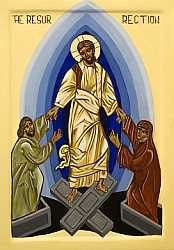
Ressurection IconThe Anastasis or Resurrection icon depicts Christ clothed in white, surrounded by a radiating blue capsule or mandorla (Italian for almond). To this point the icon resembles traditional icons of the Transfiguration. In the Resurrection icon Christ straddles the black abys of death standing on two sarcophagus lids. He is drawing Adam and Eve out of their tombs. With Christ, Adam and Eve are alive, they are resurrected.

Orthodox theology is very clear that this icon does not represent any historical moment. It does not depict that which no one saw happen, which no gospel writer describes. They all describe the death and the post resurrection appearances of Jesus. Luke describes the ascension. They tell of the empty tomb but not of the emptying moment.

Neither does the Resurrection icon depict any moment in history.

Leonid Ouspensky has written of the theology of icons. He writes of the Asastasis icon, “The unfathomable character of this event for the human mind, and the consequent impossibility of depicting it, is the reason for the absence, in traditional Orthodox iconography, of the actual moment of the Resurrection.”

Orthodox theologians describe this as a dogma icon. It is not about an event. Rather it is about a truth that interprets an event. Jesus Christ was crucified and on the third day rose from the dead and appeared to his disciples. In baptism Christians enter into Christ’s death and rise into his resurrected life. “The Resurrection of Christ is simultaneously also the Resurrection of humanity; the Resurrection is not only the Resurrection of Christ, but a majestic universal event, a ‘cosmic event’”. (Branos. Θεωρία Ἁγιογραφίας. pp.216,217., http://orthodoxwiki.org/Resurrection#cite_ref-12, April 2015)

Just as Orthodox iconographers set out to paint the image of truth about Christ, so the gospel writer, John, set out to tell in story form, truth about the resurrected Christ. We can set aside the historical veracity of the story he tells. It differs remarkably from other accounts.

We have been conditioned by Luke’s gospel to understand the transition of Christ from a man inhabiting our human existence through death, burial, resurrection, post resurrection appearances to the disciples, the ascension to heaven, and then the sending of the Holy Spirit. All very lineal. Suits our time bound existence.

Rudolf Bultmann suggests that the resurrected Christ in John’s gospel who appears to the disciples behind closed doors does so as the crucified, risen and ascended One. John has told the little story of Mary in the garden mistaking the risen Jesus for the gardener. 17 Jesus said to her, “Do not hold on to me, because I have not yet ascended to the Father. But go to my brothers and say to them, ‘I am ascending to my Father… ‘” (John 20:17). The crucified, risen and ascended Christ appears to the disciples, greets them with peace, breathes the Holy Spirit upon them, and sends them. Christ’s sending of the disciples is the same type of sending by which the Father sent the Son. The mission of God’s sending of Jesus is the mission of Jesus sending the disciples. The Church is the heir of Christ’s mission in the world.

Well, the gospel writers admit that this kind of stuff is a bit difficult to swallow. How are we supposed to believe such things? It is not difficult to imagine that there were members of the early Church that struggled with faith and doubt. The gospels suggest that it was ever thus from the beginning of the Church – from the beginning some took more time than others for the truth to click. Luke tells of two disciples who couldn’t get it at first even though they were in the presence of the risen Lord as they walked to Emmaus. Mark tells of those who are first told of Christ’s resurrection running away in fear and didn’t tell anyone. The gospels are up front. Paul nailed the issue when he wrote to the Corinthians, ‘For Jews demand signs and Greeks desire wisdom, 23 but we proclaim Christ crucified, a stumbling block to Jews and foolishness to Gentiles,…’ (1 Corinthians 1:22-23)

John puts the disbelieving problem on the shoulders of Thomas. He is the one who, for so many of us down the ages, has responded to the doctrine of the resurrection, “Prove it! – show me the evidence that the Jesus who was killed by crucifixion is the living and ascended Lord.”

A week later, John tells his church, Jesus appeared again and Thomas was there and the crucified, risen and ascended Christ invited a close inspection – a come and touch the evidence invitation. Thomas makes his declaration of faith, “My Lord and my God.” John doesn’t say if Thomas accepted the invitation to touch. Western artists such as Caravaggio depict him making an inspection with autopsy-like thoroughness.

Stylistically the inclusion of this bit of the story is a bit clunky. But it was important to tell the story because there was a body of opinion that suggested that either Jesus was not truly incarnate – he was a heavenly being who seemed to be human, or, he did not really die but seemed to die and was resuscitated. Dan Brown favours the second theory, hence the Da Vinci Code. He managed to keep the heresy alive in his block buster.

Some years ago I was at a cross cultural event in which church leaders from different ethnic origins shared something of their cultural and spiritual backgrounds. The Chinese presentation was impressive. Our colleague showed us video of the parts of the opening ceremony of the Beijing Olympic Games and he helped us to understand the richness of the history of Chinese spirituality told to the world in that display.

What we were hearing was so beautiful, so aligned with our Christian hopes for peace and harmony. One Anglo minister dared to ask the speaker, “So, why do you need to be a Christian?” His answer was quick and simple – “Because the Word became flesh”, he said. A murmur of ascent ran through the room – an ‘Amen’ to this profound expression of Christian faith.

John tells the story of Thomas and his struggle to believe because from the beginning John has said, “And the Word became flesh and lived among us, and we have seen his glory, the glory as of a father’s only son, full of grace and truth.” (John 1:14) And John asserts at the end of his gospel account that God’s word is with us in Jesus, that God is still with us in the crucified, risen and ascended Christ who breathed on his disciples and bestowed the Holy Spirit so that, in the Church, the Word still abides in flesh.

All the action is God’s. The disciples are given the encounter with the risen Christ. Thomas is given what he needs to cast doubt aside. Faith is never a work of human endeavour. Faith is God’s gift. New life in the crucified, risen and ascended Christ is a gift.

In like manner, those who paint an icon of the Anastasis, the Resurrection must take care that Christ’s hands clasp Adam and Eve in such a way that it is clear they are not holding onto him – he is holding onto them.

Adam and Eve in the Anastasis represent all humanity, all of us. The dogma captured in this image speaks of Christ reaching to us to draw us into his new life. This is not our doing. Like it or not Christ reaches out and holds us. His new life is his gift. Ours is the choice – to live his new life – or not.

5 April – Resurrection – too big a thought to think

View or print as a PDF

Easter Day
5/4/2015

Isaiah 25:6-9
Psalm 118
1 Corinthians 15:1-11
Mark16:1-8


In the reading we’ve heard this morning, Paul speaks to the Corinthians of “…[the gospel] through which you are being saved, if you hold firmly to the message that I proclaimed to you – unless you have come to believe in vain” (NRSV). He then goes on to give an account of a series of resurrection appearances, culminating in the appearance to Paul himself quite a long time after the crucifixion.

I want to focus this morning on that the final phrase: “unless you have come to believe in vain.” One scholar has recently put to this little line a sense which is especially useful for the task of thinking about thinking about the resurrection of Jesus: “…unless you believed without coherent consideration” [Anthony Thiselton (2000), The first epistle to the Corinthians: a commentary on the Greek text, Grand Rapids, Eerdmans]. I want, this morning, to pull apart what “coherent consideration” – or sensible thought – of the resurrection of Jesus might look or feel like, because sensible thought is not something which characterises most thinking about the resurrection, whether it is thought by those who believe or by those who don’t.

Now, when it comes to talk of the resurrection of Jesus, the question which presents to most people’s minds almost straightaway, of course, is something like, “did it really happen?”, and this question is, surely, fair enough! But, however hard we might think it is to answer this question, it is in fact at least as hard actually to ask it properly. Asking an honest and open question about the resurrection of Jesus may even verge upon being impossible for most of us, if not us all.

To recognise this we need to note two things. The first is that, whether or not we finally believe it to be true, the story of the resurrection wants to be an all-embracing, world-shaking, gut-wrenching, head-spinning, life-transforming proclamation. That is, it wants to make a difference, and a difference which goes right to the heart of our world and existence. It is the end, and the beginning, and so also the centre of the Christian story. If what we are talking about does not threaten to press in on us in this all-affecting way then it is not the resurrection of Jesus. But we’ll come back to this first point later.

For the moment we’ll focus on the second thing which makes it almost impossible to ask an honest question about the resurrection, which is that human beings are pretty bad at taking seriously anything which might matter in this all-embracing kind of way.

Let us try a thought experiment. Put aside for a moment any objection you might have to the possibility of resurrection and ask yourself an honest question: if it were the case that this happened – that Jesus rose from the dead – and you were somehow convinced of the fact of it, what difference would it make to you?

I put it to you that it would probably not make much difference at all. And the reason is, to put it rather bluntly, that we are much less interested in the facts than we think we are. I offer as proof of this the following. However well proven or not we might think the resurrection of Jesus is, let us consider some more familiar facts and their significance for us: It is established pretty much incontrovertibly that smoking is very bad for you, that drinking to excess is very bad for you, that narcotics and prescription drug addictions are very bad for you, that sexual promiscuity exposes you to all sorts of health risks, that driving too fast gets people killed, that too much salt, fat and sugar wreaks havoc with our health, that “the house always wins”, that predators of children get caught, that philanderers are exposed, that if we kill our enemies their children will want to kill us, that “populate or perish” has physical limits, that unrestrained consumption cannot be sustained, that we are running out of oil, that we are facing significant and possibly even catastrophic climate change, and so on.

AND YET, we continue to smoke, drink, treat our bodies as garbage disposers, gamble, speed, betray, kill, breed, consume and burn as if what we know about these things, in fact, is not the case. The point is that what we know – as a “fact” – doesn’t necessarily, or even often, make a lot of difference to how we act. Rather, we live “wishfully” – blindly – as if it won’t happen to us, or maybe only wanting it not to happen to us, imagining that our wish will change the order of things but deep down knowing all the while that it certainly won’t. I doubt that there are many, if any, who are free of this kind of self-delusion at some point (or many points) in the way they live their lives – knowing something which really should matter and yet living as if it were not the case.

Now, my intention here is not to moralise on human stupidity but simply to illustrate that it’s no easy thing to come to a real, honest conclusion about the claimed resurrection of Jesus – and any resurrection we ourselves might enjoy. If more or less irrefutable data on the effects of smoking or eating rubbish or drinking and driving or killing our enemies don’t convince us to change our behaviour, then do we really imagine that a “proof” of the resurrection of Jesus is something even worth pursuing?

The mere fact that something like the resurrection might have happened is likely to be, for us, neither nor there. The problem is that “facts” generally don’t really interest us. We are distracted by them, but they don’t really change us. We are less logical and rational than we might imagine, which matters when logic and rationality are the reasons usually given for dismissing the resurrection.

Or, perhaps more accurately, we are very often thoroughly rational, according to the way of thinking which most has us in its grip. The question is, what kind of thinking is it which pretends to trust science and logic to tell us most about ourselves or the world, and yet ignores the results of that research and continues in destructive behaviours? Our willingness to live dangerously in spite of what we know suggests that ours is, in fact, fundamentally a death-denying world-view. But if in this way we do deny death’s approach by risking or wasting our lives and resources, then it should scarcely surprise us that we are not interested in talk of resurrection. We live almost as if we don’t need resurrection, for death no longer concerns us. (This seems, in fact, to have been part of the problem Paul sought to address in the Corinthians to whom he wrote).

Now, the point of this diatribe is simply to establish this: that the question about the resurrection of Jesus – our typical “did it really happen?” question – is rarely an open or honest one. That is, we simply aren’t able to take seriously a “yes” answer, and so the more common “no” answer doesn’t really mean anything either. We might be able to force ourselves to believe, or we might be persuaded by historical evidence and arguments (of which there are many), but this is really no further advance on not believing. We’ve not felt the anxiety at which talk of the resurrection is directed, or the anxiety which it ought to produce.

To get back to Paul’s little, throw-away line: it is possible to believe, or not believe, “without coherent consideration”, without sensible thought. More than possible, it is typical that the resurrection is believed (or not) in this way.

And so, for example, it is typical that when we say the creed many people will feel uncomfortable or uncertain at the mention of the resurrection of Jesus and the more general “resurrection of the dead”. More than that, many will fall silent at that point, and pick it up again a little later.

Perhaps it is appropriate to fall silent at that point, but not because we’re unconvinced of the facts. We ought to hesitate to declare too loudly that Jesus is risen just because it is too big a thought to get our head around, let alone to adjust our lives to. We ought to hesitate here because, if he were truly risen, it would not only mean that a marvellous thing “happened”; it would make death more serious a matter – for sensible, coherent talk of resurrection only makes sense when death is a real and present reality.

I suggested before that we are basically death-deniers. We live our lives in such a way as to imply that death doesn’t really impinge upon us. We don’t really think that our abuse of our bodies by way of what we put in them will make a difference in the end; we don’t really think that our consumption of resources will make a difference to us or the environment in the end; we don’t really think that the impact of our lifestyle upon others in our society or on the other side of the world matters that much. If we did think that such deathly things mattered, we’d stop, or at least try to change direction, or at the very least confess that we are stuck and can’t really do anything to change ourselves or the lot of others. This would at least be honest.

And we should be honest, and brave, and choose not to suffer the fool who lives in us all. If Jesus’ resurrection is anything that is truly interesting – truly worth saying yes or no to, then our question about whether or not it “actually” happened is really neither here nor there, or at least not the place where we must begin. In our approach to the question about the resurrection of Jesus – if we are to be honest – perhaps we should start with ourselves. Perhaps we should ask not “did it happen?”, as if the answer would actually make a difference. Rather, perhaps we should ask: do we not need the resurrection of Jesus to happen? Do we not need such a thing to expose the truth about ourselves and the way we live – in the presence of death and yet denying it? Do we not need a call to a life which is not simply a covering-over of our impending death but an incomprehensible shattering of that death and the insidious hold it has on us, even as we refuse to acknowledge it? Do we not need to be prompted into “coherent consideration” and sensible thought about what it means truly to be human – honest, alive and free?

I confess that I do, at least. For I live as if life did really not matter, which is to say: that it is not much different from the death I do not acknowledge either. And so, for the sake of making sense of the life I live and the death I will die, I declare: Jesus is risen, to the glory of God, and that we might truly be ourselves. “This is the LORD’S doing, and it is marvellous in our eyes” (Ps 118). So let us rejoice and be glad in this good news. Amen.

3 April – The cross as throne

View or print as a PDF

Good Friday
3/4/2015

Isaiah 52:13-53:6
Psalm 40
John 12:20-33


Many of you will know the ancient Greek myth of Oedipus. It has come down to us in a number of versions, but generally runs something like this: Oedipus is born to the king and queen of Thebes. A prophecy is spoken over Oedipus, that he will kill his father and marry his mother. To thwart this, the child is left out to die but is found and is adopted by the king and queen of Corinth. Once grown up, Oedipus accidentally finds his way back to Thebes were he kills his birth-father in what was perhaps the world’s first road rage incident. Oedipus does not know that it is the king or his father, and no one else knows who killed the king. Oedipus then rids the city of an ongoing burden and threat, and receives as reward the hand of the widowed queen – his birth-mother – in marriage, who bears him a number of children. Eventually, however, everyone discovers the unwitting patricide and incest. Oedipus’ mother hangs herself, and Oedipus gouges out his own eyes and is exiled with the children (half-siblings) he had by his mother-wife.

It’s a story with something for all the family! For the Greeks it was about the unavoidability of fate, and modern depth psychology has made much of it in relation to family dynamics, but the important part of the myth for our purposes this morning is, first, that Oedipus kills his father and marries his mother not knowing who they were and, second, when these things are discovered to have taken place, the whole story is revealed as a tragedy: death and destruction and exile are all that can follow.

Of course, the death we gather to recall today is the death of Jesus. Yet I suspect that this death is heard by many to be a tragedy along the lines of Oedipus: the irony that Jesus was king of Israel, and yet Israel unknowingly crucified its king. Certainly the church often “sells” the story in this way. I want this morning to unpack a different sense of what happens in the death of Jesus, and why we gather for no mere tragic or ironic memorial but for “Good” Friday.

In our gospel reading this morning Jesus speaks of his approaching crucifixion as a “lifting up”: “And I, when I am lifted up from the earth, will draw all people to myself” (v.32; cf. John 3.14f; 8.28). It’s easy to hear this as a euphemism – a way of referring to the impending disaster of the crucifixion without actually naming it for what it is, a way of softening the blow for Jesus’ hearers.

Yet there is much more going on here than mere euphemism. The evangelist John loves double meanings and the ironies which come with them. The Greek word behind “lifted up” can certainly apply to being lifted up on a cross. At the same time, it can just as naturally be used for that kind of elevation which is an enthronement. A king’s coronation could be said to be his “lifting up”. This double meaning is suggested again later in the gospel when Pilate nails to the cross the charge against Jesus: “the king of the Jews” (19.19-22). Here is another of John’s ironies – and he intends us to note and to understand them. Pilate seeks to mock Jesus, or mock the Jews, yet in the evangelist’s mind Pilate unknowingly declares to all the world Jesus’ true identity.

We miss the point, however, if we read this as simply telling us that Israel unknowingly crucified its king in the same kind of way that Oedipus unwittingly killed his dad and married his mum. In the crucifixion it is not so much that a king is killed in tragic and ironic circumstances but rather that a king is created, or a particular kingdom comes into being. The ambiguity of “lifted up” allows John to present Jesus to us as both being crucified and enthroned, being crucified and being made king, in this “lifting up” in the crucifixion. Not a king mistakenly or unknowingly crucified, Jesus is the king because he is crucified, he becomes king in his very being crucified. His kingship takes its character not from what he should have been recognized to be before the crucifixion but from the fact that he has been crucified. It is as if the Son of God is not the Son of God for us, not our king, until he is crucified. Why? Because we are those who would crucify our king (cf. John 19.5), such that only a crucified king – a crucified God – could be our king, our God.

So it is that, for John’s gospel, the crucifixion is much less of a catastrophe than it is for the other gospels. For the crucifixion is the point at which the nature of God as faithfulness is laid forth for all to see: here the full extent of God’s reign – God’s kingship – is revealed. This is a kingship not abstractly over “all”, but specifically over those who crucify Jesus. Jesus is only king to those who would crucify him. (We approach again themes visited a few weeks ago [March 15]).

Just to reinforce this point, we should note one other way Jesus refers to the crucifixion in this morning’s first reading: “The hour has come for the Son of Man to be glorified” (v.23). The language of “glorification” here applies also to the cross, as it does elsewhere in John (cf. 12.16; 13.31f; 17.7). The glory of Christ is seen in the crucifixion. The glory is not the resurrection if that is understood as an event separate from the cross. In the crucifixion we see something about the nature of God which the resurrection by itself cannot show: a vision of God in which God’s very being – God’s very glory – is tied up with his relationship to a people which falls short of his covenant call. God’s tying of himself to his broken world goes to the very heart of what God can be, and must become; this God, this king, bears the marks of crucifixion, because we – the crucifiers – are his “subjects”.

[ASIDE: John would say to us, then, not merely that “God is love” or that “God so loved the world”, if by that is meant that God could otherwise stand aloof but in fact condescends to forgive. Rather, God is as God loves. God is the way in which he loves. This forces our language and our thinking to a strange place because a “thing”, God, becomes an action, love. It is as if a singer were to become the song. We have to say, then, not that God is “love”, as if these were two separate things we simply join together, but that the love of God is God – how God loves is itself God. Jesus upon the cross is truly Word-become-flesh, God meeting us at our lowest yet – and this is the critical point – remaining, even “becoming” God in that meeting.]

To put it differently, we might say that the gospel is the impossible proclamation that the greater the distance we place between ourselves and God, the more strained our relationship is with God, the more clearly we see God’s freedom to be God for us through all obstacles, even such a death as the cross. It is as if God becomes more “God” as we become less godly, as God overcomes the distance – overcomes the cross – that he might again be life and love for us.

Here we move within the theme of the faithfulness of God. God’s faithfulness takes its meaning from God’s response to the unfaithfulness of God’s people. That God is faithful, and that this faithfulness concerns keeping a promise of good things for God’s people, is at the heart of the biblical witness. That Jesus can be both crucified and enthroned in a single act is the meeting of our unfaithfulness with God’s faithfulness.

The God with whom the church deals is always the crucified God, because the church is composed of those who crucify, even God. And yet because God still wills to be our God, the crucifixion becomes an enthronement: the kingdom of the crucified God is a kingdom over crucifiers.

This is good news. We are those who lift Jesus up upon the cross, but not with the tragic consequences of Oedipus: exile in horror unto death. For the death of Jesus is as much God’s act as ours: the enthronement of Jesus as king over those who crucified him, that we might not be lost; even with that as part of our history, we remain his.

We cannot fall outside of God’s desire to be God for us, to heal and to restore even us. In the crucifixion we are named and judged, and forgiven and owned. And so we remember not the tragic fate of a good man, but a goodness which subverts and overcomes the ironies and tragedies of human existence: the very faithfulness of God who will not let us go.

And so, we call this not Tragic Friday, as if it were the symbol of human weakness and the dark necessities of fate. It is Good Friday because, unlike what was tragically inevitable for Oedipus and his family, here the tragic is swallowed up. Any choice we might make for death in our lives or in others’ is put behind us in the one death which really matters: the death in which death ceases to be only our end and becomes a new beginning in a relationship to a new kind of king, a new kind of God.

For this surprising, life-giving end to the tragic human story, all thanks and praise be to God, Father, Son and Holy Spirit, now and always, Amen.

22 March – This is how God loves

View or print as a PDF

Lent 5
22/3/2015

Jeremiah 31:31-34
Psalm 51
John 3:16-21


I bought a violin on Friday. Not that I can play the violin – yet. But, for reasons quite obscure to us, Coulton has wanted to learn the violin since he was about 3, and we figure that now is about the right time to start, and I’ve offered to learn with him as some encouragement along the way. Buying violins is not a straightforward thing. You have to talk to people who know something about them, research what is available, and where, and in what condition. You can learn all sorts of things via YouTube reviews of the instruments – what to look for, why it’s better if the instrument if professionally modified from its factory condition, and so on. In the case of my new violin – it came up on Thursday on Gumtree, and looked a pretty good deal. The problem was that it was in Geelong – amounting to probably a three hour return trip, all up. I contacted the chap offering it for sale, and he didn’t want to post it but would be happy if I arranged a courier. So I contacted a courier, and that wasn’t going to cost too much, so got back to the seller to arrange an electronic transfer and the courier pick up. It turned out he then needed to be in Melbourne on Friday, so I upped the offer a bit if he’d deliver it, which he did, and I have my violin. (Coulton doesn’t have his yet!)

Why am I telling you all this? Now that I’m a parent, it is becoming increasingly clear to me just how much parents do for their children, if everything is working the way that it should. Most of the time a child has no idea what is involved to make happen the things which make her life a happy one. But occasionally she’ll hear, especially is ingratitude is present, Mummy and Daddy loves you so much that is this what they have done for you. Of course, it is almost impossible that the child can understand what in fact has been done, but still it is the case: love does “so much

Which brings us to today’s gospel reading – re-visited from last week – and the first verse in particular: “For God so loved the world that he gave his only Son, so that everyone who believes in him may not perish but have eternal life”. This is one of the Christian texts: printed on T-shirts and bumper stickers and baseball caps, appearing on placards in crowds at major sporting events: it sits somewhere near the perceived centre of what needs to be said in evangelism.

“For God so loved…” Is the way to salvation the same kind of way as that by which a boy comes to learn the violin – that so much is done, which then has to be “believed” or received?

I want to propose this morning a reading of this verse rather different from the way in which the church has generally heard it, thinking through three crucial parts of the verse: first, the so which seems to carry most of the weight of emphasis (God so loved the world), then the giving of the Son and, finally, the belief we are to have in response to all this.

1. For God “so” loved the world.

It is difficult not to hear this as “so much” – so much, so big, was the love of God, that he gave the Son. In the background here is the love we have for our children and the cost it would be to us to give them up in this way. (Perhaps also, the story of Abraham’s sacrifice of Isaac also sits behind this text). And yet even though this is the sense the English suggests, it is not what the Greek implies. In the Greek, the “so” is the first word in the sentence, giving it more the sense of “thus”: Thus, or this, is the love of God: God gave the Son. The difference is subtle, but very important. If I say to Coulton – this is how much we love you, that we did all this that you might have a happy experience with the violin, his response might be, But couldn’t you have got an even better violin with a bit more effort? The “so much” implies the possibility of even more – that God has paid enough – even more – than necessary, but not necessarily everything. Here the love of God is quantified, measured: this is how much God loves you; is it not impressive?

But if we read the clause as “This is the love of God” then we are not dealing with a quantity of love which might have been smaller or even bigger but the very content of love itself: love is the giving of the Son. We’ll come back to this again in a bit.

2. God gave the Son

What then, of the second thing to note in the verse, the giving of the Son? In most Christian thinking, this touches upon the theme of sacrifice: God sacrifices the Son, trades the blood and life of the Son for the salvation of the world. This understanding is both dearly embraced by some Christians and abhorrently rejected by others. On the part of those who embrace it, there is in the background the “so much” understanding we’ve just be considering: God has sacrificed even his Son for us. On the part of those who reject this idea there is, among other things, horror at the idea of sacrifice itself, let alone of sacrificing a child (in this era of heightened sensitivity to the abuse of children). The idea of sacrifice is made all the more difficult in those understandings which insist that God had to sacrifice the Son: that there was some kind of “deep magic” which forced God’s hand in this way (see an earlier sermon on this: here). It is difficult to overstate how thoroughly ingrained this way of thinking is in the way the church speaks about the saving work of Christ. Explaining why the New Testament speaks this way about the cross would take more time than we have now; suffice it to say, the “giving” of the Son is not a sacrifice, if by that we mean that it would necessarily work in the way religious sacrifices are normally thought to work, that somehow we or God met all the requirements and sinners are automatically sprung from judgement.

In what sense, then, does God “give the Son”? We can say that God “presents” the Son. This the love of God for the world: the Son. This is perhaps a little dense to be immediately clear, but it is the heart of the matter. For “the Son” is for us always the crucified one – not the “sacrificed one” – but the crucified one. Again, the difference might seem subtle but it is everything. To understand Jesus’ cross as a sacrifice is to interpret it in terms of first century Jewish understandings of the ritual animal sacrifices in Temple, which makes perfect sense if you are a first century Jew. We today do not have – or rather, we do not acknowledge that we have – a corresponding system of sacrifice securing our religious and secular lives. And so, if we are to interpret the cross as a sacrifice, we have to become first century Jews before we can become Christians. This is what St Paul rejected in a different form when he denied that uncircumcised male Greeks needed to undergo the cut in order to become Christians.

Jesus cannot be for us “the sacrificed one” in the way he could be for those who first heard his story. But he can be for us “the crucified one”, interpreted in a different way. Christians are so accustomed to the theory of an economy of salvation in which something has to be sacrificed that it is difficult to apprehend the story in a different way. But there are other ways. The sacrifice interpretation requires that Jesus came in order to die – that this was what the Father who sent him required. But this is not the sense we get from John’s gospel. Here, Jesus comes precisely to live – to be Word made flesh, to be Life and Truth in all their fullness. Jesus does die, but not because it was somehow demanded by God. If anyone demands his death, it is us: contradicting Jesus’ purpose as the Way, the Truth and the Life. The religious authorities require that Jesus die because he threatens the peace and may invoke the wrath of the Romans (John 11.48-50,18.14). The Roman governor Pilate, who initially tries to get Jesus off, finally also sees the political risk Jesus represents and decides that saving him is not worth the trouble (John 19.12f). And so Jesus is crucified, but not as a “sacrifice”; he dies because the capital-L Life he lived was too confronting, too threatening of human self-righteousness. On this reading, the Son – Jesus – is not given to be crucified; the crucified Son is what we are given. God says: Look at this. God asks, What, Why, How has this come to pass; what shall we say about it?

On the sacrificial reading, the un-crucified Jesus appears as a kind of currency in a sacrificial economy. The cross is a kind of “spending” of that currency: an exchange of Jesus’ life and blood for ours. The fundamental problem here is that we have to believe in this economy of salvation before we can believe in Jesus.

On the “presentation” reading – that God “presents” the crucified Son to us – we are back in the realms of last week’s reflection: that the cross symbolises something about our heart and the heart of God. John’s gospel is concerned with a “Word” – a Word enfleshed. This Word becomes what we are; the question is simply: what, actually, are we? At the end of his gospel John has the Roman governor Pilate present Jesus to an angry crowd with the words: Behold, the man. The sense is more, Behold: the Human Being. Here is the human being – his humanity and ours – and this is what is crucified. Jesus, then, dies not only (or even?) “for” us, but as us; it is us on the cross, our true humanity being broken by broken humanity.

This is too much to think through here, but it is the kind of thinking which springs forth if we allow that God’s love is not a divine Son given for us but a crucified Son given to us: a revelation which effects something rather than something effected which is then revealed.

3. So that everyone who believes

For the sake of finishing within a civil time frame, the third crucial aspect of this central Christian text: “so that everyone who believes in him may not perish.” What is this “belief”?

On the traditional reading, “believe” means here something like assent as the appropriate response, and receiving salvation in return. This is not unlike the case of little boys and their violins, where “believe” looks like taking up the bow and doing whatever it is you call what a little boy does with a violin: the “so much” of the gift received requires this response.

But on the alternative reading we’ve been unpacking, “believe” is quite a different thing altogether. This is the love of God: the Son. The crucified Son, and no other. The crucified humanity of the Word-made-human. Humanity brought to nothing by humanity. Here, “believe” means recognising ourselves in all dimensions of the story. It means seeing ourselves as the cause of the cross, and as the victim of the cross, and as the beneficiaries of the cross. The giving of the Son is not a “buy-back” scheme; it is the revelation of God’s heart for us, and of us as God’s heart.

We noted in passing earlier that it is closer to the dynamic of God’s work through Jesus to say that God’s love is the giving of the Son, rather than is shown by the giving of the Son. This is the love of God: the Son, crucified, restored to life. The cross and the resurrection are God’s story, are God as love, and are given also to be our story.

To believe in this God is to receive this love as our own. It is to grow into a humanity formed after the likeness of Jesus, the Son. It is to become love, as the children of God, and to participate in God’s great work of love in the world.

This is not easy. We begin with this story as we might begin with a violin for the first time – barely possible to hold let alone to get anything like music from it. But the promise is that, in continuing to hear the story and to tell it, it will increasingly become part of us, as the instrument becomes part the musician, the one enabling the other to express, and to be.

Let us, then, open ourselves to become love as God is love, harmony to the song God sings, to our greater humanity and, what is the same thing, to God’s greater glory. By the grace of God. Amen.

15 March – Salvation’s sinful form

View or print as a PDF

Lent 4
15/3/2015

Numbers 21:4-9
Psalm 107
John 3:14-21


Some of you are probably familiar with Yann Martel’s “Life of Pi”. This is the story of young Pi Patel who finds himself the sole survivor of a shipwreck, with the exception of a 200 kilogram Bengal Tiger, with whom he shares a lifeboat for 7 months!

It’s an extraordinary story but, without giving the story away, at the very, very end there is a twist: young Pi presents us with an equally extraordinary but now appalling alternative account of what happened during those 7 months.

The real twist, however, is what is done to the reader. Having been given the alternative account of events, it is then left to us to decide which account to choose. On the one hand there’s the almost-but-not-quite-plausible story with the tiger, and on the other hand the equally extraordinary but in fact horrendously plausible alternative. Pi asks: which story do you prefer – the implausible one with the tiger, or the plausible but horrific one without?

With the characters in the book to whom the two accounts are given, we have to decide between the stories. And our view of the world and our humanity in it are both at stake. We have to decide whether to go with what doesn’t quite make sense but if true would just be an interesting story, or to go with what does make sense but would scare the “bejesus” into us, for it is a horrifying alternative. This is a decision about what the world is like: are people actually capable of such things? It is essentially a decision about involvement: has this story anything to do with us, in a fundamental sense?

As it is for Pi in his boat, so it is for Jesus on his cross: what actually is happening here? Is this a story external to us, or is it somehow also our story? If it is somehow our story then it involves us, and could possibly be a saving story – a story actually worth telling, more than mere amusement.

What, then, is happening at the cross? We take our lead from the first line of the gospel reading this morning:

…just as Moses lifted up the serpent in the wilderness, so must the Son of Man be lifted up, that whoever believes in him may have eternal life.

The “lifting up” Jesus refers to here is his crucifixion. (This way of talking is peculiar to John; see also 8.28; 12.31-36). Jesus draws a link between the cross and the lifting up by Moses of a bronze serpent on a pole, as described in the strange story we’ve heard today from the book of Numbers (Numbers 21.4-9).  Having left Egypt and while still wandering around in the desert, the people of Israel began to complain bitterly against Moses and God for how well things were not going. In response, God sends snakes among the people with disastrous effect. The people repent and call out to God through Moses. Moses makes a serpent of bronze, places it on a pole and sets it up so that any person who was bitten could look upon the image and be healed.

It’s an odd story to modern ears but our purpose here is not to debate the could- or couldn’t-haves of the story. We are trying to understand how the story tells us about what is happening in the crucifixion of Jesus. How can looking to the cross be a saving thing, as looking at the bronze serpent saved? The critical thing in this connection is that the source of the healing takes the form of the sign of the sin.

The serpents are sent among the people as the sign of the broken relationship with God and his servant Moses. But this sign then becomes the means God gives by which the people are saved. God gives both the punishment and the healing, and the healing sign reflects the sign of the sin. The sign of the people’s sinfulness is what God then presents to them as the means of their salvation: forgiveness is not forgetfulness. I must recall what I’m being forgiven because the forgiveness comes in the shape of the sign of the sin.

Taking this lead, we can get a better sense of what John would have us believe “really happened” in the “lifting up” of the crucifixion. “Just as” Moses lifted up the snake, so also Jesus is lifted up. “Just as” with the bronze serpent God uses the sign of sin as the source of healing, so also we are to read Jesus’ death as the sign not only of divine healing (as the text suggests) but also of human sinfulness. The crucified Jesus can be the location of the healing because the crucifixion is the sign of the people’s failure. The cross of Jesus only saves us if it is also the sign of our failure.

Having declared that this is the true accounting for the crucifixion of Jesus, Scripture simply waits for us to decide: which version of the crucifixion story do you prefer? Is the cross simply what happens too often in human history – the tragedy of the hero who is crushed in the machinery of human brutality, one more incidence of “man’s inhumanity to man” as we said in the old money. Certainly it has been read often enough that way both in and out of the church.

Yet we have no real investment in such a reading of the story, other than it being a kind of moral lesson. It might inspire us or frighten us, but it does not really involve us.

The bronze serpent connection, however, invites another reading: if the bronze snake takes the form of the sign of the sin, then the same applies to the cross. If the cross is the healing thing, it also indicates the sin itself: the very crucifixion. Who is saved by Jesus on the cross? Not “everybody”, in a bland, generic sense, but those who put him there. It is the body broken by us which, by the grace of God, is the body God gives for us. Are we – us personally, not humanity in general – capable or even guilty of such things?

The principal difficulty with this understanding is that, for it to be true for us, we have to be the destroyers of Jesus in order to be those who are reconciled through his cross. As with our assessment of a story about a tiger in a lifeboat, so also here – we have an investment in our decision about the cross: what are we like?

But, framed in this way, this is an impossible thing to judge, for how do we know what we are like?

In fact, there is no knowing this before we choose how to account for the fact of Jesus’ crucifixion. This is because there is a difference between the stories of the serpents in the desert and that of Jesus. In the desert the people suffer for their sin and cry out to God for healing. The sign of the snakes is interpreted by them as an obvious sign of sin, and this recognition precedes the experience of healing. The people cry out for healing because they have recognised their failure: “we have sinned.”

This is not something a Christian can do because with the crucified Jesus it is the other way around. Unlike with the snakes and the bronze serpent, no one is aware of the true sinfulness of the crucifixion until Jesus is presented back to them in the resurrection as saviour. The resurrection does not leave the cross behind, but gives it back to us as our fundamental involvement in the story of God with his people.

This leads to an extraordinary conclusion: only the one who believes on the risen Jesus knows what it is to sin against him. With Jesus, knowledge of sin follows belief, and does not come before it. This is why our prayers of confession generally follow the proclamation of the gospel. We don’t believe in Jesus because we know that we are sinners; our sense for sin comes with our faith. This being the case, perhaps some sections of the church ought to talk less about sin, not because it doesn’t matter but because it can’t make gospel sense until Jesus arrives as liberator.

For God sent the Son not to condemn but to save, not to tear down but to build up, not to terrorise but to set at peace (3.17). The love of God for the world is a work which takes our having put Jesus on the cross – then, or in some like fashion today – and makes of that failure a benefit for us.

Those who believe come to the light (3.21) because their works are always seen in light of the fact that God has loved them even to the cross.

There is life here, and good news. It is not so much the freedom to be wrong as the confidence that, no matter how wrong we get, it is not beyond redemption in the hands of this God. And our work is to become like God in this respect – giving, forgiving, serving – that the way of God might increasing become the way of God’s people.

Let it be so.

May God bless us with greater understanding of how deeply we are loved, that we might become better lovers in return, for Christ’s sake. Amen.

8 March – Tear down this temple

View or print as a PDF

Lent 3
8/3/2015

Exodus 20:1-77
Psalm 19
1 Corinthians 1:18-25
John 2:13-22


Church spires are not what they used to be.

This is the case, at least in the sense in which our own church tower has developed its own expensive and potentially dangerous little lean! More importantly, it is the case in the fact that towers and spires have been not merely overshadowed but dwarfed by the kinds of buildings we construct today. Whereas once church spires spoke across a whole landscape about what was central and what was peripheral to life, today they are lost in the midst of the dynamics of modern corporatism and the way in which that is shaping our cities and our lives: higher, denser, more. Whereas once the church tower stood out as a marvel of human engineering, a great arrow pointing to the eternal, now those same towers are relativised – one more (usually quaint) construction among many signifying one more “option” in the world.

This shift matters for our making sense of John’s account of the clearing of the Temple in our gospel reading this morning. This is a story very familiar to long-time Christians. Jesus gets angry here – no mere “meek and mild” saviour today – and this sticks in our minds. It is heard around Easter every year which, if we are paying attention, ought to be a little surprising – at least when we hear John’s version of the story. Whereas Mark, Matthew and Luke place the story at the very end of Jesus’ public ministry – which is why we hear it each year in Lent – John places it at the very beginning of the ministry, which is up to two years before Easter, on John’s own time line.

Easter is still present in the reading – in the reference to Jesus dying and rising – but it is no longer the immediate context. If it is the case that this is the same event the other gospel writers describe, and that their timing at Easter was correct, then John has deliberately unhooked the story from its position as a kind of climax of Jesus’ conflict with the religious authorities and moved it to the beginning of the gospel as a kind of programmatic statement. No longer is it what everything came to, but a foretaste of what everything was always going to be.

And what is being “tasted” here right at the start? Not only has John changed the location of the story, he has also shifted the emphasis. In the other three gospels the emphasis is what we might call moral: the attack is on the market itself and, implicitly, on those who have allowed it to happen. The Temple has been corrupted, so that we sometimes speak of this as the “cleansing” of the Temple.

In John’s account something of that moral dimension remains: “Take these things out of here! Stop making my Father’s house a market-place!” But then the emphasis shifts in Jesus’ remarks about tearing down the Temple. “I will build it up in three days” can make no sense, of course, although John is very happy for his Jesus to make no sense. Or, rather, John likes to have those Jesus’ talks to take him literally when he can only mean something more figurative. But, John’s technique aside, his point is clear: the object is not the cleansing of the Temple but its replacement. Forty-six years in the making and still not finished, the Temple is nothing compared to Jesus himself. It is no wonder that he makes no sense.

And for us today? Our problem is that we know the story so well. We know, in a way that first century Jews could not, that church buildings are not “churches” or temples. We all know that “the church is the people.” And so the church has no shortage of people who take up the role of Jesus and preach “Jesus, Jesus, Jesus” or “people, people, people” against the spires and the windows and the organs. Over against them, of course, are those who have also read the story but see great value in bricks and mortar.

For our purposes here, however, the point is that as difficult as the conversation can sometimes be it is not especially shocking to us – not shocking in the way that Jesus must have been in this exchange with the Temple authorities. In fact for them it is beyond shock – they can only ridicule him.

Perhaps it is the case that we are not shocked in the same way he was because church spires no longer dominate the landscape: our temple is too small.

What I mean is this: the church, and what it represents, is no longer big enough for us to be shocked by the idea that Jesus might somehow replace it. For Jesus to refer to himself as the Temple in front of the Temple authorities was to compare the nothing of a back-block boy to the everything which the rebuilding of the Temple represented. As we discuss whether to sell a building or repair it, or think about reforming the denomination through a strategic review, it is all a bit too small because, should the wider world be overhearing these conversations, they will seem all very in-house. With the relegation of churches and their towers to mere addresses on busy streets in the midst of much more imposing structures, so are the perceived concerns of the church relegated. “Religious” concerns, as the business of the church is categorised, are too small really to matter, for “religion” is only a part of what we are as a society today.

If they are to be of the order which John suggests the very person of Jesus was for the Temple in that time, then attacks on temples today cannot be “religious” in the narrow modern sense. That is, the temples which matter, against which the claims of Jesus might be measured, will not be churches and their spires or budgets. They will be those things which somehow represent “the whole” for us as a society.

And so the question is: what is Temple-like in our worlds today? What keeps us awake at night, or makes the hair on the back of our necks rise, or will cause uproar in the Twittersphere, or bring down a government, or take us to war? Take any one of those things and fit them into this declaration: Tear it down, and I will build it up again in three days. Tear down this economy, and I will build it up in three days. Tear down this nation-state, and I will build it up in three days. Tear down this family, and I will build it up in three days.

If Jesus is the Temple, in his exchange with the authorities, then he is our “everything’ too – but also cannot possibly be. How is Jesus the economy, which so fills our news reports, or the nation with its sovereign borders we fight so hard to secure, or the ANZAC tradition we think so thoroughly defines what it means to be Australian, or the one thing I think is breaking me, or making me? He cannot be, in the same way in which he could not have been that magnificent Temple. And yet, if he is not, then he does not finally matter – just a religious part of a whole with many parts, none of which is essential.

I do not think that God really minds that much about temples, towers, borders, economies, traditions. These are the things which people do and, loving people as he does, God can love these things as well. But they become for us so much more than “things”. An idea, an identity, a relationship, a possession – all such things are “temples” in the sense of our text this morning.

But tearing them down also gets us nowhere; every revolution replaces what is destroyed with much the same thing. The same arrogance and hubris which often drove church spires higher and higher into the sky now drives the skyscrapers higher and higher. Temples will be ever with us, even if it no longer looks as if prayer is their principle purpose.

The story that Lent tells is that there is really only one Temple which is worth tearing down: the one which so incomprehensibly challenges all the others. This is the Temple which is most problematic, Jesus says.

And it is torn down.

Is it rebuilt on the third day? This is the question the proclamation of the resurrection presents to us: not the dead-end question of whether a dead man can stop being dead, but whether we might be cured of our temple-building, of making sacred things out of merely created stuff. Our reading this morning stopped a little short of the end of the chapter. In the last couple of verses we read: “…Jesus on his part would not entrust himself to them, because he knew humankind and needed no one to testify about anyone; for he himself knew what was in the human.” What is in us is many things. It is the good which brings God to us: “for God so loved the world” that he sent the Son. It is the dangerous in us which brings about the crucifixion: do you not know that it is better that one die than that we lose all our “place” – this Temple, and all the rest – the high priest will later ask (John 11.48-50).

The gospel is that, in the midst of all our extraordinary capacity to attach so deeply to the secondary things, and in the face of the devastation that brings, there is a promised rebuilding. This Word becomes flesh and fills it out – the very presence of God in the mundane and ordinary, whatever shape it takes. When we break the bread and take the cup this is the story we tell: whatever we do – even the crucifixion of the Lord of glory – God can work with that.

Build it up, tear it down – God has our measure, knows what is in us, and will make it work. There is great freedom in this: to have without being weighed down, to give without fear of not receiving.

May the people of God ever grow more fully into that freedom, that all people might know the life which this God promises.  Amen.

« Older Entries Recent Entries »