
Category Archives: Sermons

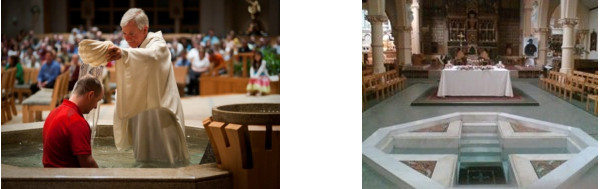
12 January – Who baptized Jesus?

View or print as a PDF

Baptism of Jesus
12/1/2025

Acts 8:14-17
Psalm 29
Luke 3:15-22

Sermon preached by Rev. Dr Peter Blackwood


The baptism of Jesus was a job lot. I know that sounds shocking but there it is, at least according to St Luke. Not only that but the celebrant at the baptism of Jesus may or may not have been John the Baptist. It probably was because John was the only known registered Baptist, but who knows, registers being as they were so long ago. John the writer of the gospel according to St John seems to have a clearer idea about the baptizing team. He says that Jesus and his disciples and John (the John we know as the Baptist) were baptizing out in the desert at Aenon near Salim because there was a lot of water there. John’s gospel does not have John baptizing Jesus. John’s gospel makes a clear distinction between water baptism as performed by John and holy spirit baptism as performed by Jesus. Sorry to bring up these anomalies but I find them interesting, so it is fun to inflict them on a captive audience. I promise to try to make sense of this later.

Today’s gospel is from Luke so let’s concentrate on him.

Luke says: “Now when all the people were baptized, and when Jesus also had been baptized and was praying, the heaven was opened, and the Holy Spirit descended upon him in bodily form like a dove.” (Luke 3:21-22)

Add to that the verse that precedes that statement where Jesus’ baptism is simply lumped with all the other baptisms. It looks like John was in prison at the time – “But Herod the ruler, who had been rebuked by him because of Herodias, his brother’s wife, and because of all the evil things that Herod had done, added to them all by shutting up John in prison.” (Luke 3:19-20) John’s gospel disagrees with this. In that gospel the Baptist is not in prison yet.

With all this confusion the church through the ages has taken its lead from Mark and Matthew on this point. They are clear that John baptized Jesus in the Jordan River. John was reluctant and only baptized him on Jesus’ insistence.

It is not unusual for various accounts of the same event to look different through different eyes and different politics and philosophies and theologies. But it looks to me as if all of them are grappling with an embarrassing issue for the early church. All the gospels agree that Jesus was baptized, although John leaves out the bit about water. The problem is that all agree that for the Baptizer, baptism was about repentance. Now, if the gospel professes that Christ was without sin and therefore had no need to repent, then, what was Jesus’ baptism about? That is a question for systematic theologians. My interest is how these accounts of Jesus’ baptism have had an impact on the church’s practice of baptism through the ages.

The main point of agreement between all the gospel writers regarding baptism is the bits about sin, water and Spirit. To deal with human sin each sinful person needs to do something about it. That is where repentance comes in. The person’s faith community needs to do something about it. That is where the water comes in. For any outcome to be effective, God needs to do something about it. That is where the Holy Spirit comes in.

From earliest accounts of the liturgical life of the church these components have been essential to the celebration of baptism. Ancient testimony tells of catechumens, converts who have undergone instruction in Christian teaching were baptized in a river on Easter Day. They repent then passed from one bank to the other but in the middle a deacon immersed each into the water three times in the name of the Holy Trinity. As they emerged on the other bank the bishop laid hands on their heads praying that they receive the Holy Spirit.

In time, as episcopal regions grew larger so that the bishop could not be on the bank of every river where deacons were performing their part of the ritual, the act of laying on of hands was delayed until the bishop could visit each local church under his charge.

The essentials of this ancient ceremony survive in baptismal liturgies today. Fonts and baptistries have symbolically brought the river into the church. The practice of infant baptism has moved and stretched the components of the ritual. Instead of instruction followed by water then laying on of hands it has been common in western denominations that practice infant baptism for the water followed by instruction then repentance and laying on of hands at confirmation. In episcopal churches the confirmation is still the prerogative of the bishop.

The laying on of hands can look like a bit of an add-on. Indeed, it is and always was. In Acts Luke maintains a strict separation between the water bits and the receiving the Holy Spirit bit. In Acts chapter 8 Peter and John visit a community that have been baptized but still need the Apostles to lay hands on them, so they receive the Holy Spirit. Paul came upon a similar issue in Ephesus in chapter 18. This clunky separation continues in modern church liturgies.

We have so few baptisms celebrated in our congregation we could be excused for being a bit hazy on how our liturgy is ordered. It runs like most western denominations. We do include a scriptural warrant. Our Reformed heritage demands this. Presbyterians didn’t do anything unless it was prescribed in scripture. The story of the wedding at Cana is read before a wedding. The institution of the Lord’s Supper would be read before the Great Thanksgiving, not included in the prayer. There are seven passages to choose from in the Uniting liturgy.

Then how do we represent the actions of the three players in this sacrament. If we are following the ancient traditions what does the baptismal candidate do, what does the faith community do, what does God do?

The candidate learns about the faith and repents. The congregation confesses the faith of the church reciting the Apostles’ Creed with the candidate and the minister pours water three times in the name of the blessed Trinity. God gives the Holy Spirit which is provided visual symbol by the laying on of hands on the candidate’s head.

All well and good, but how are we to know what these actions mean. The Uniting Church liturgy is particularly obliging in this regard. After the OK has been given by reading appropriate scripture about Jesus commanding the church to make disciples and baptize them, the minister reads a paragraph that is very helpfully called ‘the meaning of baptism’. I want to conclude by reading this statement, but please note that the statement does not duck away from the problem of why Jesus was baptized like I did. Our liturgy brings together all that I have tried to say in succinct and erudite way.

Baptism is Christ’s gift.
It is the sign by which the Spirit of God
joins people to Jesus Christ
and incorporates them into his body, the Church.

In his own baptism in the Jordan by John,
Jesus identified himself with humanity
in its brokenness and sin;
that baptism was completed in his death and resurrection.
By God’s grace,
baptism plunges us into the faith of Jesus Christ,
so that whatever is his may be called ours.
By water and the Spirit we are claimed as God’s own
and set free from the power of sin and death.

Thus, claimed by God
we are given the gift of the Holy Spirit
that we may live as witnesses to Jesus Christ,
share his ministry in the world and grow to maturity,
awaiting with hope the day of our Lord Jesus.
5 January – Epiphany according to T.S. Eliot

View or print as a PDF

Epiphany
5/1/2025

Isaiah 60:1-6
Psalm 72
Matthew 2:1-12

Sermon preached by Rev. Dr Peter Blackwood


Our order of service includes the poem “The Journey of the Magi” by T.S. Eliot. It is this poem rather than the story of the wise men in Matthew’s gospel that forms the text for this sermon. It is helpful for our reflection as it drags us away from the cosiness that cards and carols convey. Eliot takes us back to reality to reimagining the story of the Magi visiting the infant Jesus in Bethlehem in the context of travel conditions unfamiliar to us and political intrigue that maybe all too familiar. It is worth noting that the poem begins with an adapted quote from a 1622 sermon by English bishop Lancelot Andrewes. Also worth noting is that Eliot had recently converted and joined the Anglican Church.

We have heard Matthew’s version. Let’s hear Eliot’s poem.

‘A cold coming we had of it,
Just the worst time of the year
For a journey, and such a long journey:
The ways deep and the weather sharp,
The very dead of winter.’
And the camels galled, sore-footed, refractory,
Lying down in the melting snow.
There were times we regretted
The summer palaces on slopes, the terraces,
And the silken girls bringing sherbet.
Then the camel men cursing and grumbling
And running away, and wanting their liquor and women,
And the night-fires going out, and the lack of shelters,
And the cities hostile and the towns unfriendly
And the villages dirty and charging high prices:
A hard time we had of it.
At the end we preferred to travel all night,
Sleeping in snatches,
With the voices singing in our ears, saying
That this was all folly.

Then at dawn we came down to a temperate valley,
Wet, below the snow line, smelling of vegetation;
With a running stream and a water-mill beating the darkness,
And three trees on the low sky,
And an old white horse galloped away in the meadow.
Then we came to a tavern with vine-leaves over the lintel,
Six hands at an open door dicing for pieces of silver,
And feet kicking the empty wine-skins,
But there was no information, and so we continued
And arrived at evening, not a moment too soon
Finding the place; it was (you may say) satisfactory.

All this was a long time ago, I remember,
And I would do it again, but set down
This set down
This: were we led all that way for
Birth or Death? There was a Birth, certainly,
We had evidence and no doubt. I had seen birth and death,
But had thought they were different; this Birth was
Hard and bitter agony for us, like Death, our death.
We returned to our places, these Kingdoms,
But no longer at ease here, in the old dispensation,
With an alien people clutching their gods.
I should be glad of another death.

Two lines always trouble me in this account of the story. The speaker arrives at the destination and rather than remembering the encounter with the one who will change his life and alter history for ever with some kind of superlative, he states: Finding the place; it was (you may say) satisfactory. SATISFACTORY! Is that the best you can say?

I used to be a religious education teacher and had to write term reports on each student. There was no assessment to comment on. There were so many students under my tutelage I could not possibly assess most of them and judge their participation in those lessons. The best I could do was to be somewhat non-committal and my go to comment was ‘Satisfactory’ – just a little assurance to loving parents that, in my opinion, their son was OK.

The Magi arrive at the house where the infant Jesus is living with his loving parents – a dwelling of ordinary folk who are wearing ordinary clothes amid ordinary décor. There are no coloured light displays. No choirs of angels pre-empting Handel’s Halleluiah Chorus. It was ‘OK’ and then we went home but when we went home it was not OK. Of course, we could try to imagine what Eliot really meant by his understatement. If you say ‘satisfactory’ in a certain way it can sound like a superlative. IT WAS SATISFACTORY!!!! Not convincing?

The other line that puzzles me is the last one – ‘I should be glad of another death.’ The puzzle is that Eliot does not specify what death would make him glad. The commentators have speculated but my speculation is that the poet wanted the reader to grapple with the question rather than get any definitive answer.

The thing Eliot is most clear about is what he says between these two intriguing sentences.

“There was a Birth, certainly, / We had evidence and no doubt. I had seen birth and death, / But had thought they were different; this Birth was / Hard and bitter agony for us, like Death, our death. / We returned to our places, these Kingdoms, / But no longer at ease here, in the old dispensation, / With an alien people clutching their gods.”

One commentator on the poem notes that Eliot was frustrated by the way that people believed his conversion to represent a kind of comfortable settling-down, when he saw himself as [engaged on] a difficult process. (Reference)

The Magi return home to the places where they were insiders, where they felt socially comfortable, where the values of their communities aligned well with their own values. But now, after their journey, after their encounter with a birth that somehow looked like a kind of death, now they were in their own lands again. But they found themselves ‘with an alien people clutching their own gods.’ The Magi were now clutched by a different God.

There is a sense in which that is every Christian’s experience. Certainly, we rejoice that the gospel message comforts the afflicted – “Come to me, all you that are weary and are carrying heavy burdens, and I will give you rest.” (Matthew 11:28)

In The Journey of the Magi T.S. Eliot reminds us that the gospel message also afflicts the comfortable. Is it not true that, like Eliot’s Magi, the call of God on our lives through following the way of Christ brings us into conflict with the society in which we live. That even in our country whose religious affiliation is dominated by Christianity we are the outsiders, ‘no longer at ease here, in the old dispensation’.

Enough. It is still technically Christmastide – the eleventh day of Christmas. Let’s find some comfort, this time in the final lines of John Betjeman’s poem, Christmas. He has waxed lyrical about the trappings of a traditional English Yuletide with family and social and church festivities. Then he says:

“And is it true?  And is it true, / This most tremendous tale of all, / Seen in a stained-glass window’s hue, / A Baby in an ox’s stall? / The Maker of the stars and sea / Become a Child on earth for me?

And is it true?  For if it is, / No loving fingers tying strings / Around those tissued fripperies, / The sweet and silly Christmas things, / Bath salts and inexpensive scent / And hideous tie so kindly meant,

No love that in a family dwells, / No carolling in frosty air, / Nor all the steeple-shaking bells / Can with this single Truth compare – / That God was man in Palestine / And lives today in Bread and Wine.”

Now, that is satisfactory.

25 December – Nowhere else to be

View or print as a PDF

Christmas Day
25/12/2024

Colossians 3:1-10
Luke 2:1-7


On our bookshelf at home there is a book with the rather intimidating title, 1001 Movies You Must Watch Before You Die! I’ve decided to rise to the challenge, although it is quite possible that I’ve left my run a little late!

An advantage of resting in a discipline like that – if movie-watching can be called a discipline! – is that it forces you to watch and think about a lot of things you wouldn’t normally consider if you simply followed your personal tastes. The range of “must watch” flicks begins in 1902, crosses national, cultural and aesthetic boundaries, and covers every genre – at least those types that might have appeared in a local cinema near you at some time or other.

Yet, for all their variation across time, genre and style, most films have a common structure which runs something like this. The first thing which happens in the story is the placement of the central character. It might be young, innocent Maria on a mountaintop marvelling that the hills are alive with the sound of music. It might be the not so young or innocent Indiana Jones, realising the dream of finding a legendary archaeological artefact. Or it might be plucky Sidney Prescott, living a more or less happy, middle-class teenage life.

The narrative flow then moves to the displacement. Maria falls in love with Captain von Trapp and his children, and must contend with a jealous baroness, with her own sense of call to the convent and with the Nazis. Or all the boobytraps fire and send Indiana fleeing from crushing boulders through winding tunnels, and later from more Nazis. Or Sidney takes a phone call and finds herself relentlessly pursued by the murderous Ghostface.

In each case, the story begins with a placement, followed by a displacement, before the struggle of the heroes and heroines to find their way back to their proper equilibrium. And the bulk of the story is that struggle against all odds and seemingly insurmountable obstacles, climbing every mountain, fording every stream, until the dreamed-for peace is found.

This is the comedic arc the vast majority of our stories follow because most of our stories are comedies – not necessarily in the sense of making us laugh but in following that narrative flow of equilibrium, descent and restoration.

I bring all this to mind today because I want to draw your attention to a small detail in our gospel reading this morning over which we pass pretty quickly, usually noticing the noun but not the verb: “and Mary placed him in a manger”. We know about the manger, and the irony often noted here: that the one who is called “king” has such a lowly cot. But if we shift our attention from the manger to what Mary does, we seem to see again the dynamic by which our books and movies work: Mary lays, places, Jesus in a manger. This is his “equilibrium” point, the beginning of his story point from which the displacement will dislodge him. If we follow the story of Jesus from this beginning to its end, we see something like the usual flow of our stories: from his beginning condition, he descends into conflict, which culminates in the crucifixion, which is then followed by the resurrection.

The story of Jesus, then, looks like all our favourite stories: from high to low, to high again. Jesus “comes down from heaven”, slums it a bit for a while, and then “ascends” again.

Or so it seems. One problem with this way of reading Jesus’ story is that we are the slum! And, certainly, the “we” in the story – the people Jesus encounters in his circle of friends, disciples and opponents – scarcely make it easy for him. But on the other hand, we don’t get the sense from the story that Jesus is somehow dropped into a hole and needs to dig himself out, as do Maria, Indiana or Sidney; or Skywalker, Rambo or Ripley; or Harry, Hermione and Ron.

In fact, the story of Jesus is kind of the other way around. The equilibrium in the gospel story is a world in which mangers and mothers and fishermen and priests and kings already all have their place, and into this is placed the displacing Jesus. The baby in the manger becomes the threat, the thing which disrupts, the thing to be overcome.

And so, just as the heroine typically tries to fight her way back to the world which made sense, those around Jesus push back, seeking again the balance they had before he dislodged them. And this is why the story leads to the cross.

Jesus’ story, then, is not quite like our other stories. It’s a kind of “reverse” story. In a normal story, the protagonist struggles to get out of the frame, and so to disappear back into normality. But in the gospel, it’s not Jesus who struggles to disappear; it is everyone else. It is Jesus who frames them, casting them in a particular way from which they seek to escape by pushing him away.

We usually tell our stories to remind each other that there is danger out there, and that this is how to overcome it, how to get back on our feet again. But we don’t see this in the story that flows on from the manger. Jesus’ own placement and displacement are the same thing: he is at home in the world which finally rejects him, and it is this at-home-ness which is so threatening to everyone else. Jesus always acts as if he is where he should be, whereas most of us, most of the time, want to be somewhere else.

We want to be done with where we’re at. We want to be done with our studies, with our dead-end job, our dead-end relationship, or with the in-laws. We want to be done with the too-high expectations and the incompetence. We want to be done with the uncertainty, the ill health, the infirmity, the worry. We want to be done with knowing and seeing all that is wrong with us and our lives together.

As we struggle to find a way out of all such things, we seek to prove to ourselves that our lives are comedies, despite all appearances to the contrary: the real me cannot be here and now but is still to come. I just need to climb out of this displacement, whatever it is.

The child placed in the manger knows nothing of this. What does a swaddled baby care about straw or silk? A gentle song at a warm breast is close enough to heaven. And this doesn’t change as the story unfolds. Mary’s embrace of Jesus becomes the embrace of the one he knows and names as the divine Father. As at his birth so in the full stride of life, Jesus is where he is supposed to be, and so God’s will is done on earth, without waiting for some distant or future heaven to arrive.

We should entertain no sentimentality, then, as we hear of Jesus’ birth, and the manger, and everything else we’ve added to the story ever since. It is not that things start well in the stable and go downhill from there, only finally to end well by the power of God. It is rather that whether he is with cradle or cross or crown (TIS 321), Jesus is always in the right place; there is nowhere else he needs to be. He is in the right place, whether in Mary’s arms, with his disciples, disputing with the scribes, or standing before Pilate. Jesus is not always in a comfortable place, but it is always the right place, a place where he can be true.

And so this is the proposal of the baby placed in the manger: that it is better to be in the right place than in a comfortable place. The comfortable fear being uncomfortable again, and those who seek mere comfort will fear its loss if they ever find it. But those who know themselves to be in the right place don’t fear anything.

We tell the story of Christmas because it is the beginning of a possibility which might be our own: being fully alive wherever we are, comfortable or not. As Mary places Jesus in the manger, God places him in the world to the part of the world which is always true, wherever it is. The story of Jesus is not comic like the stories we like or tragic like the ones we don’t; it is simply full, and true. Jesus has much to do, but he has nowhere else to be.

And God places us in this same way in the manger of the world, to live stories which are neither tragic nor comic, but pressed down and flowing over with truth and life.

Let the message of the God who finds a home among us be the beginning of our finding our home in the world in which we’ve been placed. For we too have much to do, but nowhere else to be.

1 December – The Time Lord

View or print as a PDF

Advent 1
1/12/2024

Jeremiah 33:14-16
Psalm 25
Luke 21:25-36


The Doctor is a time traveller. And if you’re wondering, “Doctor who?” – precisely! In a cunningly disguised time machine, Doctor Who, the last of the Time Lords, travels from the very beginnings of all things to their very end.

Even if you’re not particularly interested in the time-travel/science fiction genre, you likely know the apparent paradoxes of time travel. One of the first questions to which the possibility of time travel generally gives rise is, What would happen if you were to travel back in time and kill your own parents before you were born? The paradox, of course, is that if I kill my parents and so am not born, how could I kill them?

Storytellers have sought to think through this and other time travel paradoxes with varying degrees of success, although, in the end, none of it really makes any sense. And, often enough, making sense isn’t really the point – certainly not in the case of Doctor Who, at least, where the point is more enjoying watching a crazy person and his sassy sidekick do their stuff.

What has this got to do with today’s text from Luke’s gospel, with its apocalyptic foretelling of the end of time? Just this: New Testament apocalyptic thought is a time machine with its own set of paradoxes and contradictions.

The word “apocalypse” relates to the uncovering of the end of the world – the revealing of the goal towards which God draws it – quite apart from the dramatic form apocalyptic thought took. New Testament apocalyptic serves as an itinerary for the end times, by which we might know where we are up to as that time approaches.

Yet the most apocalyptic thing in the New Testament is not any of its “watch-for-this” predictions of what is yet to come but the already-happened resurrection of Jesus.

Resurrection as a general “idea” was an apocalyptic concept at the centre of the religious and political atmosphere of Jesus’ time. The details varied in the different accounts, but the point was not that resurrection was a miraculous return to life. At the apocalypse – the revelation of God’s righteousness – a general resurrection of one sort of another was anticipated as part of a great judgement; it was how the final setting-right touched upon everyone – the living and the dead.  This meant that, in late biblical times, if someone were to stop being dead, this would be a sign that the end of the world had come. By affirming Jesus’ resurrection, then, the church affirms not life after death but that we have seen the end of the world: the goal towards which God is drawing us, even Jesus himself.

This is where the time machine of New Testament apocalyptic kicks in with a couple of temporal twists of its own. The first of these is that the resurrection does not reveal Jesus in the future. Unlike the Doctor and all other time travellers, Jesus doesn’t move through time into the future. Rather, the future is seen in him, here and now. And if his disciples sense that Jesus continues to be present to them long after the events of Easter, then their future is also present to them, here and now in the presence of the future-containing Jesus.

More than this, the Jesus the disciples see in the resurrection is the same Jesus they knew in his prior ministry. The preaching, teaching, exhorting and challenging Jesus was the same as the Jesus encountered in the resurrection. The resurrection was merely(! ) the apocalypse – the uncovering, the revelation – of who Jesus was and how he was related to God. It was not, then, so much that our once-future moves in the resurrection to be relocated in Jesus; it was always in him, even as he walked the dusty roads of Palestine. This would seem to be the point of the Transfiguration of Jesus one ordinary day on a hilltop: here, for a moment, the meaning of Jesus’ extraordinary ordinariness is seen.

The paradox of the New Testament apocalyptic time machine is that the now of Jesus, in whatever condition he might be met, is the future. And the gospel is that this now future might be ours.

Now, as interesting as I hope you’re all finding this to be, I admit that it is not yet very useful! What I’ve tried to say is that time is a central notion in the New Testament’s wrestling with the person of Jesus, and that the outcome of that wrestling is a notion of the past, the present and the future which is quite confounding of ordinary understandings. To confess the resurrection of Jesus is to remember our future, and this must qualify our reading of New Testament apocalyptic such as we find it in texts like today’s from Luke.

The importance of all this – its usefulness – is that, for the New Testament, a Time Lord is not one who controls time – who can wind it forwards or backwards. A Time Lord is one for whom the present time is no impediment to life. Such a one has no need to wind forwards or backwards; now is always good enough. Life does not have to wait for tomorrow (or even return to yesterday, to recall last week’s thoughts).

This, of course, messes with our usual sense of time. The time which matters here is not the ticking of clocks, as it usually is in sci-fi time travel. It can be that, but this is scarcely a very interesting type of time. The biblical sense of time is entirely social and political – and so is utterly interesting if we are paying attention – and we come closer to the truth if we say that time is what passes between persons. Such time is more a quality than a quantity. The ticking of clocks is a mere medium for that human passage, that human exchange.

If a Time Lord is properly one for whom time is no impediment to life, then this means that my set of relationships here and now are not merely where I happen to live. The here and now – and not the tomorrow – is where I can be truly alive, God’s will done on earth, as in heaven.

It is our failure to live in such a timely fashion which bears in on us from all sides. Time – in the mode of our current relationships – is something from which we constantly seek to escape. This is the meaning of Israel in Gaza, of Russia in Ukraine, of the rhetoric of our politicians, or of our dismissal of the insufferable neighbour, colleague or spouse. It is the meaning of lonely old souls in nursing homes, of binge-watching streamed TV series and of comfort chocolate. In our fractured relationships with each other and our lack of reconciliation within our very selves, true life is only to be found in the kind of future which comes from the further ticking of a clock. Peace, reconciliation, oneness – heaven – are always put off till tomorrow.

It is in contradiction of this that the risen Jesus is the future, here and now. In him, longing for the future is met with his fullness of life in the present. Jesus is lord over time by reconfiguring the relationships around him. He reconciles, heals, joins, uncovers new possibilities, overcomes without destroying. The future in him is now because God is able to work with our now. It is as Lord over this kind of time that Jesus is Lord over all time, which is to say that the Incarnation is the meaning of the Resurrection.

And us? Unlike the Doctor, Jesus is not the last of the Time Lords, the only one who can pull off life in the midst of death. By God’s grace, he is the first among a great family of Time Lords, called to live the future in the present, to find life in all its fullness in the midst of the change and decay which surrounds us. The Body of Christ is called to be timely in the way of Jesus himself.

If the point of watching Doctor Who is to enjoy a Time Lord and her sassy sidekick do their crazy thing, then the point of Christian discipleship is to be Time Lords. This will often make us seem crazy. For most of the world, it is well understood that if the life of heaven were our destination, we would be poorly advised to try to get there from here.

But our call is the call to the Now.

And even if it is crazy, we do our reconciling, relationship-renewing, time-bending thing anyway. This is because our sidekick is especially sassy: Jesus the Christ, who is first and last, who is today, yesterday and forever, and in whom we now and finally live, and move and have our being.

With a God like this, every time is God’s time, and ours.

17 November – More Than Stones: Finding True Hope in Jesus

View or print as a PDF

Pentecost 26
17/11/2024

1 Samuel 2:1-10
Psalm 16
Hebrews 10:11-14, 19-25
Mark 13:1-8

Sermon preached by Yoojin Song


Have you ever watched a Superman movie or read the comic? Most of us have probably heard of him or know his story.

In 2013, another Superman movie was released, called Man of Steel, directed by Christopher Nolan.

In the movie, Superman wears a suit with an ‘S’ symbol on his chest. For a long time, I thought this ‘S’ stood for ‘super.’ But there’s a scene in Man of Steel where Lois Lane asks Superman what the ‘S’ really means. Superman explains that it’s not actually an “S” but a symbol for hope in his world.

While many focus on Superman’s superhuman powers, his true role is to bring hope to seemingly hopeless situations. In moments of crisis, disaster, or danger, people look to Superman with hope, waiting for him to appear and save them. In fact, in the Superman series, we often see scenes where people wait for his rescue in their most desperate times.

Not just in movies, but in real life, many people try to hold on to hope in the face of an uncertain reality and future. But where people place their hope can be very different. Some place it in wealth, others in their own abilities, but what really matters is if our hope is in the right place.

Just as people look to Superman in moments of crisis, trusting in his power to rescue them, we, too, have a Savior who stands ready to respond to our needs. Through the Holy Spirit, Jesus is always with us, deeply understanding our struggles and listening to our prayers. Our hope in Jesus takes shape as a daily reliance on His presence, His strength, and His unchanging love.

This hope allows us to do our best in what we can control, while entrusting what we cannot to Jesus, finding peace in knowing He is always near. Like the words of Psalm 23, we can trust that He will lead us in goodness. With this trust, we find true peace and freedom here on earth, knowing that He is guiding us faithfully each day. Just as Superman’s symbol represented hope, the cross of Jesus reminds us of a far greater hope: a Savior who not only hears our cries but walks with us, offering peace in every circumstance.

Today’s reading from Mark chapter 13 connects back to events in chapter 12. In chapter 12, while Jesus was teaching in the temple, He criticized the scribes. Their actions were not just small mistakes; they had twisted their religious responsibilities, making faith seem confusing and shallow. Jesus spoke out against their hypocrisy and empty show, and then He pointed out a poor widow who was giving her offering in the temple.

While the wealthy gave a portion from their abundance, this widow gave all she had to live on. Jesus praised her offering, teaching that the true value of giving lies not in the amount, but in the heart of faith and sincere devotion behind it.

In Mark 13:1, one of Jesus’ disciples says, “Look, Teacher, what large stones and what large buildings!” Admiring the beauty of the temple, he was impressed by the grand stones and impressive structure. This reaction makes sense because the temple was the center of Israel’s religious life. The temple in Jerusalem, built by Herod, was known for its grand and beautiful appearance. The Jewish historian Josephus even described it as being made of white marble stones, carefully arranged to look like waves flowing across the walls when viewed from a distance.

But Jesus responds differently. He says, “Do you see these great buildings? Not one stone will be left here upon another; all will be thrown down.” He is foretelling the complete destruction of the temple—a prophecy that was fulfilled in A.D. 70 when Roman soldiers destroyed it.

Hearing this, the disciples ask Jesus when these things will happen and what signs to look for. Here, it’s important to understand that biblical prophecy is not given to simply satisfy curiosity about the future. While prophecy may indeed point to future events, its purpose goes deeper: it calls believers to respond in the present with faith and a renewed commitment to live according to God’s will. This is what sets biblical prophecy apart from secular predictions or fortune-telling, which often aim to exploit fears about the future. Biblical prophecy always carries a message that urges us to live faithfully now, no matter what lies ahead.

So in Mark 13:32, Jesus says, “But about that day or hour no one knows, neither the angels in heaven, nor the Son, but only the Father.”

Jesus didn’t focus on the outward beauty of the temple building. Instead, He saw the inner corruption and predicted its destruction. This message reminds us that the true temple is not a building, but the community of believers, created through Jesus’ sacrifice, resurrection, and ascension (Acts 2:44-47). It also reminds us that our own bodies are temples of the Holy Spirit (1 Corinthians 6:19). Our true hope and trust should rest in Jesus Christ alone.

In our lives, we might also rely on things that are ultimately temporary, like the temple that would be destroyed. Jesus warns us in verse 6, saying, “Many will come in my name and say, ‘I am he!’ and they will lead many astray.” We should reflect on whether there are things in our lives that we hold onto as if they could replace Jesus.

In Counterfeit Gods, Timothy Keller, the former pastor of Redeemer Presbyterian Church in New York, explains that our modern society is not so different from ancient cultures. He says that each culture has its own idols. For example, places like offices or gyms can become “temples,” where people pursue blessings for a happy life and try to ward off misfortune. In our personal lives and society as a whole, we can find gods of beauty, power, money, and achievement, all holding a near-divine place. Keller points out how young people today, especially young women, often struggle with depression or eating disorders due to an extreme focus on appearance. Many prioritize money and success as the highest values, even at the cost of family and community.

Similarly, the temple in Jerusalem during Jesus’ time was created for a good purpose—to connect God and His people. Yet, over time, an obsession with the temple itself led the leaders to become addicted to wealth and status, while the people suffered under misguided teachings.

He also shares the story of Chris Evert, a top tennis player in the 1970s, who idolized success. With the highest career win rate in history, she considered retirement with great fear. She once said in an interview, “I was afraid of letting go. Who would I be and what would I do without tennis? Winning gave me a sense of worth and applause, and I needed it to feel like someone.”

Yet, in times of crisis, wealth, status, and achievements often fail us. Wealth, status, and achievements cannot protect us from war, famine, economic instability, or natural disasters.

Like the disciples who admired the beauty of the Jerusalem temple, it’s easy for us today to be swept away by the glamorous progress of modern civilization without stopping to question it. Yet, as Christians, we are called to see beyond the glamour of the world and recognize the increasing corruption and moral decay hidden beneath.

Just as Jesus reached out to those who were marginalized and became a source of hope, our purpose as God’s children is to love God and love our neighbors. Jesus’ cross may have seemed like a failure in the eyes of the world, but it became the foundation of our hope and the beginning of new life.

Jesus, who became fully human and experienced life as we do, is not a distant observer of our struggles and pains. Even now, through the Holy Spirit, our heartaches and burdens are brought before Him. He sees our sorrow and suffering as His own and desires to show us a way forward in hope. When we bring our frustrations to Jesus in prayer, He listens to our stories and responds with compassion.

Following His example, may we, both as individuals and as a community, look around to see where help is needed and live as a light of hope, sharing God’s love and justice with the world. Amen.

3 November – … all things new

View or print as a PDF

All Saints
3/11/2024

Revelation 21:1-6a
John 11:32-44

Sermon preached by Rev. Rob Gotch


Over the past few weeks, the lectionary has drawn passages from the middle chapters of Mark’s gospel, and also from the letter to the Hebrews.  This letter explores the obedience, suffering, death and resurrection of Jesus as the one begotten by God and appointed as great high priest to appear forever before God on our behalf.  The many significant declarations made in this letter follow the no less significant introduction: ‘Long ago God spoke to our ancestors in many and various ways by the prophets, but in these last days he has spoken to us by a Son, whom he appointed heir of all things, through whom he also created the worlds.  Jesus is the reflection of God’s glory and the exact imprint of God’s very being, and he sustains all things by his powerful word.’

In order to speak this powerful word, Jesus arrives in the midst of human history, gathering a community of disciples and engaging in a ministry of healing, truth telling, justice seeking, and restoration.  As this journey unfolds, Jesus teaches his disciples about the kingdom of God, a kingdom that he inaugurates through his own humble self-giving.  Over and against assumptions that kingdoms are created and sustained only through the exercise of oppressive imperial power, Jesus inaugurates the kingdom of God by submitting to that power.  Three times in Mark’s gospel Jesus describes his impending passion, and on each occasion the misunderstanding and fear of the disciples beckons to us across the centuries and invites us to wonder about our own discipleship.

On this day that recalls the All-Saints tradition of the church, we shift briefly away from Mark’s gospel to read from the gospel according to John.  We read about the raising of Lazarus, and the apocalyptic literature in Isaiah 25 and Revelation 21, in which God’s oppressed and persecuted people hear words of hope about how God will wipe away all tears and swallow up death forever.  I suspect that much of the church’s most precious literature was written by those who were facing the end of life as they knew it.  So perhaps that’s the key for how we should read that literature in our own place and time.

There are many things in our own context that threaten life as we know it:  the obscene profit of those who peddle weapons of war;  the unaccountable exploitation of the politics of fear;  the loss of confidence in, and commitment to, shared truth;  the blind reliance on economic growth to build common wealth;  the rampant greed of industries that refuse to reduce greenhouse gas emissions.  And just recently, the word apocalypse has been used to describe the shocking devastation of life, limb and infrastructure in Gaza, and the flood ravaged Spanish city of Valencia.  These things certainly threaten life as we know it, but do they also constitute an apocalypse in which the hiddenness of God is revealed to sustain God’s people in faith and hope?  Indeed, what would such an apocalypse look like?

In the gospel passage we hear the pain of Mary’s grief when she says to Jesus: ‘Lord, if you’d been here, my brother would not have died.’  And we also note the deep irony in the lament of her community:  ‘Could not he who opened the eyes of the blind man have kept Lazarus from dying?’

How does this connect with your own experiences, feelings and fears about the things that threaten life as we know it?  Can you imagine yourself lamenting:  ‘Lord, if you’d been here, the things that threaten life as we know it would not cause so much anxiety and grief?’  Friends, if you can ask this question, then I hope you can also believe that, just as Jesus wept for the family and community of Lazarus, so too does he weep over your uncertainty and disorientation.

But note that his weeping in the gospel passage is not the end of the story.  It’s not enough for him to draw alongside Mary and Martha and their community in empathy and compassion.  He prays for that community, but not for some vague blessing, or that God will draw near in comfort and peace, or that God will journey with them and sustain them in hope.  These are all fine sentiments, and I’ve used such words myself many times, but this is not what Jesus offers in his prayer.  Rather, he declares that the purpose of his prayer is that those hearing him may believe that he has been sent by the one to whom he prays.  And it’s because he’s been sent by the God of life that, upon the command of Jesus, Lazarus comes out of the tomb.  We’re told that many people who see what Jesus has done believe in him.  They come to faith in Jesus, not just as a great teacher or miracle worker, but as the one who has power over life and death.

Indeed, this is the real and only purpose of miracles in the gospels – miracles are signs that Jesus is himself the embodiment of the kingdom he proclaims.  Apocalyptic literature graphically recalls the life denying forces in our world, but it also affirms that these forces have been overcome by God;  the God, according to John’s Gospel, whose Word became flesh to speak life into the world.  This Word, silenced briefly upon a cross, now speaks forever through an empty tomb, breathing the peace of his Spirit upon his fearful disciples in every age.

The crises of our time are deeply challenging, and it’s tempting to define them as an apocalypse.  They certainly seem to threaten life as we know it, but it’s not clear to me how they also declare hope in the God who draws near.  In fact, the most significant crisis before us is also the most unexpected one, because it comes to us through the Gospel of Jesus Christ.  The phrase ‘lurching from one crisis to another’ is sometimes used to describe a person or an institution that is out of control and about to descend into complete chaos.  This phrase reflects the notions of control and power that are so desired in our society, and in which a crisis is something to be avoided or managed.

But the Gospel declares the crisis of the cross;  not a crisis to be avoided or managed, but a crisis by which we are invited to recognise the tombs of darkness, doubt and despair from which Jesus yearns to release us.  Thanks be to God, whose Word gathers his saints in the fellowship of the Holy Spirit, welcoming them to his banqueting table, where he offers himself in bread and wine, and raises us into life as his body.  Thanks be to God for the one who declares: ‘Behold, I am making all things new.’

And now to the holy, blessed and glorious Trinity, three persons and one God, be all glory and praise, dominion and power, now and forever.  Amen.

27 October – My teacher, let me see again

View or print as a PDF

Pentecost 23
27/10/2024

Hebrews 7:23-28
Psalm 34
Mark 10:46-52


“Teacher, let me see again”, asks Bartimaeus son of Timaeus, a blind beggar, sitting by the roadside as Jesus left Jericho.

Most of us know this story pretty well, so I won’t spend too much time on the details, other than to note that the miracle in the story – the opening of Bartimaeus’ eyes – is the miracle we are ourselves to expect when we gather in this way to hear and consider these accounts of the ministry of Jesus. The question to bring to the text is not whether Jesus “could” open a blind person’s eyes, but whether we are sure we can see.

The religious and the secular

So, rather than unpack our text directly this morning, I want to invite you into a space about which I’ve been recently pondering. This space is the rise of what is being called “Christian nationalism”, in the US, as well as in Europe and part of South America. What is there to see here?

What is interesting about this resurgence of religious identity at a political level is that is is happening now, after several generations of a predominantly secular outlook in the modern liberal West. In Western societies, religion has been reduced to an optional concern within the wider range of human pursuits which make up the secular city. Secularity has served as a kind of political and social neutrality which allows for religious conviction but does not require it. The secular is the universal – common to all – and the religious (and other things) are options within that universality.

On the face of it, the resurgence of religion within some social and political spaces looks to be a simple anti-secular move in which religion is reasserted as having public relevance: the churches (or mosques, etc.) are fighting back. But the resurgence of religion can be read to have less to do with conventional religion than the rejection of social, political and economic universals which deny local interests and commitments. This includes the rejection of many of the conclusions and impositions of Western secularism.

Religion is a useful means by which local or national communities can protest against a prevailing universalist order. If the religious are outsiders or a subset within a secular national or international liberal polity, then we can reject an imposed universalism like Western secularity by appearing more religious. The intention here is less to be religious than to be politically and culturally particular, against perceived imperialisms imposed from without. Such communities are not so much “religious” as just non-secularist, if acceptance of secularism means assent to a set of political, economic and anthropological narratives which we experience as oppressive or alien.

The irony here is that the secularism of Western liberalism has started to seem rather parochial, rather limited, rather like a religion, despite having no commitment to a god conventionally understood. And so as certain polities claim their religious heritage, they do it explicitly against the West: the West is not our religion.

Everything turns into religion

Of course, the secularist doesn’t want to look religious. Yet if, as the secularist holds, religion is divisive, it is reasonable to characterise what is divisive as broadly religious. And so it has become almost passé to observe that we “now live in broad settled ideological tribes,” which tribes “demand from us a devotion to orthodoxy and they abide not reason, but faith.” (to quote from Chimamanda Ngozi Adichie’s 2022 Reith Lectures [the BBC])

Faith and religion are usually invoked in this way to signal decay; the notion is usually that common experience and rationality have been abandoned and we are back in the realm of metaphysics and credulity. But it is just as possible that this new religi‑fying of human existence is less a zombie-esque paroxysm of the previously suppressed disease of religion than the re­‑cognition of an ineluctable reading of the human – homo religiosus, the human tendency to construct fractious, religio-cultural political systems and, through these, to project universalised transcendences which suck the rest of the world into them.

The important point is that modernist secularity, with its intention to bind with certain social and political norms, is experienced by many as divisively religious in this sense. Adichie’s suggestion, then, that we “now” live in broad settled ideological tribes, is inadequate; the difference between “now” and the implied non-tribal “before” is not the recent emergence of religion-like ideological tribes but the re‑cognition of what was previously de‑cognised: the human as tribal, ideological, religious. The old turtles are now displaced by pieties and devotions: it’s religion, all the way down.

“Religion”, of course, is redefined here as what develops when two or three of us gather with intent. But if the redefinition holds, the current resurgence of religion in politics is not the political problem to be treated. Rather, this resurgence is simply the resurfacing of our Midas-like capacity for turning everything into religion, even our secularity. If I – a nation even – wish to resist the imposition of someone else’s idea of what I should do or be, religious identity is an effective means of resistance. Contemporary religious resurgence takes a nationalistic shape because borders are convenient fault lines for breaking away from oppressive socio-political impositions. In this, nations are less claiming themselves as profoundly Christian, Muslim, or Hindu than they are simply being polities with majorities having a particular religious heritage, which is useful for reinforcing a distinct local identity.

This is to say that politics becomes inherently theological. To say that religion is both universal and problematic is to say that the political problem is the religious problem; there is no neutral politics, certainly not “democracy”. And it is to say, further, that conventional religion is no convenient scapegoat for explaining our fracturing political compromises, as if human religiosity were a disease which could be treated. The resurgence of religion is a response to secular religion itself. “Christian” nationalism is not the problem; the deep-rooted and divisive religion of nationalism is: Make [America / Hungary / Brazil / Poland / Russia / etc.] Great Again.

Any lamenting of the resurgence of religion, then, misses the point. If it is true that our tendency is always to be divisively religious even as we try to be secular, the political question becomes not what to do with religion but which is the best kind of religiosity for the future of humankind. This is because it is the best religiosity which gives us the best secularity, the best political unity.

Eighty years ago, the Christian thinker Dietrich Bonhoeffer was sitting in a Nazi prison in Tegel, thinking through the relationship between particular religious experience and universal human experience. In his own case, he asked how Christian religion could be more than just for God-botherers, or the weak or the fearful? How does the God of all things break out of the confines of local religious identity into the wider world, speak from a particular tradition into all traditions?

Central to Bonhoeffer’s tentative thinking here was the idea of “religionless Christianity”. To modern minds, of course, this is a contradiction in terms, for what is Christianity if not a religion? And so what is it but limited and divisive?

The simplest explanation is to look at the example of Jesus himself, whose own existence we could say was “non-religious religious”. Again, this seems a contradiction in terms: as a Jew, Jesus looks to be thoroughly religious. And he is, in the way that we all are, one way or another.

Yet the Jesus who matters here is not the one defined by synagogue attendance but the one who stands simultaneously for and against his religious tradition, necessarily religious in some mode but not limited by that religiosity. This is a religiosity “for” others rather than over against them, a particularity which connects rather than isolates. Jesus stand as one for others, rather than against them. As a man who sees, Jesus is “there for” Bartimaeus, the one who does not.

This, of course, is precisely what is not happening in the resurgence of so-called Christian nationalism. Nations are doing what they have done pretty much since the rise of the nation-state – making themselves great. And, as has also been the case since the rise of the nation state, religion has been pretty useful for this – so useful that the nation and the religion tend to coincide and feed from each other.

What can we do about this? Jesus’ own fate is sobering – his purported resurrection notwithstanding – as was Bonhoeffer’s own fate. This may be what Christian maturity – religionless religiosity – looks like in a radically religious world: an actual or metaphorical death at the hands of the dominant religion, society and politics of one’s day: a death for God at the hands of the gods, a death for the other at their own hands.

Thinking this way about what is happening with religion in the world at the moment (and all moments) doesn’t give us an easy out. It simply clarifies what is happening and what is at stake. Whether it is conventional religion, or secularist and philosophical variants, religion is everywhere, and it’s killing us, as it always has.

We are in this place today to hear about Jesus only because we hope this might be a place where we might, with Bartimaeus, see such things a little more clearly. And if we do, then the invitation is clear: Let us, again with Bartimaeus, throw off the heavy cloak of religion and follow Jesus “on the Way”.

13 October – God’s Real World

View or print as a PDF

Pentecost 21
13/10/2024

Isaiah 25:6-10a
Psalm 116
Revelation 21:1-6

Sermon preached by Alisha Fung


What do you imagine?

We are given a scripture today of tangible and tasty images from the Book of Isaiah.

The only place in the Bible, in fact, where we’re given this much description of food and drink.

And so, it’s a scripture we’re meant to really sink our teeth into.

But it’s also a scripture we were meant to sing.

And in its rhythm and reverberations we just heard read, maybe we can even begin to imagine this day of celebration and restoration.

A time where all people are gathered on the mountain of God, sitting at the table of God with rich food filled with marrow and well-aged wine.

A time where the covering of sorrow and suffering, despair and death is lifted.

Where every tear is wiped dry,

where death will be no more and

where we will be glad and rejoice at last.

But do we really let these images sink into our minds, mold into our muscles and become a part of our marrow?

Do we let hope become part of our body, our breath and our being?

Or do we, like the wealthy guests invited to a master’s banquet, turn away?

——–

While I was doing my period of discernment a few years ago before candidating with the UCA, I was encouraged to take an improv workshop.

Even though I was new to improv, never having done drama in my life, there was something about it that was deeply intuitive.

It reminded me of my early childhood days in a way that I had completely forgotten; some of which were the most nourishing times of my life.

It wasn’t because of the clubs I was a part of, the vacations I went on or the kinds of toys I had.

It was because of my imagination.

I remember how easy it was to jump in and out of different personas like becoming a witch with my friend next door, making potions out of her mother’s herb garden.

To becoming one of the Spice Girls and performing in the corner of a playground. (I was Posh Spice if you were wondering)

But my fondest memory by far was spending the weekend creating a world with a bucket full of street chalk.

I remember the freeness of my imagination as I drew out railways, roads, and restaurants on the blank canvas that was the driveway.

And when the masterpiece was done, I remember taking a cardboard box and making it into a car as I drove around the world I created.

I didn’t care that in rainy Vancouver, the clouds would come and wash away my world as quickly as I had created it.

It was just an excuse to do it again the next time the sun came out.

—————

Looking back at it now, there was nothing that filled me with more joy than the simpleness of creating something out of nothing.

And it made me realize that, as children, imagination is as natural and as necessary as the air we breathe and the water we drink.

It was second nature to me and my hunch is, it was second nature for you.

————

And then something happens.

We grow up and we enter the real world.

In the song ‘Aint no rest for the wicked’, Matt Shultz sings: “Money don’t grow on trees, we got bills to pay, we got mouths to feed, there ain’t nothing in this world for free.”

In other words, we set limits on our lives, boundaries around what’s possible.

We let the fast-paced rat race and the frequency of our news inform our world view of what’s fact, what’s fiction and what to be frightened of.

But this doesn’t just happen during our Monday to Fridays.

We often bring this temperament to the places we worship, not wanting it to disrupt us too much from our real world.

And so, if we’re not paying close attention, church can become a tempered and tame animal, within our calculated control.

And when a hint of imagination does surface, we might feel that it is either too dangerous or too disillusioned.

We mock it, we smother it but, at worst, we crucify it and leave it in the realm of our childhoods.

And yet, as Carl Sagan the American scientist said, “Imagination can carry us to worlds that never were. But without it, we go nowhere.”

————-

And this is the wisdom our scripture in Isaiah is tapping into:

that our imaginations are necessary for the fullness of life and are often stimulated, if not necessarily activated, in the presence of nothing.

For this was the context in which the prophet of Isaiah was writing from, amidst a time where the Jewish people were covered in sorrow and suffering, despair and death, exiled from their home and their place of worship.

In other words, a time of extreme change and extreme loss.

Does this sound familiar? As we look at the state of our church, our country, our world or maybe even our own lives in a rapidly changing 21st century and as war and death reign overseas?

Imagining hope seems like it should be the last thing on the menu;

and yet, as we hear in our scripture,

this defiance despite reality

is actually what begins to change hearts, lives and, eventually, leads God’s people into new ways of experiencing God in seemingly desolate, despairing and desert times.

It’s like how Jim Wallis, the founder of the Sojourners magazine, says it “trusting God in spite of all the evidence, and then watching how the evidence changes.”

—————-

Now hear what I’m not saying.

I’m not saying that we should use our imaginations to escape the realities of this world.

I’m not saying imagination should take the place of acting for justice in the world.

And I’m not saying that imagination is reserved for those with nothing.

What I am saying is when we give our imaginations over to God, it becomes the key that connects us to God’s real-world.

George MacDonald, the Scottish author, poet and minister of the 19th century, says it this way: “It is by imagination God enters into our world, so that through imagination we can enter into the world of God.”

And it is through this kind of imagining we can begin to join in God’s feast.

But it might not be as comfortable as we think it is.

It is a feast, after all, that reorients all are misconceptions of who gets to take part:

It’s a feast for all the wrong kinds of people, of Pharisees and foes, sinners and Samaritans, the disenfranchised and the desolate.

But this is the song that’s being sung in Isaiah today, and it’s not the only place where it’s sung.

Hannah echoes this deep knowing in 1 Samuel by singing, “Those who were full hire themselves out for food, but those who were hungry are hungry no more.”

And again this tune is carried by Mary in the Gospel of Luke when she sings, “The Lord fills the hungry with good things and sends the rich away empty.”

And our scripture in Revelation takes these songs of God’s feast of celebration and restoration, of wiping away tears and swallowing up death forever and riffs them and reverberates them into the here and now.

Notice the present tense in our Revelation reading, “It is done”.

Because the thing about our Christian story, about the Christ event, is that time and space collapses in itself so that the day of God’s feast is not just in the end, not just in the beginning but here amongst us now.

That is, the Alpha through to the Omega, the beginning to the end.

————-

God who, from the beginning, made creation out of nothing makes Jesus out of the nothingness of this world, dust of the earth, matter from an unmarried Jewish teenager.

He had Isaiah’s, Hannah’s and his mom’s song sung to him while he was bouncing on his mother’s knee.

He lived out these imaginings in his ministry, eating with all the wrong kinds of people and every uninvited guest, feeding the hungry, healing the hurt, freeing the enslaved, wiping away every tear from every eye.

And it was the power of this imagining that led him to his death and resurrection where he swallowed up death forever.

And here’s the wild thing: we are left with the rhythm and the reverberations of this imagining now.

———

So when we participate in communion, we are meant to make real the fact that we are participating in God’s holy feast where every tear is wiped dry,

where death is no more, and

where gladness and rejoicing is realized at last.

When we eat what, sometimes, tastes worse than nothing in these small bits of bread, we are eating the rich food filled with marrow at God’s table where all things are made new.

When we drink this ordinary juice, we are drinking the well-aged wine from the spring of life where the covering of sorrow and suffering, despair and death is passing away.

These are the bits of nothing, the mustard seeds, the pinch of yeast that yields a radical celebration and restoration in God’s real world

A feast that will happen on the last day, has happened since the beginning of time and is happening here and now.

———–

You see, communion isn’t just about eating these visible signs of God’s promise, it’s about embodying them.

While we’re standing idly, we’re invited to imagine wildly the glass ceilings to our imaginations being shattered in light of what is possible.

We’re invited to join in these songs of old sung by these prophets so that we might live this radical feast in our lives.

And we’re invited to let these visions melt into our minds, mold into our muscles so that it might become part of our marrow.

———-

Because when we come to the table in a moment, we have a profound opportunity to partake in the new heaven that is coming to this world.

A world where all will gather at God’s feast on the last day, from the beginning and even here and now.

——–

So whether it be through a bucket full of street chalk, a mustard seed, some bread or some wine….

What do you imagine?

For it is the power through which we can participate in God’s feast at last.

6 October – Suffer the Little Children

View or print as a PDF

Pentecost 20
6/10/2024

Job 1:1, 2:1-10
Psalm 26
Mark 10:2-16

Sermon preached by Rev. Dr Peter Blackwood


What was your childhood like? My memories of my childhood are pretty good really – when I think about the times and places that I grew up in – the experiences our parents provided for us, the adventures we got into, the stories and music that surrounded us. It would be pretty easy to reminisce through the happy filters of my memory and forget many of the realities of childhood. Just for starters – time went so slowly. We had to wait such a long time for anything to happen. There were so many things that we longed to do but we couldn’t because we hadn’t learnt how, or we weren’t big enough or strong enough. Kids weren’t allowed, we couldn’t go on our own, we didn’t have our own transport. Don’t forget the sting of the grazed knees, the terror of the dentist, the fickleness of playground friendships and the awful taste of wintertime tonics that were supposed to keep you safe from the hazards of poorly heated drafty classrooms.

Childhood was good to me, but it does not need to be idealized. The bible certainly doesn’t do that. Reports of children in scriptures usually involves then getting sick and dying. One was very nearly sacrificed by his father. Another was given away by his mother to be a trainee priest. Another was found in a basket on the Nile. Baby boys in Bethlehem were massacred. Aged 12 Jesus got into big trouble for going AWOL in Jerusalem at festival time. Jesus’ disciples turned the children away when they were brought to see him. Who would want to be a kid. It’s all pretty typical. You can’t come here because you are not old enough, or strong enough, or clever enough. You are subject to the authority of big people who have power.

In the bible, when you talk about children, you are talking about the most vulnerable, the most in need of rescue from a dangerous world. They are the ones whose survival is most precarious, yet they are the ones on whose shoulders the survival of the future depends. These were the ones that the disciples turned away. These were the ones on whose behalf Jesus rebuked the disciples. These were the ones that Jesus received. These were the ones that Jesus enfolded in his arms and blessed them.

By means of this story children have had a special place in the life of the church. Children were especially blest by Jesus, therefore the church has felt a call to provide blessing for children. What many churches lament these days is the lack of children it has to bless.

The department of Government Services wrote to me a few weeks ago.

Dear Peter Blackwood, Your Working with Children Check [long convoluted number] expires on [a date about a month away].

To continue doing child-related work, you will need to renew your Check. The renewal process is online and includes uploading a new photo.

The photo you upload must be less than 12 months old and of passport quality. To view the Requirements for an acceptable photo for your Working with Children Check, go to – and a link address was inserted. I know you will be relieved to hear that this week I got another email to say that my new working with children card is in the mail. I passed the photo test.

In my last job as a church bureaucrat one of my tasks was to attend settlement negotiations in which the church was required to compensate people for abuse that they experienced from employees of the church while they were in our care, and I was instructed by our church to offer an apology on behalf of the church for what happened to them. As far as I know the UCA was the only denomination to have senior staff attend these conferences with the lawyers and offer a personal apology on behalf of the church.

In my last job as a church bureaucrat, I was required to attend a state parliamentary inquiry into institutional child abuse. Our church, in response to Jesus’ example to receive children and care for them, inadvertently harboured a culture in which abuse flourished, and in our naivety that escalated into criminal negligence our church stood culpable in the eyes of society.

When his disciples turned away children they received a corrective word from Jesus. When the church of Jesus Christ has been implicated in the abuse of children the corrective word of God has come by way of government requirement. I am not complaining that I am required to renew my working with children check. This is a good thing the government requires of me.

It is kind of annoying and certainly embarrassing that the word of the Lord reminding us that Jesus received children and blessed them has its best effect, not by hearing this story every three years by this lectionary reading, but by social requirements imposed by government.

Let’s turn back to these few verses from Mark’s gospel. The disciples got it wrong and they needed correction. So what is being proclaimed into our context?

I dare to suggest two things.

Firstly, and obviously the gospel proclaims that the least powerful, the ones least endowered with life’s wisdom and experience and time to gain accomplishment in good deeds or virtuous endeavour, the ones turned away, are the very ones that Jesus received to be touched and blessed. Not only that. The kingdom of God belongs very particularly to them. This we learn from the account of the disciples, the children and Jesus but it is not only the children who are found to be powerless, denied opportunity to accomplish or are turned away. Other accounts in Scripture reveal those who were especially prized by Jesus, the Samaritan woman at the well, Mary Magdelene, the man, sick for 38 years who lay by the pool at the Sheep Gate in Jerusalem, the Gerasene demonic who lived among the tombs, to name just a few.

Of course, God didn’t just invent this particular concern when the Father sent God’s Son. Hebrew Scripture prescribes it. The Torah lists requirements of social behaviour and interaction that is especially directed for the benefit of the widow, the orphan and the stranger. This is most beautifully illustrated in the story of Ruth and the gleaning laws at harvest time that deliberately leaves grain that falls from the reapers’ arms, and corners of the field left uncut for the widows, the orphans and the stranger, the foreigner, the refugee.

God requires that the little ones, the powerless, are provided special care.

Secondly, our experience as the church, not just the UCA, but churches across the world facing government instigated inquiries and commissions into abuse and neglect of the powerless, comes as a reminder that the gospel that God declares in Christ is sometimes born down upon the church, not by bible readings, prayers, hymns, liturgies. It is this sobering thought. The society in which the church exists so often requires of us the same things that God requires of us. Sometimes it is our duty to remind society of what God requires and sometimes we need to humbly hear society reminding the church what God requires.

I will conclude with this little story concerning two school students. During this week I have been preparing this sermon. I had remembered the gleaning laws that helped Ruth and Naomi survive when they were most powerless. Friday was the saint’s day for Francis of Assisi who taught about the care of the poor and powerless to an extreme degree. On Thursday and Friday I was conducting a school holiday program attended by six young people who wanted to learn about painting icons. I had decided that they would learn by painting an icon of Mary the mother of Jesus. Two of them decided they didn’t want to paint Mary. They were our little rebel corner. I swallowed my old schoolteacher self that would usually not tolerate such defiance and decided to help them do what they wanted. The result was two beautiful icons, one of Ruth and the other of St Francis.

29 September – Go, make disciples, baptize them

View or print as a PDF

Pentecost 19
29/9/2024

Romans 6:3-14
Psalm 122
Mark 16:14-20

Sermon preached by Rev. Em. Prof. Robert Gribben


Over the years I have noticed that certain important topics, which ought to be preached about in a regular congregation are not, or hardly ever.  It’s rarely a practical thing to preach a solid sermon at a baptism – though if we baptized more adults, it would simply be necessary, and they would not disrupt as infants sometimes do.

In this, we at Mark the Evangelist have been privileged, since we have had a succession of ministers who have been thoughtful theologians as well as pastors.  But the matter or baptism has been occupying my mind lately, chiefly because it is the sacrament which joins people to Christ and the Church, and we are not alone in rarely celebrating it. Is this one of those signs of the times we had better take notice of? Is it not also a prophecy?

I fear that that the Uniting Church has generally failed to grasp the call to reform which church union opened to us.  Some have noticed that in the UCA we do things differently from our previous denominations; very few will have noticed that UiW-2 moved forward from its predecessor.

The Basis of Union says (#7) that “The Uniting Church acknowledges that Christ incorporates people into his body by Baptism. In this way Christ enables them to participate in his own baptism, which was accomplished once on behalf of all in his death and resurrection and which was made available to all when, risen and ascended, he poured out the Holy Spirit at Pentecost.”  That is a rich statement of the very Gospel itself, and baptism proclaims it, in a sacred action, a “visible Word”.

The baptism of a child cannot convey all the Basis holds out because it is built on their parents living the baptized life. It may preach the inclusion of children into Christ’s kingdom, but the mothers of Salem knew that. The accounts in the New Testament of children being baptized only occur at the baptism of their parents (and their slaves) which is what “household” implies in the text. That communal understanding of family carried the logic that all who live depending on each other should also share in the blessings of the God who is our Father and our Mother. But the fact is, theologically and historically, that baptism is for adults. (Yes, after all those years, the Baptists were right – at that point!)  It is a response to the Gospel by adults. It is for mature-enough human beings working out their faith in fear and trembling.

Both Uniting in Worship books set new standards in word and action, in 1988, to take the step from our three traditions into the new union; in 2000, to learn from the ecumenical renewal. They both offered baptism by immersion as the first option. Of “the mode of pouring”, the rubric (the little directions in red) reads “the minister pours the water visibly and generously on the candidate’s head three times, once at each name of the Trinity.”  The mode of sprinkling officially disappeared from the UCA in 1988.

Of course, there is a danger in rubrics: in the Nonconformist tribal memory is a deep-seated fear of anything imposed and I share it – except for when the Gospel demands it. Yes, rubrics diminish the ability of ministers to “do it their way”. They may reopen old arguments, but there may be fresh freedoms in our time.  It may be that we just don’t like change, so we blame the Anglicans or the Baptists because it was one of their peculiar ways.  They, by the way, have similar fears of us.  The Gospel itself demands a new way of life – and expects we will live it in the way of Jesus, and we accept that obligation as part of our faith.

Image of Baptism and Font Oxford St LondonOther churches are also making changes to reclaim a believable baptismal practice. On the front cover is one way of doing a normal Catholic baptism; on the back cover are two serious modern fonts, one in a Catholic Church just off Oxford Street in London, which regularly baptizes adults as well as children; the other is in the beautiful cathedral at Salisbury, UK, designed by William Pye in 2008 and he has now supplied a new moveable nave altar in the same style.  It can also accommodate a child or an adult.
Inside its rim are the words of Isaiah 43: 1-2,

Font - Salisbury Cathedral‘Do not fear for I have redeemed you.

I have called you by name, you are mine.

When you pass through the waters, I will be with you.

And through the rivers,

they shall not overwhelm you.’

This font preaches. Every presbytery should have one!

Our inherited suspicions of “show”, both religious and Australian – have reduced what was simple and beautiful even under the Puritans to a harsh minimalism.  When I visited Methodist Churches in England, I used to play the game “Find the font”. In my native Cornish chapel, it was in the vestry and contained a pencil and a ping-pong ball. But without display, colour and beauty can find its right place in a Uniting Church. If they draw attention, let it be to central things and let their symbolic language be clear. Let what we do also critique the gaudiness and commercialism of our current culture. But there are further issues.

Some now object to baptism in the name(s) of the Trinity, because of our new and proper sensitivity to destructive relationships based on masculine predominance, and it is right that we have sought fresh expressions. But that trinitarian formula has been a test of Christian authenticity from at least the Council of Nicaea (325 AD), and if we want baptisms in the Uniting Church to continue to be accepted as true baptism in other churches – which has been one of the great ecumenical and pastoral victories of our time – then we will need to find ways both to keep it and express it acceptably.

Of course, the Nicene Fathers knew well they were trying to define a Mystery and were concerned to maintain both the unity of God and the distinctiveness of the ways God has revealed Godself.  I am not saying the questions need not be pursued: the Mystery was set for us by God, by the very nature of God, and the Spirit opens our minds to the truth. But tread gently, in next year’s seven-century celebration of the Nicene Creed, lest we lose everything.

The UCA is not face this alone – and the post-Vatican II Roman Catholic Church has shown what can be done. The great Pope John XXIII called for aggiorniamento, a wonderful Italian word meaning “up to today-ness”.  The Vatican Council startled us all by its thoroughness, holding together its high view of doctrine, church, liturgy – and evangelization. Then, it made a priority of educating the clergy and the laity in the implications of the reform.  (We have never done that thoroughly. After my Guide (1990), we had to wait for Pilgrim’s Anglican professor of liturgy to produce a most commendatory book on Uniting in Worship[2012] !)[1]  In the process, the Vatican Council challenged all the other churches to reopen old debates and re-examine old prejudices, and to “up-to-today” it all, led by Uniting in Worship.  UiW-2 was published in the year 2000, a quarter of a century ago.  We no longer seek a UiW-3, but nor is there the slightest sign that we are providing material to inspire worship for the middle of this century, of a church which declares itself to be ecclesia reformanda, reformed and always being reformed.[2]

This great work will fall to hands other than ours.  Our congregation, by its weekly eucharist, with its worthy preaching, and in its courageous outlook, is in the vanguard. We should continue to make sure that everything we do is the very best we can offer.

God will honour our sacrifice.  Christ will call disciples. The Spirit will be our

[1] Stephen Burns, Pilgrim People, An Invitation to Worship in the Uniting Church, 2012.

[2] At the very least, we should have material prepared to put into the hands of enquiring adults. The Catholic catechumenate has been adapted by Anglicans, Lutherans and Baptists.

helper.

« Older Entries Recent Entries »