Author Archives: CraigT

MtE Update – February 1 2018

The latest MtE News!

  1. Our Lenten studies for this year begin on Wednesday February 21 and Friday February 23; details are here.
  2. Brother Peter Bray from Bethlehem University is returning to Melbourne, and will again be hosted by MtE in a public forum; more details here. If social media is your thing, please help to make this event known via the Facebook link.
  3. An update on Child Safety in churches
  4. “Read it as if you wrote it”. Attention all rostered (and potentially rostered!) in-worship Scripture readers: we’re planning a workshop on the important ministry of lector after morning tea on February 25 — “Read it as if you wrote it”. Please plan to be there if you’re able; those who don’t read the Scriptures for worship also welcome!
  5. For those interested in some background commentary to the readings for this Sunday February 4, see the links here.

Old News

  1. A public lecture: Appraising the Royal Commission Report into Sexual Abuse and Religious Organizations.

Oasis of Peace Behind the Wall: Bethlehem University in the Holy Land

Come and hear Vice-Chancellor Brother Peter Bray speak on what is happening in Bethlehem University and in the Holy Land

Thursday 22 February 2018 6.30 pm
Public Gathering: all Welcome

Venue: Elm Street Hall, 4 Elm Street, North Melbourne, near cnr of Curzon Street
(Melways ref 2A H10)

Presented by the Uniting Church in Australia, Congregation of Mark the Evangelist, North Melbourne in collaboration with the Palestine Israel Ecumenical Network Inc.


February 14 – Cyril and Methodius

These weekly “People to Commemorate” posts are a kind of calendar for the commemoration of the saints, reproduced here from a Uniting Church Assembly document which can be found in full here. They are intended for copying and pasting into congregational pew sheets on the Sunday closest to the nominated date.

Images (where provided) are of icons by Peter Blackwood; click on the image to download a high resolution copy of the image.

Cyril and Methodius, Christian pioneers

The ninth century was perhaps the most active period of missionary activity in the Eastern (Orthodox) churches since apostolic times. Patriarch Photius chose two Greek brothers from Thessalonica, Constantine whose monastic name was Cyril, (826-869), and Methodius (?815-885) to initiate the conversion of the pagan Slavs – Moravians, Bulgarians, Serbs and Russians. They had grown up on the borders of these lands, and they knew the Slavonic language, amongst others. Cyril was a librarian and known as a philosopher; both were ordained priests. In 863 they set off for what is now the Czech lands with an invitation from the local prince and the blessing of the Byzantine emperor. In preparation for this venture, the brothers had translated the Gospels, the larger part of the New Testament and some of the Old, and the liturgical books into Slavonic, an enormous task, especially since they had to begin by inventing an alphabet, now known, in a developed form, as Glagolithic or Cyrillic. That is, they set out with the basic tools to build a church of peoples who did not know Christ. What is known as Church Slavonic is still the basic liturgical language of the Russian and related churches, and a great literature grew from it in the related languages.
Their methodology however was in contrast to that of Rome, whose missionaries had to teach their converts Latin before they could teach them anything else – and indeed there were clashes between missionaries of the two Christian centres. At this stage, however, the eastern and western wings believed themselves to belong to the one universal church, and the brothers travelled to Rome to place their mission under the Pope. Their exceptional approach and their church books received his blessing, but sadly, under that pope’s successor, and under German Catholic influence back in Moravia, the old Latin approach was enforced, and the saints’ work eradicated soon after Methodius died. However, the seeds had been sown, and bore fruit especially in Russia, Bulgaria and Serbia, whose rulers consciously chose Cyril and Methodius’s way. Rightly are they know as the ‘apostles of the Slavs’. Success took a long time, and was largely achieved by decision of tsars and princes. Some half-convinced Greek missionaries used Greek, which was no more understandable to the Bulgars than Latin; in Romania, a Latin-based culture, the Slavonic influence is still mixed with the Latin in the Orthodox Church.

The younger brother Cyril died in Rome (he became a monk in 868 just before his death on February 14th, 869) and is buried there. Methodius had been made a bishop by the pope (ca 870) for his return to Moravian lands after their embassy to Rome. He was imprisoned for two years by rival church authorities, and endured many years of theological and ecclesiastical disputes. He died in Moravia. Their pupils, however, carried on the work into further lands, paving the way for their declaration as co-Patrons of Europe, with St Benedict, by Pope John Paul II in 1980.

By Rev Prof Robert Gribben

Lectionary Commentary – Epiphany 5B (February 4 – February 10)

The following links are to the Revised Common Lectionary commentary pages of Howard Wallace and Bill Loader, and are suggested as preparation for hearing the readings in worship for the Sunday indicated above.

Isaiah 40:21-39  see also By the Well podcast on this text

Psalm 147:1-11, 20c

1 Corinthians 9:16-23

Mark 1:29-39 see also By the Well podcast on this text

February 3 – First Christian service in Australia

These weekly “People to Commemorate” posts are a kind of calendar for the commemoration of the saints, reproduced here from a Uniting Church Assembly document which can be found in full here. They are intended for copying and pasting into congregational pew sheets on the Sunday closest to the nominated date.

Images (where provided) are of icons by Peter Blackwood; click on the image to download a high resolution copy of the image.

First Christian service in  Australia, Christian pioneers

This was held in what is now Martin Place, Sydney, at 10am on 3 February, 1788. The Rev Richard Johnson led the service from under a large tree. Attendance was compulsory for the convicts. They were guarded by soldiers to ensure that they did not misbehave or try to slip away. For some, it may well have been the first service they had attended.  Phillip was pleased with the tone of the service and the attention given to the sermon on Psalm 116:12.  Johnson also performed the first baptism. The first service of Holy Communion was held on 17 February, 1788.

Unfortunately, the text of Johnson’s sermon has not survived. It was reported that he proclaimed a Gospel which gave generous pardon to the guilty, cleansing to the polluted, healing to the sick, happiness to the miserable and life to the dying. There were common themes in Evangelical preaching. Though Phillip suspected Johnson of Methodist leanings, he respected the devoted pastoral care Johnson gave the troubled, sick and dying.

Johnson disliked being an open-air preacher, but had no choice for there was no church building provided for a decade, until he built one at his own expense in 1798. It was burnt down on 1 October, possibly by disgruntled convicts. In addition to his ministry in Sydney, Johnson regularly travelled by boat to Parramatta to take services there. His preaching was complemented by catechizing and the distribution of simple Christian literature.

by Rev Dr Ian Breward

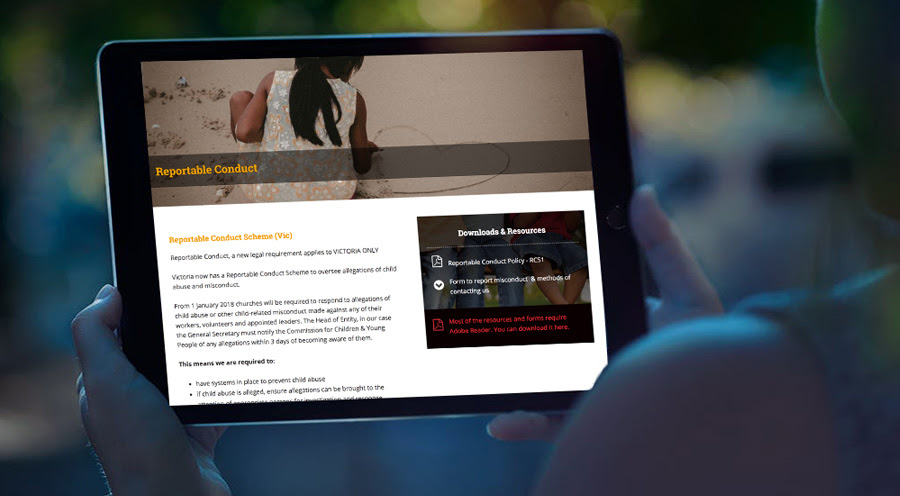
Child Safety in the Churches — “Reportable Conduct”

Keeping Children Safe website LIVE

Reportable Conduct Scheme – Keeping Children Safe

Victoria now has a Reportable Conduct Scheme to oversee allegations of child abuse and child-related misconduct.

From 1 January 2018 Reportable Conduct becomes a new legal requirement administered by the Commission for Children and Young People.

What does this mean for our Synod?

This means that the General Secretary is required to notify the Commission for Children and Young People within three business days after becoming aware of a reportable  allegation of child abuse and other child-related misconduct made against any of our ‘employees’ – this includes staff, contractors and volunteers.

What are our commitments to keeping children safe and protected?

Ensuring that we create a child safe organisation to keep children safe and protected is an individual and collective responsibility of the Uniting Church and all who engage with it.  Our commitment is documented in the Keeping Children Safe Policy and the Reportable Conduct Policy.

We are committed to ensure that:

  • we have systems in place to prevent child abuse
  • if child abuse is alleged,  allegations can be brought to the attention of appropriate persons for investigation and response
  • a proper investigation and response is made (if it involves criminal conduct, police will be contacted).

Synod of Victoria and Tasmania Moderator Rev Sharon Hollis said the new Reportable Conduct Scheme legislation reflects the concerns that many have voiced about the impact of abuse on children.

She noted it is just one of a number of ways institutions can do all within their power to make sure their spaces are safe for children.

“We applaud these initiatives which are in line with our Keeping Children Safe Policy commitments to zero tolerance of all forms of abuse and ensuring children are protected and safe,” Ms Hollis said.

What do we ask of you?

We request all ‘employees’ (defined as staff, contractors, volunteers) of Uniting Church in Australia commit and adhere to Synod’s Keeping Children Safe Policy at all times to ensure that we create a child safe organisation.

We also request that you report any allegations of child abuse and other child-related misconduct made against  employees even if;

  1. they do not have direct contact with children
  2. the conduct occurred outside of their role in the church.

What is Reportable Conduct?

The five types of Reportable Conduct are:

  • sexual offences committed against, with or in the presence of a child
  • sexual misconduct committed against, with or in the presence of a child
  • physical violence against, with or in the presence of a child
  • any behaviour that causes significant emotional or psychological harm to a child
  • significant neglect of a child.

How do I report?

If you have a reasonable belief that reportable conduct has occurred you should report using the form in this link.

Or phone: (03) 1300 789 374 

Or email: reportableconduct@victas.uca.org.au

You can also report directly to the Commission for Children and Young People:

Ph: (03) 8601 5281

Email: childsafestandards@ccyp.vic.gov.au

Additional Resources

The Reportable Conduct Policy has further information on how to report.

If you would like further information on the Scheme please refer to the Commission for Children and Young People website https://ccyp.vic.gov.au/.

To download an easily printable PDF version of this email click here.

Thank you for all you do in your ministry to keep children safe.

Please make sure this information is made known to your church council.

Grace and peace,

Isabel Thomas Dobson
Acting General Secretary

Keeping Children Safe

Lectionary Commentary – Epiphany 4B (January 28 – February 3)

The following links are to the Revised Common Lectionary commentary pages of Howard Wallace and Bill Loader, and are suggested as preparation for hearing the readings in worship for the Sunday indicated above.

Deuteronomy 18:15-20 see also By the Well podcast on this text

Psalm 111

1 Corinthians 8:1-13 see also By the Well podcast on this text

Mark 1:21-28 see also By the Well podcast on this text

MtE Update – January 19 2018

The first MtE News for 2018!

  1. Brother Peter Bray from Bethlehem University is returning to Melbourne, and will again be hosted by MtE in a public forum; more details here.
  2. A public lecture: Appraising the Royal Commission Report into Sexual Abuse and Religious Organizations.
  3. MtE has been talking for a while about encouraging other UCA congregations to consider a move to celebrating the Eucharist in their principal Sunday service. A web site on this project is now “live”, here.
  4. The latest Presbytery update (Jan 19) is here.
  5. For those interested in some background commentary to the readings for this Sunday January 21, see the links here.


« Older Entries Recent Entries »