

Author Archives: CraigT
MtE Update – April 6 2017
Friends,
the latest MtE Update!
- This coming Sunday’s service – Passion/Palm Sunday – will feature a full reading of St Matthew’s passion narrative.
- The latest Presbytery update (March 28) is here.
- The latest Pilgrim college update (March 30) is here.
- The latest Synod newsletter (April 6) is here.
- Information on the progress of the Implementation of the Major Strategic Review
- Palm Sunday walk info; UCA members are invited to gather in front of Wesley Church, Lonsdale Street, at 1pm where the Moderator will speak, before proceeding to the beginning of the walk from the State Library by 2pm.
- Nomination forms are now available for this years Synod meeting (Box Hill from 8th to 13th September); speak to Craig if you’re interested in attending.
- Our Mark the Evangelist luncheon is coming up — Sunday April 23; Wes Campbell will be our guest preacher on that day.
- Our Easter services are as follows:
Passion Sunday April 9, 10.00am with Eucharist
Maundy Thursday April 13, 7.30pm with Eucharist
Good Friday April 14 10.00am
Easter Vigil Service Saturday April 15 8.00pm
Easter Day Service 10.00am with Eucharist
- There is an ecumenical service at St Paul’s cathedral on ANZAC Day, 11am.
Other things of potential interest:
A Tenebrae service at Auburn Uniting Church
UNITING CHURCH IN AUSTRALIA MEDIA RELEASE, 1 April 2017
The President of the Uniting Church in Australia Stuart McMillan has asked Church members to lend their support to UCA appeals for communities suffering in the aftermath of Cyclone Debbie.
“Our Church will be there to support people in need and help Queensland and northern NSW recover,” said Mr McMillan. “Please continue to pray for the safety and the welfare of all affected communities, as they come to terms with their losses.”
“I ask all UCA members to please try to support our appeals, which go to support ministry in these communities.” Cyclone Debbie made landfall on the Whitsunday Coast as a Category 4 storm with winds of more than 260 kilometres an hour on Monday 28 March causing extensive damage. Five days later water, shelter and communications are still limited into towns of Ayr, Bowen and Proserpine. Torrential rains from the weakening cyclone have also seen rivers in south-east Queensland and northern New South Wales reach record peaks, causing major flooding in Beaudesert, Lismore and the Tweed Valley. Tens of thousands of residents had to be evacuated.
Counsellors from Lifeline UnitingCare Community in Queensland are working in the disaster-affected communities to supports locals to deal with the trauma of the last week. Disaster relief chaplains in NSW are working at evacuation centres in flood-affected areas in Lismore and the the Tweed Valley. National Disaster Recovery Officer Rev. Dr Stephen Robinson says all communities face a long road to recovery. “What’s most needed now are our prayers and support,” said Rev. Dr Robinson. “Your donations will support the recovery of those affected by providing personal and practical care to people, many of whom might otherwise fall through the gaps of formal support.”
“The Uniting Church is well-placed to provide this kind of support, because we’re part of the affected community, and we’ll be there alongside the community into the future.”
In the weeks ahead, the Synods of Queensland and NSW/ACT will be sending trained peer supporters to come alongside church leadership as the process of recovery begins. Rev. Dr Robinson will be following up with affected presbyteries and congregations and working with Synods to assist the recovery effort. Queensland Synod has launched a Disaster Relief Appeal. The NSW/ACT Synod is encouraging its members to donate to the Moderator’s Appeal. The Assembly’s National Disaster Relief Fund remains open to receive donations, with funds to be drawn on by Uniting Churches and agencies supporting recovery in affected areas. https://assembly.uca.org.au/national-disaster-relief-fund/. Donations of $2 and over are tax-deductible.
From Andy Calder, Disability Inclusion
Director, Uniting CPE – The John Paver Centre
“The most extraordinary, precise, deep and beautiful account of blindness I have ever read. It is to my mind a masterpiece.” – Neurologist and author Oliver Sacks
Jan Dale has written to let us know about a wonderful film which was made about Prof. John M. Hull. Their father was a Methodist minister, Rev. J.E. Hull, his last ministry being at Elsternwick Methodist around 1960. John went to live in the UK in the late 50s and was considered one of the most influential religious educators in the world. He held the first full professorship in Religious Education in England (at Birmingham University). John became blind in mid-life after a history of eye problems. John kept an audio diary recording his struggle with loss of sight and subsequently published it in a book “Touching The Rock: An Experience of Blindness.” The filmmakers discovered the book and decided to make a documentary and then discovered that the original diary tapes still existed. These, along with recent interviews with John and his wife, are used as the film’s dialogue with actors lip synching. Sadly John died as a result of an accident just after the filming began. The film has won many awards and received extraordinary reviews.
There is to be a special screening on April 26th at Cinema Nova at 6.30 but only if enough tickets are sold by 17th April. The screening is the first time it has been available in a cinema in Australia. https://tickets.demand.film/event/1522
There is an app available for visually impaired people through MovieReading which automatically synchs with the film and gives an audio description of scenes, writing on the screen etc. in between the film’s dialogue
I commend this film to you and your networks
With thanks, Andy.
Commission For Mission
130 Little Collins St Melbourne 3000
t (03) 9251 5489 | f (03) 9251 5491 | m 0417 562 556
e Andy.Calder@victas.uca.org.au
w victas.uca.org.au
April 4 – Martin Luther King, jnr
These weekly “People to Commemorate” posts are a kind of calendar for the commemoration of the saints, reproduced here from a Uniting Church Assembly document which can be found in full here. They are intended for copying and pasting into congregational pew sheets on the Sunday closest to the nominated date.
Images (where provided) are of icons by Peter Blackwood; click on the image to download a high resolution copy of the image.
Martin Luther King Jnr, martyr & social activist
Martin Luther King, Jr. was a product of southern black Baptist Protestantism in the United States. The son, grandson, and great-grandson of Baptist preachers, he was born in Atlanta, Georgia. Driven by an “inner urge to serve God and humanity,” he accepted the call to ministry and was ordained at age nineteen. From that point, King committed himself to an active and well-rounded ministry, a ministry that was spiritually satisfying, intellectually sound, and socially relevant.
King’s exposure to a social gospel began at Atlanta’s Ebenezer Baptist Church, a congregation pastored by both his maternal grandfather, Adam D. Williams, and his father, Martin Luther King, Sr. While at Ebenezer, and later at Atlanta’s Morehouse College, King studied the gospels and the entire biblical revelation, and concluded that biblically and theologically inspired Christians had a responsibility to pursue freedom, peace, and justice in the social, political, and economic realms of society.
The lessons King learned at Ebenezer and Morehouse were reinforced and provided more of an intellectual structure during his years at Crozer Theological Seminary and Boston University, where he immersed himself in the writings of the Social Gospel theologian Walter Rauschenbusch. Rauschenbusch advocated redeeming individual and corporate life by applying the biblical principles of love and justice to the church, the family, the state, and other institutions, and King found here “a theological basis” for the social concern he had already embraced during his upbringing at Ebenezer Baptist Church and studies at Morehouse College.
King’s application of Social Gospel principles began with the Montgomery bus boycott in Alabama in 1955-56, his very first attempt at organized social protest. In Montgomery, King combined the teachings of Jesus’s Sermon on the Mount with the nonviolent methods of Mohandas K. Gandhi, thus forging both a personal ethic and a social ethic that would guide him throughout the thirteen years of his leadership in the struggle for civil and human rights.
After the successful outcome of the Montgomery bus protest, King led civil rights demonstrations throughout the American South, achieving varying degrees of success. His efforts led to the elimination of structures and patterns of racial segregation, and also the achievement of basic civil and/or constitutional rights for black people.
From 1965 to 1968, the last three years of his life, King consciously shifted his focus beyond basic civil and/or constitutional rights for blacks to issues of economic justice and international peace. He called for a radical redistribution of economic resources for the benefit of the poor in America and abroad, and for a world without war and the stockpiling of weapons of mass destruction. At that point, King’s call for “a new South” and the fulfillment of “the American dream” had become thoroughly intertwined with his vision of “the great world house,” in which humans must learn to live together in peace and harmony despite differences in race, nationality, religion, and culture.
King was assassinated in Memphis, Tennessee on April 4, 1968, while involved in a strike with sanitation workers.
Lewis V. Baldwin
ANZAC Day Service 2017

ANZAC DAY 25 APRIL 2017
11.00 AM, ST PAUL’S CATHEDRAL MELBOURNE
Truly, we will remember them.
An Ecumenical Service of Lament, Repentance and Hope for the Centenary of the First World War, especially in 1917, the Battle of Passchendale, those who said no to war, the Aboriginal wars.
This service is sponsored by St Paul’s Cathedral and Pax Christi Australia, the Victorian Council of Churches, the Uniting Church in Australia, the Anglican Social Responsibilities Committee, Social Policy Connections, and the Anzac Centenary Peace Coalition.
March 31 – Maria Skobtsova
These weekly “People to Commemorate” posts are a kind of calendar for the commemoration of the saints, reproduced here from a Uniting Church Assembly document which can be found in full here. They are intended for copying and pasting into congregational pew sheets on the Sunday closest to the nominated date.
Images (where provided) are of icons by Peter Blackwood; click on the image to download a high resolution copy of the image.
Maria Skobtsova, martyr
Maria Skobtsova was an Orthodox Christian nun in Paris in the early twentieth century. She encouraged hospitality and love of one’s neighbour, often in the most uncompromising of terms. She considered this to be the foundation of the Christian gospel, and she embodied it in her life. She is often compared to Dorothy Day, an American Roman Catholic who founded the Catholic Worker movement. Maria Skobtova died in Ravensbrück prison. She was glorified as a saint by the Orthodox Church on January 16, 2004, along with her companions, the Orthodox Priest Dmitri Klepinin, her son George (Yuri) Skobtsov, and Elie Fondaminsky. They are commemorated on July 20 in the Orthodox Church.
Born to a well to do, upper-class family in 1891 in Latvia, she was given the name Elizaveta Pilenko. Her father died when she was a teenager, and she embraced atheism. In 1906 her mother took the family to St Petersburg, where she became involved in radical intellectual circles. In 1910 she married a Bolshevik by the name of Dimitri Kuzmin-Karaviev. During this period of her life she was actively involved in literary circles and wrote much poetry. Her first book, Scythian Shards, was a collection of poetry from this period. By 1913 her marriage to Dimitri had ended.
Through a look at the humanity of Jesus, “He also died. He sweated blood. They struck his face,” she began to be drawn back into Christianity. She moved, now with her daughter, Gaiana, to the south of Russia where her religious devotion increased.
In 1918, after the Bolshevik Revolution, she was elected deputy mayor of the town of Anapa in Southern Russia. When the White Army took control of Anapa, the mayor fled and she became mayor of the town. The White Army put her on trial for being a Bolshevik. However, the judge was a former teacher of hers, Daniel Skobtsov, and she was acquitted. Soon the two fell in love and were married.
Soon, the political tide was turning again. In order to avoid danger, Elizaveta, Daniel, Gaiana, and Elizaveta’s mother Sophia fled the country. Elizaveta was pregnant with her second child. They travelled first to Georgia (where her son Yuri was born) and then to Yugoslavia (where her daughter Anastasia was born). Finally they arrived in Paris in 1923. Soon Elizaveta was dedicating herself to theological studies and social work.
In 1926, Anastasia died of influenza, a heartbreaking event for the family. Gaiana was sent away to Belgium to boarding school. Soon, Daniel and Elizaveta’s marriage was falling apart. Yuri ended up living with Daniel, and Elizaveta moved into central Paris to work more directly with those who were most in need.
Her bishop encouraged her to take vows as a nun, something she did only with the assurance that she would not have to live in a monastery, secluded from the world. In 1932, with Daniel Skobtov’s permission, an ecclesiastical divorce was granted and she took monastic vows. In monasticism she took the name Maria. Later, Fr Dmitri Klepinin would be sent to be the chaplain of the house.
Mother Maria made a rented house in Paris her “convent.” It was a place with an open door for refugees, the needy and the lonely. It also soon became a centre for intellectual and theological discussion. In Mother Maria these two elements, service to the poor and theology, went hand-in-hand.
When the Nazis took Paris in World War II, Jews soon approached the house asking for baptismal certificates, which Father Dimitri would provide them. Many Jews came to stay with them. They provided shelter and helped many escape. Eventually the house was closed down. Mother Maria, Fr Dimitri, Yuri, and Sophia were all taken by the Gestapo. Fr Dimitri and Yuri both died at the prison camp in Dora.
Mother Maria was sent to the camp in Ravensbrück, Germany. On Holy Saturday, the day before Easter in 1945, Mother Maria was taken to the gas chamber and entered eternal life. It is suggested that she took the place of another who had been selected for that death.
By Father Kyril
MtE Update – March 24 2017
Friends,
the latest MtE Update!
- Our congregational picnic is this Sunday, March 26, following worship on that day (Royal Park) — BYO everything to gather at the Australian Native Gardens section of Royal Park, near the corner of Gatehouse Street and The Avenue, Parkville (map) – about 5 minutes from the church.
- If you’re wondering what is going on with the children’s talks in church recently, there’s a description of the logic on this new page on our web site. From the bottom of that page you can jump to another page which includes a demonstration of the memory palace concept with a 360° panoramic picture of the church as an aid to developing the memory of the unfolding story.
- If you’d like to do some background work on this coming Sunday’s readings (March 26, Lent 4A), these links will be of assistance:
Other things of potential interest:
A local fundraiser for a Philippines charity
LitBit Commentary – William Cavanaugh on Christian Community

LitBit: … gathering in solidarity and love was not a Christian innovation. Members of Roman collegia addressed each other as brethren and often held goods in common. What distinguished the Christian Eucharistic community was the way that it transcended natural and social divisions. In Christ there is no Jew or Greek, slave or free, male or female (Galatians 3.28).
William Cavanaugh, Theopolitical Imagination, p.115f
March 7 – Perpetua & Felicitas
These weekly “People to Commemorate” posts are a kind of calendar for the commemoration of the saints, reproduced here from a Uniting Church Assembly document which can be found in full here. They are intended for copying and pasting into congregational pew sheets on the Sunday closest to the nominated date.
Images (where provided) are of icons by Peter Blackwood; click on the image to download a high resolution copy of the image.
Perpetua & Felicitas, martyrs
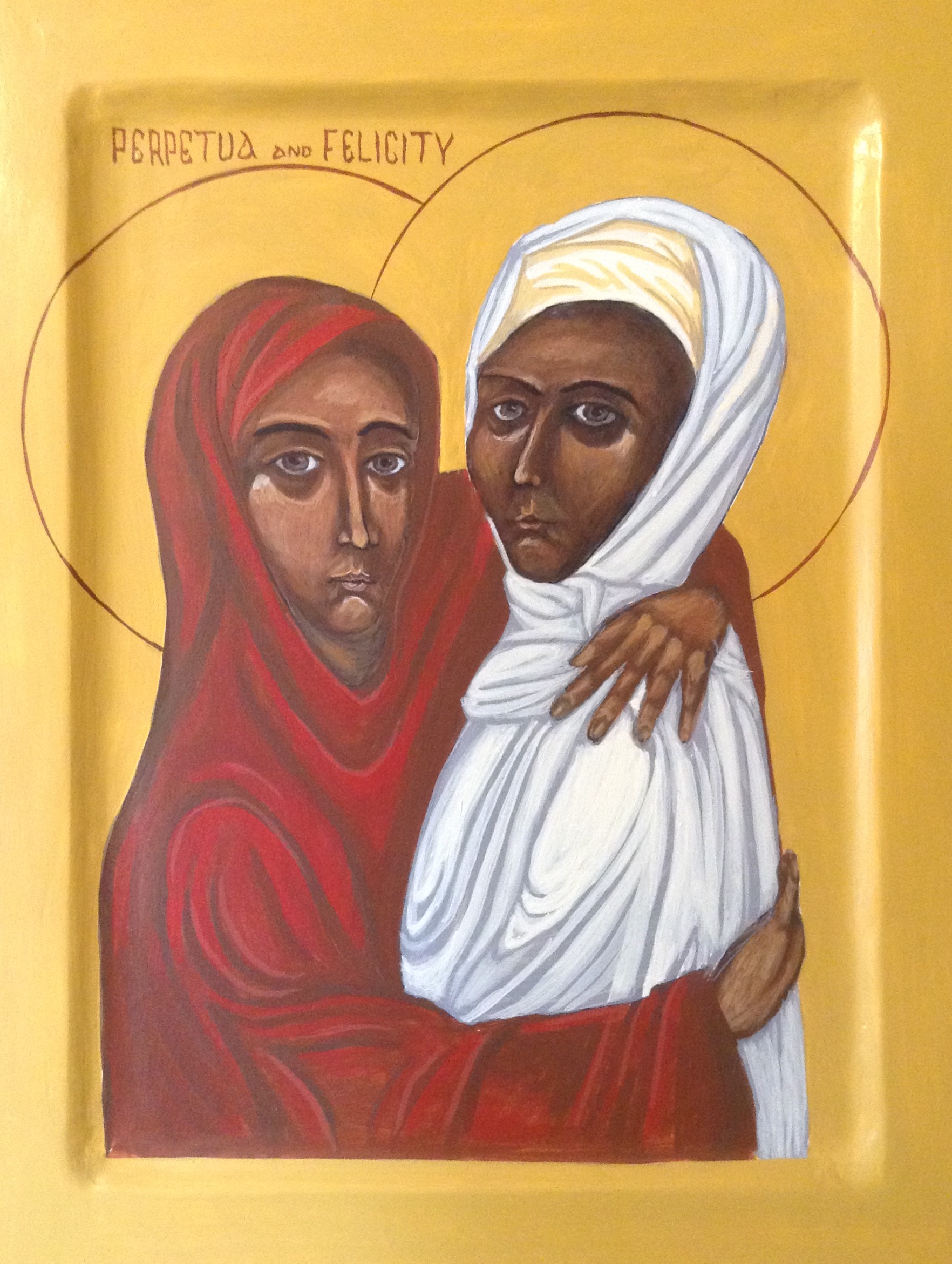
Perpetua and Felicitas
Few women have shaped the Christian spiritual tradition like the young North African martyr and visionary, Vibia Perpetua. She has inspired people of different centuries, countries, and cultures. Her story, told in The Passion of Saints Perpetua and Felicitas, is a “dazzling text”, one of the most gripping accounts of martyrdom from the ancient church.Virtually from the moment of its writing in an early third-century Carthaginian prison, Perpetua’s story has played an important part in Christian spirituality. It is “timeless”, according to the medieval historian, Joyce Salisbury, meaning that it speaks to the human heart across the centuries, societies, and cultures.
An unknown figure first saw the potential of Perpetua’s story. He framed her story in such a way that succeeding generations of readers (or listeners) would treat it almost like Scripture. He saw in her visions a demonstration of the unceasing operation of the Holy Spirit and a witness for the glory of God and the good of the Church. The popularity of Perpetua and her companion Felicitas soon spread beyond the North African church. By the late fourth century their feast day was honoured in all the early calendars and martyrologies and their names were regularly remembered in Sunday worship.
By the early fifth century, Perpetua and Felicitas, were among the most venerated of African martyrs. Augustine loved these saints and drew inspiration from their life and witness. We know, for example, that Augustine preached at least three sermons in honour of Perpetua (after whom his sister was named). In Augustine’s first sermon he describes how upon hearing the story of the martyrdom of Perpetua and Felicitas read in church, the congregation joined in a “celebration of universal devotion”. In his second sermon, Augustine elevates the merits of Perpetua and Felicitas above all other martyrs. And in the third sermon, he names Perpetua and Felicitas as a model for all those who suffer for the faith.
The overwhelming reason for the popularity of Perpetua in recent times is her importance for women’s religion. She gives an intimate view into the mind of a third-century woman, which, for centuries, has been a great source of inspiration for women struggling with questions of identity and meaning. Given the degree of silence that has surrounded women throughout history, Perpetua’s story is astonishingly rare and precious. She may well not be the first woman to have put her thoughts on paper; she is, however, one of the first of whom we have any real knowledge. In her writing we can hear a voice too little heard. It is an extraordinary voice. She has given the Church – especially women – a role model and a positive example of empowerment.
Contributed by William Emilsen
March 26 – Caroline Chisholm
These weekly “People to Commemorate” posts are a kind of calendar for the commemoration of the saints, reproduced here from a Uniting Church Assembly document which can be found in full here. They are intended for copying and pasting into congregational pew sheets on the Sunday closest to the nominated date.
Images (where provided) are of icons by Peter Blackwood; click on the image to download a high resolution copy of the image.
Caroline Chisholm, renewer of society
Caroline Chisholm arrived in New South Wales in 1838 with her husband Archibald, an Army officer on leave from service in India. She quickly became aware of the plight of many of the settlers, and especially of young girls who arrived from Britain after a long sea journey, sometimes seeking a husband or boyfriend who had been sent out as a convict or who had arrived earlier to find work. Often illiterate and impoverished, and without friends or contacts, many girls turned to prostitution in order to survive. Caroline established a home for them in an old barracks, launching an employment agency offering work with local families who, as part of the contract, gave them protection and care. Her work broke down prejudices against “convict girls” and helped to establish a sense of solidarity in the emerging colony.
Recognising that good work could be found in the emerging farms and homesteads; Caroline led wagon trains out into the bush, settling young people with jobs. She became famous as a matchmaker, as girls met and married farmers and founded homes of their own. A devout Christian, Caroline believed in the sanctity of marriage and family life, and saw the injustice of official government policy, which encouraged young men to settle in Australia but tried to block the arrival of women who were officially described as “encumbrances”.
Men who had been sent out as convicts begged her to find their wives or fiancées back in Britain, and she travelled to London to do this, eventually reuniting many families. Renting a modest home near the London docks, she started a Family Colonisation Society helping poor families to settle in Australia, commissioning ships with clean and adequate accommodation, and establishing a London hostel next to her own home where families could stay while waiting to sail. Former shipping arrangements had meant men and women sharing accommodation, and a complete lack of privacy: she established a scheme in which all young unmarried people were adopted into families for the voyage, which also ensured networks of friendship and practical assistance on arrival in Australia.
Sometimes subjected to insults because of her Roman Catholic faith, Caroline remained a good-humoured woman whose tact and discretion, especially when dealing with the poorest families, made her much loved. She became the first woman ever to give evidence to a British Parliamentary committee, addressing MPs examining the ending of transportation and the possibilities of family migration. Herself a farmer’s daughter, she energetically promoted Australian farming, taking a sheaf of wheat from a New South Wales farm into Parliament to make her point.
Returning to Australia, Caroline worked to establish “Chisholm shelters” along the rough tracks leading out into the bush, opened a small school, and continued to lobby for the needs of settlers. Eventually settling back in London, she died in 1877 and is buried in her native Northampton where her grave names her as “The Emigrant’s Friend”.
Joanna Bogle
MtE Update – March 9 2017
Friends,
the latest MtE Update!
- The Wednesday night Lenten study group has commenced; next week’s (second, March 15) study will meet 30 minutes earlier than advertised (600pm tea, 630pm study); the study is available here.
- The most recent Presbytery Newsletter (March 9) is here.
- The most recent Synod Newsletter (March 8) is here.
- The March Pilgrim College News is here.
- Pastoral Statement from President Stuart McMillan about the Uniting Church in Australia’s appearance at a public hearing for Case Study 56 of the Royal Commission into Institutional Responses to Child Sexual Abuse.
- For the diary: our congregational picnic is coming up on March 26, following worship on that day (Royal Park).
- If you’d like to do some background work on this coming Sunday’s readings (March 12, Lent 2A), these
Other things of potential interest:
From the UCA’s Refugees Network (March Update):
Dear Vic/Tas Uniting for Refugees Network Members,
There are quite a few events coming up in the next month or so, and we’d love your help in promoting these within your Congregations / Schools / local communities and online!
These are important events for us to support as we gather together with others from others right across the refugee sector to keep calling for #Justice4Refugees and for the Government to #BringThemHere !
Palm Sunday Walk for Justice for Refugees:
It’s just over a month until Palm Sunday and we’d LOVE your help in promoting the Palm Sunday Walk for Justice for Refugees!
The flyers for both the Melbourne and Launceston events are attached, and the Facebook event pages for the corresponding events are:
Melbourne: http://bit.ly/PalmSunday2017
Launceston: Coming soon! In the meantime contact jeff@citybaptistchurch.net for further information
Please can you make sure that the relevant events are promoted on any noticeboards or newsletters in your local Congregations / Schools / local communities? If you’d like bulk copies of the Melbourne or Launceston posters (A3 or A4 size) and the Melbourne double-sided leaflet (electronic copies are attached) please let me know, as I’m happy to send out to you – we have plenty to distribute!
Palm Sunday Walk pre-event in Melbourne:
As in previous years, we are inviting UCA people (and anyone else who’s interested in joining us!) to gather together at Wesley Uniting Church in Lonsdale Street at 1.00pm on Palm Sunday before walking down to the State Library together. Rev. Sharon Hollis the Synod’s Moderator will be speaking to those gathered before we head off behind the UCA banners!
Please help invite others to attend that event too – for those on Facebook you’ll find details of the event here: http://bit.ly/PSPreEvent For others, simply just turn up ahead of the 1pm start at Wesley!
If you can’t join us at Wesley, you’ll be sure to find us gathered behind the Synod and the “Uniting for the Common Good” banners at the State Library!
Lentara Asylum Seeker Program Update:
Could you spare a cup of coffee to support someone seeking asylum?
Lentara’s Asylum Seeker Program supports vulnerable asylum seekers with safe housing, a basic living allowance and material aid. The people we support have no work or study rights, no income support and no Medicare and therefore no way to live with dignity. We are not government funded and are wholly reliant on individual donations, grants and philanthropic funding.
This year we need to raise $40,000 dollars to meet our fundraising deficit.
What does $40,000 mean to people like you and me? A cup of coffee? A piece of cake?
$5 can provide one child a healthy meal
$10 can give one family access to public transport
$50 can give one child access to a GP
$137.60 can provide the basic living allowance to one family
$200 can provide cost of housing utilities
$500 can pay the rent and utilities for one family for one month
Fundraiser for Palm Sunday and Refugee Legal
The Refugee Advocacy Network are holding a fundraising event to help raise funds for the Palm Sunday Walk for Justice for Refugees event (as it’s a costly event to pull together), and also for Refugee Legal who provide much-needed legal services to people seeking asylum and refugees who live in our local community.
The evening will be an opportunity to have fun; deepen your understanding of the issues affecting refugees; support the Palm Sunday Walk for Justice, and the important work of Refugee Legal.
There will be a lot of things happening on the night and we’re keen to give this our support. They are hoping to sell 200 tickets for the event, as we’d love to see some of you there for what will be a fantastic night!
More details are on the attached flyer, and to book your ticket please visit: https://www.trybooking.com/OWFS There’s a few of us from the Network going and have booked our tickets already, so we’d love you to join us on the night!
International Women’s Day – 8th March
Another International Women’s Day has rolled around!
There will be breakfasts and gatherings as women celebrate the gains in rights and opportunities. And rightly so, says refugee rights activist Pamela Curr.
But what if you’re a woman who doesn’t enjoy those freedoms – a woman in detention?
This is a timely reflection on International Women’s Day today – http://bit.ly/INewMatildaIWD
Thank you ALL for your ongoing support and commitment to working together to support refugees and people seeking asylum!
Kind regards – Jill
|
Jill Ruzbacky Social Justice Officer, Justice & International Mission |