Category Archives: Illuminating Liturgy

LitBit Commentary – James K A Smith on the Call to Worship

LitBits Logo - 2

Litbit: The congregation gathers in response to a call to worship, which is the fundamental vocation of being human. God is calling out and constituting a people who will look “peculiar” in this broken world because they have been called to be renewed image bearers of God – to take and reembrace our creational vocation, now empowered by the Spirit to do so.

James K. A Smith, Desiring the Kingdom.


How to use LitBit Features and Commentaries.

February 18 – Martin Luther

These weekly “People to Commemorate” posts are a kind of calendar for the commemoration of the saints, reproduced here from a Uniting Church Assembly document which can be found in full here. They are intended for copying and pasting into congregational pew sheets on the Sunday closest to the nominated date.

Images (where provided) are of icons by Peter Blackwood; click on the image to download a high resolution copy of the image.

Martin Luther, reformer of the Church

Martin Luther, (10 November 1483 – 18 February 1543) who is regarded as the founder of the German Reformation, began life as the son of a miner in Saxony. His path to becoming a Reformer began in 1505. As a student he feared being stuck by lightning during a storm, prayed to St Anne for help, promising to become a monk. He entered an Augustinian monastery, but the terror of the experience that brought him into religious life remained significant. The church of the day traded on the fear of hell and judgement, and for Luther himself the terror aroused by the storm was transferred to holy fear in the presence of Christ the judge, a figure graphically depicted in the art of the time. As a monk and priest he trembled at the thought of the Bread and Wine being changed into the body and blood of Christ in his hands.

Luther came to believe the only way a priest could be at ease in the presence of Christ was to have confessed all his sins. So troubled was he in conscience he sometime confessed for 6 hours per day. He ransacked his soul for every fault, and then, on returning to his room, would remember something he had not mentioned. This defeated him and wore out his superiors who, hoping he might work out his own salvation, made him a teacher of biblical studies. Luther began to wrestle with scripture. As a result of pondering the concept of justification in Paul’s letter to the Romans he underwent a complete liberation from his condition. The key passage for him was Romans 1:16-17.

From this Luther came to understand that the Justice of God stands for what God does to bring us back into right relationship with himself through faith, despite the fact that we are sinners and fall short of God’s gifts. This insight revolutionised his life. He no longer feared an avenging God, and became a much more cheerful soul. The emphasis on “the works of the law” or merit – that is our virtuous living and our efforts to secure a place with God– was replaced by life lived as a glad response to God’s acceptance of us before we ask.

On this basis his discipleship no longer served as a means of self-justification but took the form of glad and willing service of a merciful and gracious God. This was Martin Luther’s gift to the Church.

Martin Luther’s reform brought about a renewed understanding of the Gospel of Jesus Christ that brought life and refreshment to many in his day, and has continued until now. In a world where it becomes harder and harder to recognize and name true sanctity, in Martin Luther’s life fear surrendered to peace with God; merriment replaced guilt and a sour spirit, and distrust of our human nature was replaced with acceptance and respect.

From Luther onwards the witness to Christ in Scripture was privileged as the guiding source of the Church’s life. But so long as the central ideas about faith were right, Luther did not argue about secondary issues such as vestments and gestures. Some even accused him of retaining too much “popery”. He also re-introduced the reception of communion in both kinds, expanded congregational singing and translated the Bible and the Liturgy into the language of the people. Luther did not remain a monk, but married Katharina von Bora and had a family. The Uniting Church was formed on the basis of going “forward together in sole loyalty to Jesus Christ, and it privileges the place of Scripture in the church. Luther would have approved of both.

Refs: Roland Bainton Here I Stand I Can Do no Other, F.L. Cross (ed) The Oxford Dictionary of the Christian Church

Rev John Smith

Lent 1 February 18: The baptism of Jesus

It is only two weeks since the Baptism of Jesus was the Gospel reading. Then it was seen as an epiphany, leading to the climax for the season of Epiphany, the Transfiguration.

Today, the Baptism is linked to the Temptations of Jesus, and marks the beginning of the ministry of Jesus. The emphasis is on the opening of the heavens, the descent of the Spirit (dove) and the words of the Father “You are my Son”. (This is an important text for the doctrine of the Trinity.) The Spirit drives Jesus into the wilderness, the abode of Satan, for a confrontation with evil. Mark makes no mention of particular temptations. Instead Mark announces that the victory over temptation leads to Jesus proclaiming the good news that the Kingdom of God has come near, as promised in the opening words of the Gospel (Mark 1:1).

At the Baptism, the heavens were “torn apart”. Mark uses the same word at 15:38 to describe the curtain of the temple being torn apart as Jesus dies. The dove evokes Genesis 1:2 where, in the old translation, “the Spirit moved upon the face of the waters”, and also Genesis 8:11 where the dove brings evidence to Noah that order and peace are restored after the flood.

In this icon (an original composition) Jesus is naked because he is stripped of his heavenly glory. He has “emptied himself” (Philippians 2:7). By becoming fully human, he clothes humanity in a garment that is incorruptible. The angels who minister to Jesus in the wilderness are seen here bringing new clothes after his baptism. Total immersion indicates Christ’s dying (drowning) and rising again. With his right hand Jesus blesses the water, and water takes on sacramental significance. Traditional icons show evil powers lurking in the depths, such as river gods riding dolphins, but here the powers to be overcome are war and violence, represented by a tank, and pop culture, represented by a TV set. Note that on one side there is the wilderness, the scene of the temptations, and on the other a fertile paradise, with a gum tree. The mountains are taken from a photo of the Olgas. There are several aboriginal motifs, so that the whole of our Australian culture is included. The part circle at the top indicates the Father, who is eternal, but the whole circle is hidden because we do not fully comprehend the mystery which is God.

CONTEMPLATIVE PRAYER.

Lord Jesus,

By the stripping of your garments you show humility, and we too are humbled, stripped of all posturing, and concern for our own self-importance.

By your descent into the water, you faced chaos and turbulence in order to bring us peace, assurance and stillness.

By your blessing of the water, water becomes a sacrament, offering new birth, new creation, and life from death.

By your rising from the water, and your triumph over temptation, you overcome the evil one and give hope for peace in the world.

By the descent of the dove you are blessed, and yet driven into the wilderness, where your struggle with Satan intensifies, as does ours in your service.

By the word of the Father we know you as the beloved of the living God, and we too affirm pleasure in your presence.

May your Spirit live in us, bring power to our prayers, build up your people in this place, and give us all a sense of belonging in the community of the baptised that circles the globe.

Lamb of God, have mercy on us.


Lent to Easter at MtE

Worship at Mark the Evangelist during the 2018 Lenten season will feature a growing “display” of icons relating to readings and themes of the period. These icons are classical images from the church’s tradition, painted (or “written”) by members of the MtE congregation.

Rob Gallacher has written an introduction to how the icons might be prayerfully incorporated into our personal and corporate worship.

Each week a new icon will be introduced into worship, with an accompanying account of its significance in the pew sheet and email updates. Icons of the specified saints for the Sundays of this Lent will also be introduced.


An introduction to the icons over Lent-Easter

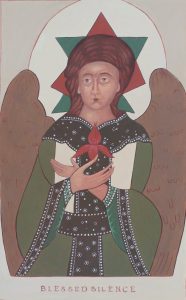
Ash Wednesday: the icon of Blessed Silence

Lent 1 February 18

Lent 2 February 25

Lent 3 March 4

Lent 4 March 11

Lent 5 March 18

Palm/Passion March 25

Maundy Thursday

Holy Saturday

Good Friday

Easter

Some aspects of contemplative prayer

Rob Gallacher

Some aspects of contemplative prayer

Start with “sacrament”. In Confirmation Class I was taught that “sacramentum” was the oath of obedience that Roman soldiers took, pledging allegiance to their commander, however dangerous that might be. So to take the sacrament was to renew your promise to serve Christ in the same way. Something that was between you and God, i.e. individualistic.

Now I learn that “sacrament” is the Latin translation of the Greek “mystikos”, and that gives it an entirely different perspective.

The root of “mystikos” is “my” or “mu”, and it means silence or a secret. If I were to tell you something very special, and then say “Keep Mum about it!”, what do you think I meant? “Not don’t tell your mother.” Rather, reflect in silence about my message. It’s meaning is profound and you need to take time to quietly contemplate it in order to understand, or, better, explore some of its hidden depths. The transaction here is between you and something bigger than you, bigger than your capacity to comprehend, certainly beyond your capacity to find words that will say it all. But as you contemplate the enormity of it, some bite become clear, and when you perceive a little, it leads you on to a little more.

Have you ever gone home after a conversation and suddenly you say to yourself, ‘Oh, is that what she meant?” And the next time you see her, you check it out, and out comes a whole lot more.

Mystery – not a puzzle to be solved, it is like climbing a mountain, and when you get to the top, you pause to enjoy the view, which is hard to describe. Then you see that there is another mountain beyond, and then another, for you to explore and contemplate.

I read somewhere, I think it is James Joyce who does this in great detail, that “mmmm” is one of the basic sounds out of which language developed.

Imagine the first caveman wondering how to catch an elephant. He has an idea, and he goes “mmmm” or possibly “nnnnn”. His mind is whirring. He sees another person pondering, and he thinks, that’s an “mmmm-er” too. But the elephant, it’s not an “mmmm-er”. So the word “mmmannn”, or “human” develops to express this particular characteristic of our species. We can contemplate something that is obscure, or very big, and gradually it will reveal its secrets to us.

We apply our mind. Latin for mind = mens, mentis. That gives us mental, mentality, mentor, mention.

Related words are remind and reminisce.

Latin again: “memor” is mindful, and that gives us memory, memorable, memorial, memorandum, memoir, memento, memo, and particularly for today’s study, remember and remembrance – the word Jesu used at the Last Supper, “Do this in remembrance of me”. The Greek word is “anamnesis”. So what Jesus is saying is, when you drink the wine which is my blood, do a bit of whirring, or “mmmm-ing”. There is a mystery here which is bigger than you will fully comprehend, but apply your mind and the secrets will gradually be revealed to you.

When “mystikos” is used for the mystery of the Eucharist, or for Baptism, it means (mmmeannns!) enter into this astounding action of God. And try to work out how you can catch it and apply it.

This brings us to Paul, e.g. Colossians 1:26 – the mystery that has been hidden throughout the ages but now is revealed to his saints. God’s purpose which is implied or hidden in the Old Testament, is made known to us in the incarnation of Christ.

Christians share in the life of Christ through the sacraments, the “mysteria”. It is a sharing with other Christians in the mystery which is always revealing more and more of God’s truth. Not an individual direct line to God – Medieval mysticism took it this way. A mystic is a person who has a direct way of knowing God, through visions, dreams, voices, that others don’t perceive. This is the point Louth is making forcibly. In the early Christian writings, a mystic is one who perceives the secrets revealed in Word and Sacrament – Truth so big, hidden in the OT, clarified in Christ, but still so enormous that we need to contemplate as we participate, and this is communal.

An icon is a sacramental object, sometimes called, the Bible in pictures, the visible word – so it is appropriate to contemplate, to pray and “mmmm” prayer, letting it talk to you, to reveal its hidden mysteries. Letting it draw you into the great company of “mmmmm” people who share this mystery.

It has a dimension of personal commitment (sacramentum) but it is more significantly the entry into another world, through contemplation of the mystery which God has revealed in Christ.

“We all partake the joy of one, the common peace we feel, a peace to sensual minds unknown a joy unspeakable. “ Ammmmennnn.


Most of the above is drawn from The Origins of the Christian Mystical Tradition, by Andrew Louth, Professor of Patristic and Byzantine Studies at Durham University; this edition is a reprint to which he has added a final chapter in which he says that if he were writing the book today.


Ash Wednesday: the icon of Blessed Silence

The muted tones of this icon suggest humility and peace, themes appropriate for Lent.

The eight pointed star in the halo first catches the eye. According to the imagery of Genesis, God created the world in six days, and rested on the seventh, so the eighth day is the first day of a new phase. Christ dies on the sixth day, rested in the tomb on the seventh day, and rose on the eighth day, the first day of the new creation. The resurrection on the eighth day indicates the beginning of a new dispensation. The created world can now participate in the reign of Christ. It is a foretaste of the kingdom to come, hence Paul’s phrase, “a new creation”. Not only is Christ raised, but we are raised with Christ, incorporated into Christ, in union with the Triune God. (Hence Sunday worship.) Note that Abraham circumcised Issac on the eighth day, starting a Jewish tradition that transformed into Christian Baptism. Baptismal fonts are octagonal because the baptised are entering into new life in Christ.

The complementary colours in the star, red and green, reinforce the feeling of harmony and heavenly peace. When I began painting this icon, I assumed the figure was the face of Christ. But, not only is the face beardless, there is no cruciform halo. In fact it is not clear if there is a halo at all. the more I contemplated the icon, the more the figure become a representation of redeemed humanity. Here is a person like me!

The wings are a puzzle. Sometimes John the Baptist appears with wings, because he is the messenger (“angelos” in Greek) pointing to Christ. Perhaps these wings suggest that I, in company with all the redeemed, am to be a messenger, pointing the world to Christ. He is “the lamb of God who takes away the sin of the world. (John 1:29)

The seraph reminds me of the call of Isaiah. One of the seraphs came and touched Isaiah, and cleansed him. Penitence is encouraged on Ash Wednesday. Here, the hands appear to be receiving the personal, healing approach of the seraph. “Your guilt has departed and your sin is blotted out”. (Isaiah 6:8)

The original Icon, on which this one is modelled, was created by the Russian Old Believers in the eighteenth century. When a new patriarch in Moscow set about reforming and modernising the liturgy, many objected and broke away. Their numbers swelled greatly when Peter the Great set about westernising everything, including the church, especially its art and its order.


Prayer before the icon of Blessed Silence

Be still my soul, you are safe in the presence of God.

Raised up with Christ,

A child of the new creation,

Baptised into Christ,

Cleansed by the angelic touch,

Forgiven and renewed.

Let strivings cease,

Let the inner voices be quelled,

Silence is blessed.

Be still my soul.

You are in harmony with the eternal purpose of God,

In union with Christ

Safe in the Spirit

Let it be.


February 14 – Cyril and Methodius

These weekly “People to Commemorate” posts are a kind of calendar for the commemoration of the saints, reproduced here from a Uniting Church Assembly document which can be found in full here. They are intended for copying and pasting into congregational pew sheets on the Sunday closest to the nominated date.

Images (where provided) are of icons by Peter Blackwood; click on the image to download a high resolution copy of the image.

Cyril and Methodius, Christian pioneers

The ninth century was perhaps the most active period of missionary activity in the Eastern (Orthodox) churches since apostolic times. Patriarch Photius chose two Greek brothers from Thessalonica, Constantine whose monastic name was Cyril, (826-869), and Methodius (?815-885) to initiate the conversion of the pagan Slavs – Moravians, Bulgarians, Serbs and Russians. They had grown up on the borders of these lands, and they knew the Slavonic language, amongst others. Cyril was a librarian and known as a philosopher; both were ordained priests. In 863 they set off for what is now the Czech lands with an invitation from the local prince and the blessing of the Byzantine emperor. In preparation for this venture, the brothers had translated the Gospels, the larger part of the New Testament and some of the Old, and the liturgical books into Slavonic, an enormous task, especially since they had to begin by inventing an alphabet, now known, in a developed form, as Glagolithic or Cyrillic. That is, they set out with the basic tools to build a church of peoples who did not know Christ. What is known as Church Slavonic is still the basic liturgical language of the Russian and related churches, and a great literature grew from it in the related languages.
Their methodology however was in contrast to that of Rome, whose missionaries had to teach their converts Latin before they could teach them anything else – and indeed there were clashes between missionaries of the two Christian centres. At this stage, however, the eastern and western wings believed themselves to belong to the one universal church, and the brothers travelled to Rome to place their mission under the Pope. Their exceptional approach and their church books received his blessing, but sadly, under that pope’s successor, and under German Catholic influence back in Moravia, the old Latin approach was enforced, and the saints’ work eradicated soon after Methodius died. However, the seeds had been sown, and bore fruit especially in Russia, Bulgaria and Serbia, whose rulers consciously chose Cyril and Methodius’s way. Rightly are they know as the ‘apostles of the Slavs’. Success took a long time, and was largely achieved by decision of tsars and princes. Some half-convinced Greek missionaries used Greek, which was no more understandable to the Bulgars than Latin; in Romania, a Latin-based culture, the Slavonic influence is still mixed with the Latin in the Orthodox Church.

The younger brother Cyril died in Rome (he became a monk in 868 just before his death on February 14th, 869) and is buried there. Methodius had been made a bishop by the pope (ca 870) for his return to Moravian lands after their embassy to Rome. He was imprisoned for two years by rival church authorities, and endured many years of theological and ecclesiastical disputes. He died in Moravia. Their pupils, however, carried on the work into further lands, paving the way for their declaration as co-Patrons of Europe, with St Benedict, by Pope John Paul II in 1980.

By Rev Prof Robert Gribben

« Older Entries Recent Entries »